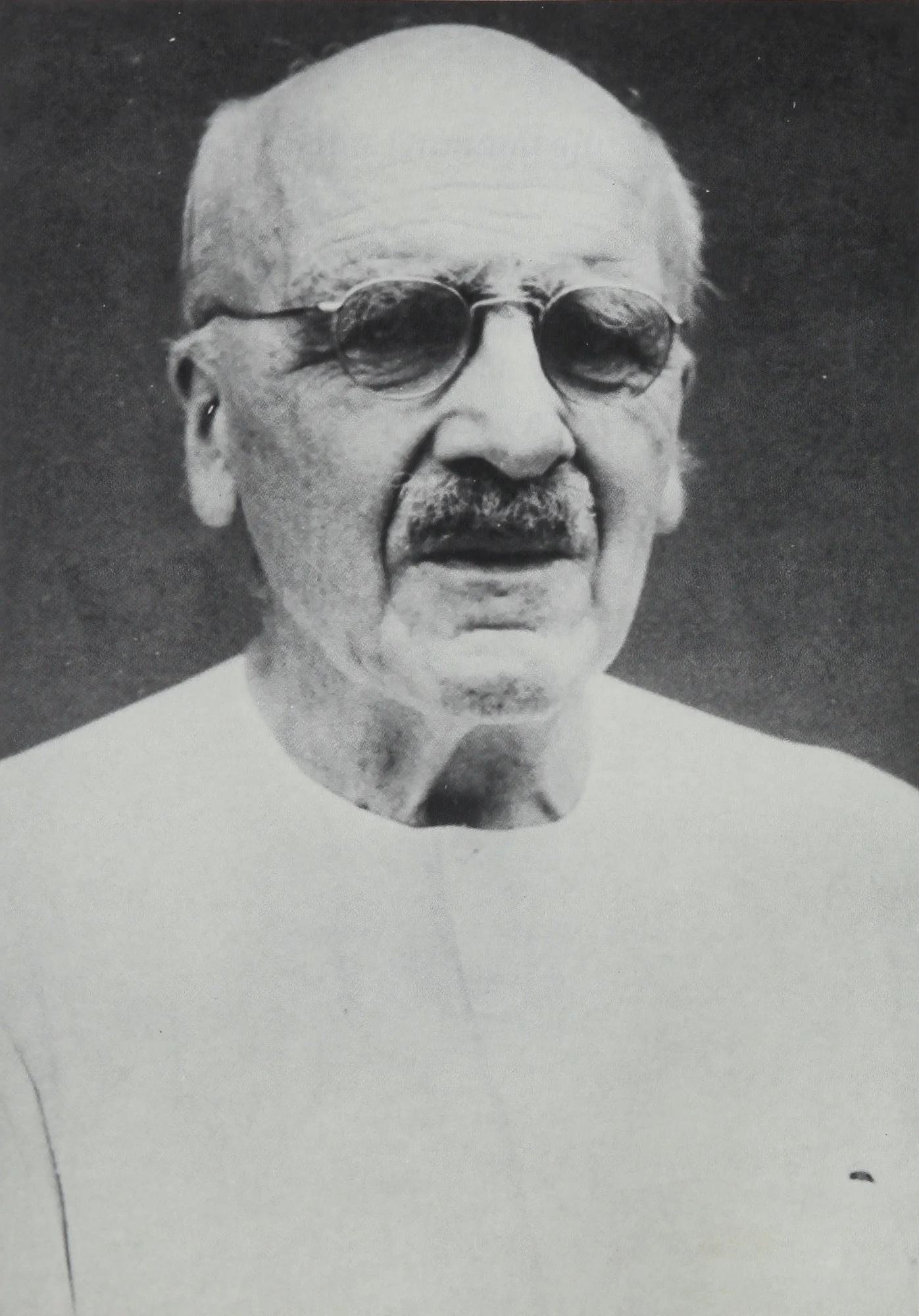
J.B.S. Haldane
 United Kingdom
biologist•geneticist•physiologist
Also known as: Jack Haldane, JBS
Date de naissance
November 5, 1892
Signe astrologique
Scorpio
Lieu de naissance
Oxford, England
Âge
Décédé(e) à 72 ans
Taille
5 ft 9 in (175 cm)
À propos
J.B.S. Haldane était un biologiste, généticien et physiologiste né britannique qui a acquis la citoyenneté indienne. Il est l'un des fondateurs de la génétique des populations et du néo-darwinisme, utilisant les mathématiques pour unir la génétique mendélienne à la sélection naturelle. Il a proposé la théorie de la soupe primordiale pour l'origine de la vie, formulé la règle de Haldane sur la stérilité hybride et correctement lié la drépanocytose à la résistance au paludisme. Il a également inventé le terme « clone » et prédit la fécondation in vitro des décennies avant qu'elle ne se produise.
Haldane n'a jamais obtenu de diplôme formel en biologie, mais il a enseigné à Cambridge, à l'University College de Londres et à l'Indian Statistical Institute. Marxiste et athée convaincu, il a renoncé à la citoyenneté britannique en 1961 et a passé ses dernières années en Inde. Son travail continue d'influencer la génétique, la biologie évolutive et la physiologie. Peter Medawar l'a qualifié d'homme le plus intelligent qu'il ait jamais connu.
Jeunesse et origines
Haldane a grandi à Oxford entouré de science. Son père, John Scott Haldane, était un célèbre physiologiste qui étudiait la respiration et la sécurité minière. À trois ans, Jack lisait des textes scientifiques, et à quatre ans, il corrigeait les calculs de son père. Il accompagnait souvent son père lors d'expéditions minières, testant des équipements respiratoires dans des conditions dangereuses.
Il a fréquenté l'Oxford Preparatory School puis le Eton College, où il excellait en lettres classiques et en mathématiques. En 1910, il entra au New College d'Oxford pour étudier les Literae Humaniores, obtenant une mention très bien en 1914. Il n'a jamais suivi de cursus en biologie, mais son environnement familial et ses lectures autodidactes lui ont donné une éducation scientifique approfondie.
Pendant la Première Guerre mondiale, Haldane a servi comme capitaine dans le régiment Black Watch. Il a été blessé au combat mais a continué à mener des expériences physiologiques sur lui-même et ses camarades soldats, testant les effets des gaz toxiques et des conditions extrêmes. Cette expérience de guerre a renforcé son engagement à appliquer la science aux problèmes concrets.
Évolution de carrière
La percée de Haldane survint en 1924 lorsqu'il publia des travaux statistiques montrant que la génétique mendélienne pouvait être conciliée avec la sélection naturelle darwinienne. Cela fit de lui un fondateur de la génétique des populations aux côtés de Ronald Fisher et Sewall Wright. En 1929, son essai « The Origin of Life » proposa la théorie de la soupe primordiale, suggérant que la vie émergea d'un mélange chimique énergisé par la lumière ultraviolette.
En 1932, il publia The Causes of Evolution, qui établit mathématiquement la relation entre les taux de mutation, la pression de sélection et le changement évolutif. La même année, il formula la règle de Haldane, stipulant que chez les espèces hybrides, le sexe hétérogamétique est plus susceptible d'être stérile ou non viable. Il a cartographié les gènes humains de l'hémophilie et du daltonisme sur le chromosome X, et en 1949, il proposa correctement que la drépanocytose persistait parce qu'elle conférait une résistance au paludisme.
Haldane a inventé le terme « clone » en 1963 et envisagea l'ectogenèse, l'économie de l'hydrogène et le clonage d'organismes. Il a été conseiller scientifique du gouvernement britannique pendant la Seconde Guerre mondiale, recherchant la physiologie de la plongée et l'évacuation des sous-marins. En 1956, il émigra en Inde, acceptant un poste de professeur à l'Indian Statistical Institute. Il devint citoyen indien en 1961 et établit le Laboratoire de génétique et de biométrie à Bhubaneswar, où il travailla jusqu'à sa mort.
Chronologie de carrière
Image publique et style
L'image publique de Haldane est celle d'un polymathe brillant et excentrique. Il était connu pour fumer la pipe, porter des costumes froissés et faire preuve d'un esprit acéré. Les représentations médiatiques soulignent son rôle de fondateur de la biologie évolutive moderne et de visionnaire qui a anticipé de nombreuses biotechnologies du XXIe siècle. Ses écrits mêlaient rigueur scientifique et style littéraire, faisant de lui un vulgarisateur scientifique populaire pour des médias comme le Daily Worker. Il n'existe pas de nom de fandom officiel, mais il est vénéré dans les communautés scientifiques, surtout en Inde et au Royaume-Uni. Des comptes hommages sur les réseaux sociaux perpétuent son héritage avec du contenu éducatif.
Notoriété et fandom
J.B.S. Haldane stands as a towering figure in the history of science, revered by historians and biologists for his foundational work in population genetics and his prophetic insights into modern biology. Despite his immense intellectual legacy, iFANN's Global Fame Engine has evaluated this person, but they do not currently hold a placement in the published rankings (Global Top 1,000 or a Top-100 scope list). This absence of a numeric rank reflects his status as an academic pioneer rather than a mass-market celebrity with a consumer following. His admirers are scholars and enthusiasts who preserve his memory through archival projects like jbshaldane.org rather than organized fan clubs or social media campaigns. There is no documented fandom name for his supporters; the community remains a loose network of researchers and readers drawn to his radical politics and scientific wit. While he predicted test-tube babies and cloning decades before they occurred, these achievements cemented his place in textbooks rather than generating viral moments or chart-topping popularity. The stories fans still retell focus on his eccentric self-experimentation and his principled exile to India, which define his character more than any pop culture phenomenon could. Unlike modern stars whose fame fluctuates with trending topics, Haldane's influence is steady and enduring, rooted in the very structure of evolutionary biology. He remains a symbol of the independent thinker who prioritized truth over career security, a narrative that resonates deeply within the scientific community without requiring the machinery of a formal fandom.
Faits intéressants et légendes
Haldane was famous for his daring self-experimentation, once drinking hydrochloric acid to study its effects on respiration and spending time in decompression chambers. He coined the word "clone" from the Greek for "twig" during a 1963 speech and correctly linked sickle-cell disease to malaria resistance. In 1923, he predicted test-tube babies more than fifty years before Louise Brown's birth. A committed atheist and Marxist, he left the Communist Party of Great Britain in 1950 over Lysenkoism. His body was dissected by medical students in India as he had requested. His sister, Naomi Mitchison, was a noted novelist; together they demonstrated genetic linkage in mammals. Legends surrounding him include the Oparin-Haldane hypothesis, where he independently proposed that life arose from organic compounds in a primordial atmosphere, a theory that later inspired the Miller-Urey experiment. Another enduring story involves the Infinite Monkey Theorem, which he popularized to illustrate statistical mechanics. His political dissent led to his departure from England in the late 1950s, settling in India to continue his research. Finally, his speculative essays on eugenics are widely credited with inspiring Aldous Huxley's dystopian novel Brave New World, though Haldane later expressed regret over the interpretation of his serious scientific predictions.
Citations notables
“The universe is not only queerer than we suppose, but queerer than we can suppose.”
“The scientist is not a person who gives the right answers; he is one who asks the right questions.”
“If I were to die, I would like my body to be used for medical research. I want to be useful even in death.”
Famille et vie privée
Le père de Haldane, John Scott Haldane, était un physiologiste renommé connu pour ses travaux sur la respiration et la sécurité minière. Sa mère, Louisa Kathleen Trotter, était une suffragiste et militante communautaire. Son oncle, Richard Burdon Haldane, était un homme d'État éminent. Sa sœur, Naomi Mitchison, était romancière et collaboratrice. Haldane n'a eu aucun enfant de ses deux mariages. Il vivait modestement, surtout après son déménagement en Inde, et légua son corps à la recherche médicale.
Relations notables
Haldane a collaboré avec Ronald Fisher et Sewall Wright en tant que co-fondateur de la génétique des populations. Il a travaillé avec sa sœur Naomi Mitchison sur la liaison génétique chez les mammifères. Il a correspondu avec Jawaharlal Nehru sur la politique scientifique en Inde. Peter Medawar l'a qualifié d'homme le plus intelligent qu'il ait jamais connu, et Arthur C. Clarke admirait sa vulgarisation scientifique. Son père, John Scott Haldane, a été son premier mentor scientifique.
Relations et vie amoureuse
Haldane s'est marié deux fois. Sa première épouse était Charlotte Franken, une journaliste et romancière germano-britannique. Ils se sont mariés en 1926 et ont divorcé en 1945 après près de deux décennies. Pas d'enfants. En 1946, il a épousé Helen Spurway, une généticienne qui avait été son étudiante. Ils ont travaillé ensemble à l'University College London puis en Inde. Helen lui a survécu après sa mort en 1964. Pas d'enfants de l'un ou l'autre mariage.
- Marié(e)Charlotte Haldane1926 - 1945Journaliste et romancière germano-britannique ; rencontrée dans les cercles littéraires ; divorcée après 19 ans ; pas d'enfants.
- Marié(e)Helen Spurway1946 - 1964Généticienne et ancienne étudiante ; a travaillé avec lui à l'UCL et en Inde ; est restée mariée jusqu'à sa mort ; pas d'enfants.
Décès et conséquences
Décès
December 1, 1964 (à 72 ans)
Lieu de décès
Inconnu
Cause du décès
Inconnu
By the autumn of 1964, J.B.S. Haldane had settled into a quiet routine at his home in Bhubaneswar, India, where he continued to lead the Genetics and Biometry Laboratory despite advancing age. On December 1, 1964, the renowned scientist passed away at the age of seventy-two, bringing an end to a life that bridged British academia and Indian science with equal fervor. The specific medical cause of his passing was not publicly detailed by his family or local authorities, leaving the exact nature of his final hours undocumented in the public record. His body was donated to medical research as per his long-standing wishes, reflecting his lifelong commitment to science even beyond his own life.
The scientific community reacted with profound respect for a man who had fundamentally reshaped population genetics and predicted the molecular basis of heredity decades before the technology existed. Tributes from peers highlighted his unique ability to synthesize complex mathematical models with biological reality, noting how his work on sickle-cell disease and hybrid sterility remained foundational to modern evolutionary theory. While no grand state funeral was held, his passing marked the loss of a pivotal figure who had championed both scientific rigor and social justice throughout his career. His legacy endured through the institutions he built in India and the countless students he mentored, ensuring his intellectual contributions would guide future generations of biologists.
Fortune (valeur de la succession)
$100 Thousand
Estimation de l’équipe éditoriale d’iFANN
Haldane's estate at his death in 1964 was modest, reflecting a life lived simply, particularly after his move to India. He left no significant wealth, relying instead on academic salaries, book royalties from works like The Causes of Evolution and Possible Worlds, and lecture fees. Posthumous republication rights generate some income, but per iFANN's editorial analysis, the total estate value is estimated at $100 Thousand. Haldane specified his body be used for medical research rather than a lavish funeral.
Récompenses remportées (3)
Haldane a reçu la médaille Darwin de la Royal Society en 1952 pour ses contributions à la biologie évolutive. Il a également remporté la médaille Darwin-Wallace de la Linnean Society en 1958. Il a été élu membre de la Royal Society en 1932 et a reçu le prix commémoratif Weldon de l'Université d'Oxford en 1953. Malgré plusieurs nominations, il n'a jamais remporté de prix Nobel.
1952 · Biologie
Contributions to evolutionary biology
1958 · Biologie
Contributions to evolutionary theory
Connu pour
Population genetics
1924 · Fondateur
Primordial soup theory
1929 · Proposer
Haldane's rule
1932 · Formulator
Sickle-cell malaria resistance
1949 · Proposer
Coining the term 'clone'
1963 · Coiner
Mots-clés
Faits clés
- Profession
- biologist, geneticist, physiologist
- Né(e) le
- +1892-11-05
- Lieu de naissance
- Oxford
- Décès
- +1964-12-01
- Lieu de décès
- Bhubaneswar
- Genre
- Homme
- Conjoint
- Charlotte Haldane, Helen Spurway
- Signe astrologique
- Scorpio
Informations personnelles
- Nom complet
- John Burdon Sanderson Haldane
- Taille
- 5 ft 9 in (175 cm)
- Conjoint
- Charlotte Haldane, Helen Spurway
- Formation
- New College, Oxford (Classics)
Questions fréquentes
Pourquoi J.B.S. Haldane est-il célèbre ?
J.B.S. Haldane a-t-il remporté un prix Nobel ?
Pourquoi J.B.S. Haldane a-t-il déménagé en Inde ?
Qu'est-ce que la règle de Haldane ?
Comment J.B.S. Haldane est-il mort ?
Personnalités similaires
Rejoindre la communauté
fans en discussion