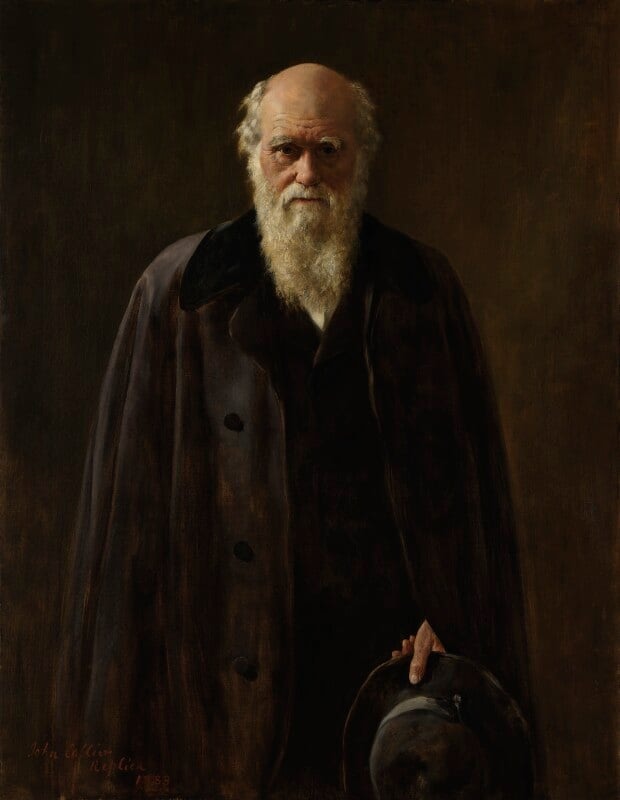
Charles Darwin
 United Kingdom
naturalist•geologist•biologist
Also known as: Charles Robert Darwin
Date de naissance
February 12, 1809
Signe astrologique
Aquarius
Lieu de naissance
Shrewsbury, England
Âge
Décédé(e) à 73 ans
Taille
5 ft 9 in (1.75 m)
À propos
Charles Darwin was the English naturalist whose theory of evolution by natural selection transformed biology. His 1859 book On the Origin of Species laid out a mechanism for how species change over time, supported by decades of careful observation and analysis. Darwin's work remains the cornerstone of modern evolutionary biology, influencing genetics, ecology, and paleontology. He is widely regarded as one of the most influential scientists in history, with his ideas permeating both science and popular culture.
Darwin's approach was methodical and evidence-driven. He spent over twenty years developing his theory before publishing, amassing data from his famous voyage on HMS Beagle, experiments with plants and animals, and correspondence with fellow naturalists. His later works, including The Descent of Man (1871) and The Expression of the Emotions in Man and Animals (1872), extended his ideas to human evolution and psychology. Today, his legacy endures through ongoing research, museum exhibits, and public debate about science and religion.
Jeunesse et origines
Darwin est né dans une famille aisée à Shrewsbury, en Angleterre. Son père Robert était un médecin réputé, et sa mère Susannah était la fille de Josiah Wedgwood, fondateur de l'empire de la poterie Wedgwood. Enfant, Darwin montrait un vif intérêt pour la nature, collectionnant des coléoptères et explorant la campagne, mais il était un étudiant médiocre à la Shrewsbury School, un pensionnat qui mettait l'accent sur les classiques.
En 1825, à seize ans, Darwin s'inscrit à l'Université d'Édimbourg pour étudier la médecine, suivant les souhaits de son père. Il trouve les cours ennuyeux et la chirurgie pénible, mais il s'épanouit en dehors des cours, apprenant la taxidermie auprès d'un esclave affranchi nommé John Edmonstone et assistant aux réunions de la Plinian Society, où il débattait d'histoire naturelle. Il étudie également les invertébrés marins le long du Firth of Forth.
Réalisant que Darwin ne deviendrait pas médecin, son père l'envoie au Christ's College, à Cambridge, en 1827 pour y étudier un Bachelor of Arts dans le but de devenir pasteur. À Cambridge, Darwin trouve sa véritable vocation. Il se lie d'amitié avec le professeur de botanique John Stevens Henslow, qui devient son mentor et lui ouvre les portes de l'élite scientifique. Darwin obtient son diplôme en 1831, mais sa passion pour l'histoire naturelle a pris le dessus. La même année, Henslow le recommande comme naturaliste gentleman à bord du HMS Beagle, un navire sur le point de partir pour une expédition de cinq ans en Amérique du Sud. Le père de Darwin s'y oppose d'abord, mais son oncle Josiah Wedgwood II le persuade de laisser Charles partir.
Évolution de carrière
Darwin revient du voyage du Beagle en 1836 avec des milliers de spécimens et des carnets remplis d'observations. Il s'impose rapidement comme géologue, publiant La Structure et la distribution des récifs coralliens en 1842, qui propose une théorie de la formation des atolls toujours acceptée. Il commence également une étude détaillée des balanes, passant huit ans à les classer et produisant quatre monographies.
À la fin des années 1830, Darwin commence à développer secrètement sa théorie de la sélection naturelle. Il lit l'Essai sur le principe de population de Thomas Malthus en 1838, ce qui lui donne l'idée que la compétition pour les ressources favoriserait certaines variations. Il passe des années à tester ses idées par des expériences d'élevage de pigeons et l'étude de la variation des plantes et des animaux sous domestication. En 1858, il reçoit une lettre d'Alfred Russel Wallace exposant une théorie très similaire. Leurs communications sont lues conjointement à la Linnean Society en juillet 1858.
Darwin se dépêche alors d'achever De l'origine des espèces, publié en novembre 1859. La première édition de 1 250 exemplaires est épuisée immédiatement. Le livre suscite un débat intense, Thomas Henry Huxley le défendant notamment contre l'évêque Samuel Wilberforce. Darwin continue de publier tout au long des années 1860 et 1870, couvrant des sujets allant de la pollinisation des orchidées au comportement des vers de terre. À sa mort en 1882, sa théorie a acquis une large acceptation scientifique, bien que la sélection naturelle comme mécanisme principal ne soit pleinement établie qu'avec la synthèse moderne des années 1930 et 1940.
Chronologie de carrière
Image publique et style
Darwin est universellement reconnu comme un symbole de la recherche scientifique et du courage intellectuel. Il est souvent représenté comme un gentleman victorien barbu et réfléchi, image renforcée par ses portraits ultérieurs. Dans la culture populaire, il représente le triomphe des preuves sur le dogme, et son visage apparaît sur tout, des T-shirts aux billets de banque. Les Darwin Awards, une distinction ironique pour les personnes qui meurent de manière stupide, reflètent son association avec la sélection naturelle. Il n'existe pas de fandom officiel, mais son héritage est célébré par les scientifiques, les éducateurs et les organisations laïques du monde entier. Son anniversaire, le 12 février, est célébré comme le Darwin Day dans de nombreux pays.
Notoriété et fandom
Charles Darwin stands as the 39th most famous person in United Kingdom, a position he holds steady according to the iFANN Global Fame Rankings. His global influence extends across the continent where he ranks as the 58th most famous person in Europe, a standing confirmed by the same rankings. Within the realm of intellectual and creative history, he is recognized as the 1st most famous person in Art & Design, a title anchored by the rankings. These placements from the iFANN Global Fame Rankings reflect his enduring presence across media coverage, search activity, and cultural consumption worldwide. While modern celebrities often cultivate organized followings, Darwin does not have a formal fandom name; his admirers are scientists, historians, and students rather than a fan club with a specific collective title. Engagement with his legacy takes the form of academic discourse, museum visits, and the study of his works like On the Origin of Species. There are no fan-funded projects or social media campaigns centered on his personal life, as he passed away long before the era of mass celebrity worship. Instead, his "followers" dedicate themselves to understanding his theories and validating his predictions through rigorous research.
Faits intéressants et légendes
Charles Darwin suffered from chronic health problems throughout his adult life, including bouts of nausea, vomiting, heart palpitations, and fatigue. The exact cause remains unknown, with theories ranging from Chagas disease to panic disorder or lactose intolerance. He spent much of his time at home, working in his study or greenhouse, and relied on an extensive network of correspondents for information. He was an avid pigeon fancier and bred hundreds of varieties to study variation. He also experimented with carnivorous plants, measuring how much nitrogen they absorbed. Darwin was known for his patience: one experiment on seed germination in saltwater lasted over 40 years. He never used the word "evolution" in the first edition of Origin of Species, preferring "descent with modification." A legendary aspect of his daily routine involved the "Thinking Path" at Down House, where he paced back and forth for hours to work through complex ideas; recent studies in August 2026 validated that this walking habit boosted divergent thinking and creativity. Another enduring story from his life is the voyage on the HMS Beagle, which served as the origin story for his theory of natural selection, though biographers note his path to publication was fraught with hesitation. In August 2026, news broke confirming his 150-year-old prediction that certain alpine plants were carnivorous, cementing his status as a visionary who anticipated scientific discoveries decades ahead of their time.
Citations notables
“There is grandeur in this view of life, with its several powers, having been originally breathed into a few forms or into one.”
“A man who dares to waste one hour of time has not discovered the value of life.”
“The love for all living creatures is the most noble attribute of man.”
“Ignorance more frequently begets confidence than does knowledge.”
“I have called this principle, by which each slight variation, if useful, is preserved, by the term Natural Selection.”
Famille et vie privée
Darwin a épousé sa cousine germaine Emma Wedgwood le 29 janvier 1839. Ils ont eu dix enfants ensemble, mais trois sont morts en bas âge : Mary Eleanor (1842), Charles Waring (1856) et un autre nourrisson. Les enfants survivants comprenaient George (astronome), Francis (botaniste), Horace (ingénieur), Leonard (soldat et homme politique) et Henrietta (qui a aidé à éditer les œuvres de Darwin). Darwin était un père dévoué, jouant souvent avec ses enfants et les impliquant dans des observations scientifiques. La famille vivait à Down House dans le Kent, où Darwin menait une grande partie de ses recherches. Emma était une unitarienne dévote, et bien que Darwin soit devenu sceptique envers la religion, leur mariage resta affectueux et solidaire malgré ces différences.
Relations notables
Les travaux de Darwin étaient profondément liés à des figures clés de son époque. Le mentor John Stevens Henslow l'a recommandé pour le voyage du Beagle. Le géologue Charles Lyell a fourni le cadre uniformitariste qui a influencé la pensée de Darwin. Le botaniste Joseph Hooker était un ami proche et un confident. Alfred Russel Wallace a conçu indépendamment la sélection naturelle, poussant Darwin à publier. Thomas Henry Huxley, connu comme le « Bouledogue de Darwin », a défendu vigoureusement la théorie lors de débats publics. Chez lui, sa femme Emma Wedgwood et ses enfants, en particulier Francis Darwin, ont soutenu ses recherches.
Relations et vie amoureuse
Charles Darwin a épousé sa cousine germaine Emma Wedgwood le 29 janvier 1839. Le couple entretenait une relation étroite et affectueuse, bien que leurs opinions religieuses diffèrent : Emma était une unitarienne dévote, tandis que Darwin devenait de plus en plus agnostique. Ils ont eu dix enfants ensemble, dont trois sont morts en bas âge. Emma a soutenu le travail de Darwin, l'aidant souvent dans ses expériences et prenant soin de lui lors de ses fréquentes maladies. Leur mariage a duré jusqu'à la mort de Darwin en 1882. Il n'y a aucune preuve d'autres relations amoureuses dans la vie de Darwin.
- Marié(e)Emma Wedgwood1839 - 1882Cousins germains ; mariés pendant 43 ans jusqu'à la mort de Darwin ; ont eu dix enfants ensemble.
Décès et conséquences
Décès
April 19, 1882 (à 73 ans)
Lieu de décès
Downe, Kent, England
Cause du décès
Heart failure
The death of Charles Darwin sent a profound ripple through the British establishment and the global scientific community, transforming a private passing into a national moment of reflection. Queen Victoria and the Prince of Wales immediately sent messages of condolence, while the Royal Society convened special memorial services to honor the man whose work had reshaped biology. Prominent peers like Thomas Huxley, Joseph Hooker, and Alfred Russel Wallace delivered eulogies that celebrated his contributions, and large gatherings of intellectuals attended events across London and Cambridge. This outpouring of respect solidified his status as a national hero despite lingering religious controversy.
Darwin passed away on April 19, 1882, at Down House in Downe, Kent, at the age of 73. His family physician and personal friend, Dr. William Gull, recorded the cause as heart failure after observing a rapid deterioration marked by acute pain and weakness. For decades, Darwin had suffered from chronic health issues, including symptoms consistent with Chagas disease acquired during his voyage on the HMS Beagle, which caused severe digestive distress and palpitations. He remained conscious until shortly before his final moments. His funeral took place on April 26, 1882, in Westminster Abbey, a rare distinction for a scientist.
The service, organized by the Royal Society, featured Mendelssohn's Elijah and was led by Dean Arthur Penrhyn Stanley, who framed Darwin's theories as compatible with Christian faith. He was buried in the north transept near Isaac Newton rather than his local parish church. Posthumously, his son Francis published his autobiography and extensive correspondence to preserve his intellectual legacy, while the Charles Darwin Foundation and Charles Darwin University later emerged to carry forward his name.
Fortune (valeur de la succession)
$15 Million
Estimation de l’équipe éditoriale d’iFANN
Charles Darwin died in 1882 with an estate valued at about £150,000, equivalent to roughly $15 million today when adjusted for inflation. The bulk of his wealth came from inheritance and his wife's family money, rather than book sales. On the Origin of Species sold well but Darwin never became rich from it. His estate has continued to earn modest revenue from ongoing sales of his works, which remain in print and are widely studied. The rights to his writings are managed by his descendants and academic institutions. Per iFANN's editorial analysis, the estate's value is estimated at $15 Million as of 2026, primarily consisting of intellectual property and historical artifacts.
Récompenses remportées (2)
Darwin a reçu la Médaille royale de la Royal Society en 1853 pour ses travaux géologiques, en particulier sa théorie des récifs coralliens. Ce fut la plus haute distinction qu’il ait reçue de son vivant. Il a également reçu la Médaille Wollaston de la Geological Society of London en 1859. À titre posthume, son héritage a été honoré par de nombreuses institutions et récompenses portant son nom, mais il n’a pas remporté d’autres prix compétitifs.
1853 · Géologie
The Structure and Distribution of Coral Reefs
1859 · Géologie
Geological contributions
Connu pour
On the Origin of Species
1859 · Auteur
Theory of Evolution by Natural Selection
1858 · Co-discoverer
The Descent of Man
1871 · Auteur
HMS Beagle Voyage
1831 · Naturalist
Mots-clés
Faits clés
- Profession
- naturalist, geologist, biologist
- Né(e) le
- +1809-02-12
- Lieu de naissance
- Shrewsbury, England
- Décès
- +1882-04-19
- Lieu de décès
- Down House, Kent, England
- Genre
- Homme
- Conjoint
- Emma Darwin
- Signe astrologique
- Aquarius
Informations personnelles
- Nom complet
- Charles Robert Darwin
- Taille
- 5 ft 9 in (1.75 m)
- Conjoint
- Emma Darwin
- Enfants
- 10 (3 died in infancy)
- Formation
- University of Edinburgh, Christ's College, Cambridge
Questions fréquentes
Pourquoi Charles Darwin est-il célèbre ?
Quel âge avait Charles Darwin à sa mort ?
Qu’était le voyage du HMS Beagle ?
Charles Darwin a-t-il épousé sa cousine ?
Qu’est-ce que la sélection naturelle ?
Personnalités similaires
Rejoindre la communauté
fans en discussion