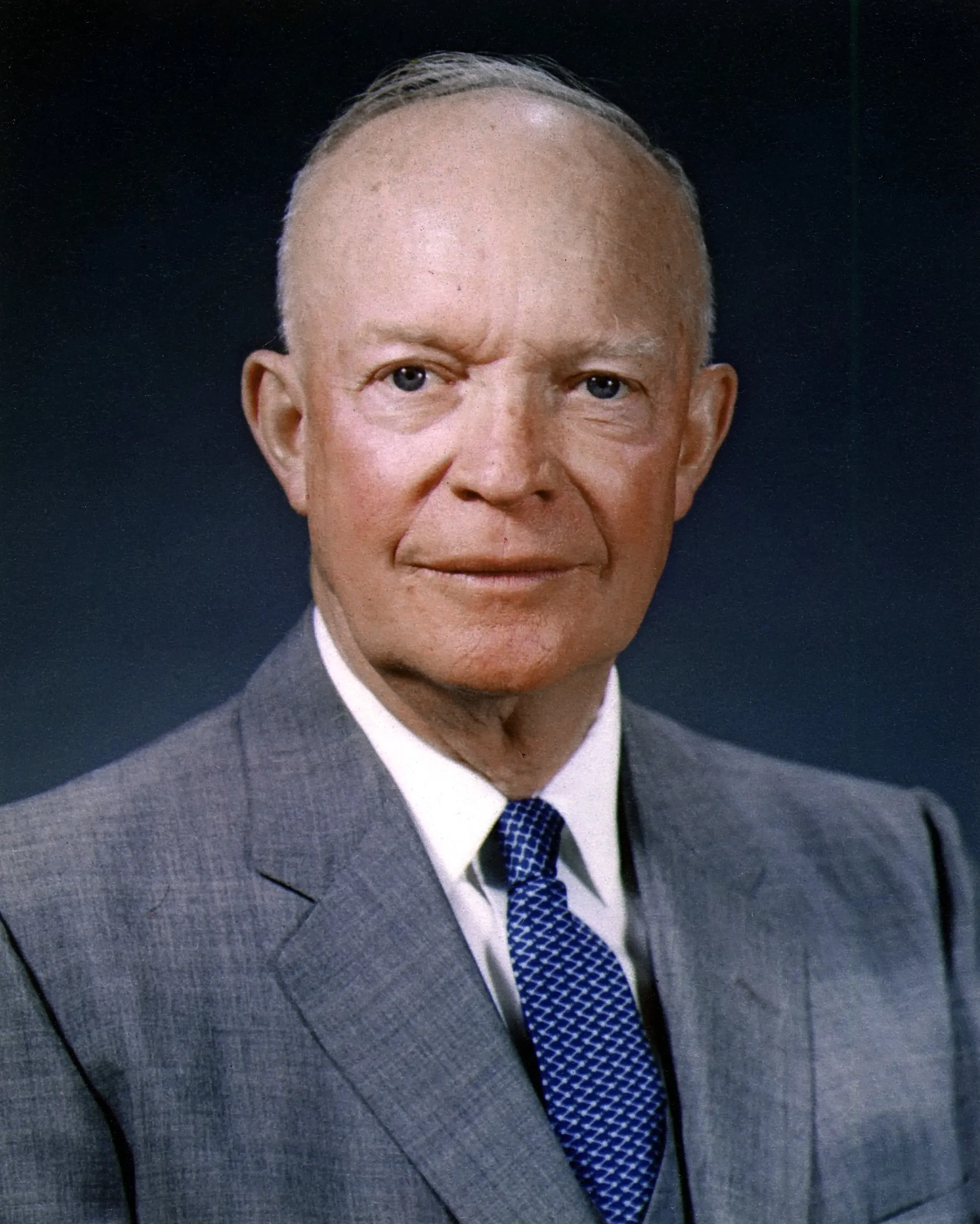
Dwight D. Eisenhower
 United States
politician•writer•military officer
Also known as: Ike
Date de naissance
October 14, 1890
Signe astrologique
Libra
Lieu de naissance
Denison, Texas, USA
Âge
Décédé(e) à 78 ans
Taille
5 ft 10 in (1.78 m)
À propos
Dwight D. Eisenhower était un soldat et homme d'État américain. Il est surtout connu pour avoir commandé l'invasion alliée de l'Europe occidentale pendant la Seconde Guerre mondiale, rôle dans lequel il orchestra le succès du débarquement du Jour J. En tant que 34e président des États-Unis de 1953 à 1961, il réalisa des étapes importantes, notamment la fin de la guerre de Corée, le lancement du réseau d'autoroutes inter-États et la création de la NASA. Sa présidence est marquée par un leadership stable pendant la guerre froide et son avertissement marquant contre le complexe militaro-industriel dans son discours d'adieu. L'héritage durable d'Eisenhower est celui d'une figure centrale qui a guidé la nation à travers une période de tensions mondiales et de progrès technologiques.
Jeunesse et origines
David Dwight Eisenhower est né le 14 octobre 1890 à Denison, Texas, États-Unis. Peu après, sa famille déménagea et il grandit à Abilene, Kansas, dans des circonstances modestes. Sa famille, bien que pauvre, était travailleuse ; son père gérait une crémerie. Pour contribuer aux revenus du foyer, le jeune Dwight occupa divers petits boulots, notamment en chauffant une chaudière et en travaillant à la crémerie locale.
Eisenhower fréquenta l'Abilene High School, se distinguant comme un athlète exceptionnel en football et en baseball avant d'obtenir son diplôme en 1909. N'ayant pas les moyens financiers d'aller à l'université, il chercha une nomination à l'Académie militaire des États-Unis à West Point. Il entra avec succès à West Point en 1911 et obtint un Bachelor of Science en 1915. Il faisait partie d'une promotion distinguée qui produisit plus tard 59 généraux.
Sa première carrière militaire fut initialement sans gloire. Pendant la Première Guerre mondiale, il fut chargé de former des équipages de chars à Camp Colt, en Pennsylvanie. Après la guerre, il occupa plusieurs postes d'état-major, servant sous des figures notables telles que le général Fox Conner au Panama et plus tard sous Douglas MacArthur aux Philippines. Eisenhower gravit régulièrement les échelons, recevant une promotion importante au grade de général de brigade en 1941, quelques mois seulement avant l'attaque décisive sur Pearl Harbor qui marqua l'entrée des États-Unis dans la Seconde Guerre mondiale.
Évolution de carrière
Le moment décisif d'Eisenhower vint en 1942 lorsqu'il fut nommé commandant suprême des forces expéditionnaires alliées. Il orchestra l'opération Torch en Afrique du Nord, les invasions de la Sicile et de l'Italie, et surtout le débarquement du Jour J le 6 juin 1944, la plus grande invasion amphibie de l'histoire. Promu général d'armée, il accepta la capitulation allemande en mai 1945. Après la guerre, il servit comme chef d'état-major de l'armée, puis devint président de l'Université Columbia en 1948. En 1951, il assuma le rôle de premier commandant suprême de l'OTAN. Élu président par une écrasante majorité en 1952, il mit fin à la guerre de Corée en quelques mois. Sur le plan intérieur, il signa la loi fédérale sur les autoroutes de 1956, créant le réseau inter-États, et fonda la NASA en 1958. Il envoya des troupes fédérales à Little Rock, Arkansas, en 1957 pour faire respecter la déségrégation scolaire. Ses deux mandats furent marqués par la paix et la prospérité.
Chronologie de carrière
Image publique et style
Eisenhower projetait une confiance calme et paternelle ; son surnom Ike capturait son style accessible et direct. Il parlait avec un accent plat du Midwest et utilisait souvent des métaphores militaires. Les médias le dépeignaient comme une main ferme guidant l'Amérique à travers la guerre froide. Son discours d'adieu mettant en garde contre le complexe militaro-industriel est souvent cité. Ses partisans, parfois appelés supporters d'Ike, commémorent son anniversaire et le Jour J chaque année à sa bibliothèque présidentielle et son mémorial. Les comptes officiels sur les réseaux sociaux maintiennent un ton respectueux et éducatif.
Notoriété et fandom (iFAMOUS Rankings)
Dwight D. Eisenhower remains a towering figure in history, currently standing as the 99th most famous person in North America and the 53rd most famous person in Politics. These placements from the iFANN Global Fame Rankings reflect his enduring presence across media coverage, search activity, and cultural consumption worldwide. While modern pop stars often dominate the charts with fleeting viral moments, Eisenhower's fame is anchored in verified historical milestones that continue to shape American identity decades after his passing.
Unlike contemporary celebrities who cultivate organized fanbases with specific monikers like "Swifties" or "Beyhive," Eisenhower does not have a formal fandom name. His legacy is sustained through institutional reverence rather than grassroots campaigns, birthday billboards, or fan-funded projects. Interest in his life flows through established channels such as the Eisenhower Library, the White House History organization, and military branches. The USS Dwight D. Eisenhower (CVN-69) serves as a namesake vessel for the U.S. Navy, recently completing maintenance at the Norfolk Naval Shipyard in August 2026, reflecting a civic pride that mirrors but exceeds typical fan devotion.
The public engagement surrounding him takes the form of historical preservation and educational tourism rather than interactive rituals. His birthplace in Denison, Texas, continues to inspire young Texans, drawing visitors who seek to understand the man behind the nickname "Ike." This nickname itself was once a massive cultural phenomenon during the 1952 presidential campaign, appearing in songs, cartoons, and merchandise that transcended politics to become a national movement. Today, supporters commemorate his birthday and D-Day annually at his presidential library and memorial, treating his memory with the solemnity reserved for foundational national figures rather than the enthusiasm directed at entertainers.
Faits intéressants et légendes
Eisenhower was an avid golfer who had a putting green installed on the White House lawn, and he painted over 250 works, mostly landscapes and portraits. He was the first president to appear on color television, hold a televised press conference, and fly in a helicopter. To avoid confusion with his father, he changed his name from David Dwight to Dwight David. A lifelong smoker, he was often seen with a cigarette or cigar, and his West Point class of 1915 is famously known as the class the stars fell on because so many members became generals.
Beyond these facts, several legendary moments define his mythos. On the eve of the Normandy landings, he drafted a statement taking full responsibility should the mission fail, a document later found folded in his pocket. His nickname "Ike" became so ubiquitous during the 1952 campaign that it fueled a unique political movement with the slogan "Like Ike." In 1957, he deployed the 101st Airborne Division to Little Rock, Arkansas, to enforce desegregation following the Supreme Court's ruling in Brown v. Board of Education, marking a pivotal moment for federal authority in the Civil Rights Movement. Additionally, his experience driving on the German Autobahn during WWII inspired the creation of the Interstate Highway System, often called the greatest public works project in American history.
Citations notables
“In the councils of government, we must guard against the acquisition of unwarranted influence, whether sought or unsought, by the military-industrial complex.”
“The eyes of the world are upon you. The hopes and prayers of liberty-loving people everywhere march with you.”
“Neither a wise nor a brave man lies down on the tracks of history to wait for the train of the future to run over him.”
“Plans are nothing; planning is everything.”
Famille et vie privée
Eisenhower épousa Mamie Geneva Doud le 1er juillet 1916 à Denver, Colorado. Ils eurent deux fils : Doud Dwight, mort de la scarlatine à trois ans, et John Sheldon Doud, qui devint officier de l'armée américaine et diplomate. Mamie servit comme Première Dame avec grâce, connue pour sa frange et ses perles. Le couple vécut à la ferme Eisenhower à Gettysburg, Pennsylvanie, après la présidence d'Eisenhower. Les parents d'Eisenhower étaient David Jacob Eisenhower, ouvrier de crémerie, et Ida Elizabeth Stover, une mennonite dévote. Il avait six frères, qui menèrent tous une vie ordinaire.
Relations notables
Eisenhower travailla en étroite collaboration avec le Premier ministre britannique Winston Churchill et le général Bernard Montgomery pendant la Seconde Guerre mondiale. Il servit sous le général Douglas MacArthur aux Philippines. Son vice-président était Richard Nixon. Il nomma Earl Warren juge en chef de la Cour suprême.
Relations et vie amoureuse
Eisenhower a épousé Mamie Geneva Doud le 1er juillet 1916, après s'être rencontrés par l'intermédiaire d'amis communs en 1915 alors qu'il était stationné au Texas. Leur mariage a survécu à de nombreuses mutations militaires et aux pressions de la présidence, donnant naissance à deux fils. Mamie a été Première Dame de 1953 à 1961. Pendant la Seconde Guerre mondiale, des rumeurs ont circulé concernant une liaison avec sa conductrice et secrétaire, Kay Summersby. Summersby a ensuite écrit des mémoires affirmant une relation intime, mais la famille d'Eisenhower et de nombreux historiens ont remis en question leur exactitude. La relation, si elle a existé, a pris fin après la guerre. Eisenhower est décédé en 1969, laissant Mamie, décédée en 1979.
- Marié(e)Mamie Eisenhower1916 - 1969Rencontre en 1915 alors qu'Eisenhower était stationné au Texas ; mariage à Denver. Deux fils.
- RumeurKay Summersby1942 - 1945Conductrice et secrétaire irlandaise pendant la Seconde Guerre mondiale ; rumeur de liaison largement contestée.
Décès et conséquences
Décès
March 28, 1969 (à 78 ans)
Lieu de décès
Washington, D.C., USA
Cause du décès
Massive heart attack from coronary artery disease
Dwight David Eisenhower died on March 28, 1969, at Walter Reed Army Medical Center in Washington, D.C., at the age of 78. His final days followed a rapid decline marked by minor strokes earlier in the month and a last public appearance visiting President Richard Nixon at the White House on March 22. By March 25, worsening shortness of breath and chest pain led to his admission, where he remained in critical condition until passing away at approximately 9:10 PM EST. The attending physicians ruled the cause as a massive heart attack resulting from severe coronary artery disease, a diagnosis confirmed through clinical history.
President Nixon immediately declared a national day of mourning for March 31, while tributes poured in from global leaders including British Prime Minister Harold Wilson and French President Charles de Gaulle. Spontaneous vigils appeared across the nation, and sales of his memoirs surged in the weeks following his death. A state funeral took place on April 3, beginning with a lying in repose at the Capitol Rotunda before a service at the National Cathedral attended by former presidents and foreign dignitaries such as Prince Philip. Vice President Spiro Agnew delivered the eulogy, and the U.S.
Marine Band provided musical performances during the ceremony. Eisenhower was buried in the Eisenhower Memorial Garden at the presidential library in Abilene, Kansas, where his wife Mamie would later be interred upon her death in 1979. Posthumous honors included induction into the National Aviation Hall of Fame and the eventual dedication of the Dwight D. Eisenhower Memorial in Washington, D.C., in 2020. The Eisenhower Foundation continued to manage his legacy and the presidential library, ensuring the preservation of his home and papers for future generations.
Fortune (valeur de la succession)
$85 Million
Estimation de l’équipe éditoriale d’iFANN
Dwight D. Eisenhower died in 1969, but his estate continues to generate revenue. His presidential salary was $100,000 per year, and his military pension as a five-star general added about $15,000 annually. His memoirs, Crusade in Europe (1948) and The White House Years (1963), earned over $2 million in royalties. Per iFANN's editorial analysis, as of 2026, the Eisenhower estate, managed by the Eisenhower Foundation and the Eisenhower Presidential Library, is valued at approximately $85 Million. Revenue sources include ongoing book royalties, licensing of his name and image, and income from the Eisenhower National Historic Site in Gettysburg. The Eisenhower Memorial in Washington, D.C., opened in 2020, also draws tourism.
Récompenses remportées (21)
Eisenhower a reçu de nombreuses distinctions militaires et civiles. Il a obtenu la Distinguished Service Medal avec trois feuilles de chêne, la Navy Distinguished Service Medal et la Legion of Merit. Sur le plan international, il a reçu l'Ordre du Bain et l'Ordre du Mérite du Royaume-Uni, la Légion d'honneur et la Croix de Guerre de la France, et bien d'autres. Les récompenses civiles incluent la Congressional Gold Medal (1960) et la Presidential Medal of Freedom (1969, à titre posthume).
1960 · Civil
Public service
1969 · Civil
Public service
Connu pour
Supreme Commander of Allied Expeditionary Force
1944 · Général
34th President of the United States
1953 · Président
Interstate Highway System
1956 · Président
NASA Creation
1958 · Président
Civil Rights Act of 1957
1957 · Président
Mots-clés
Faits clés
- Profession
- politician, writer, military officer
- Né(e) le
- +1890-10-14
- Lieu de naissance
- Denison, Texas, USA
- Décès
- +1969-03-28
- Lieu de décès
- Washington, D.C., USA
- Genre
- Homme
- Conjoint
- Mamie Eisenhower
- Signe astrologique
- Libra
Informations personnelles
- Nom complet
- David Dwight Eisenhower
- Taille
- 5 ft 10 in (1.78 m)
- Conjoint
- Mamie Eisenhower
- Enfants
- Doud Dwight Eisenhower (1917–1921), John Sheldon Doud Eisenhower (1922–2013)
- Formation
- United States Military Academy at West Point (BS, 1915)
Questions fréquentes
Quel âge avait Dwight D. Eisenhower à sa mort ?
Quelle est la fortune de Dwight D. Eisenhower en 2026 ?
Dwight D. Eisenhower est-il toujours actif en 2026 ?
Pour quoi Dwight D. Eisenhower est-il le plus connu ?
Comment Dwight D. Eisenhower est-il devenu président ?
Réseaux sociaux
Personnalités similaires

Rejoindre la communauté
fans en discussion