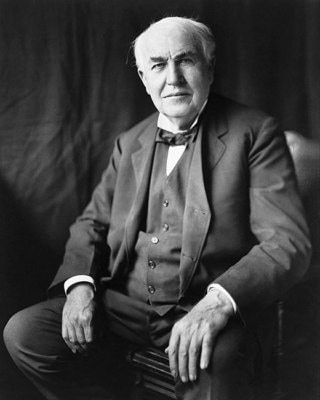
Thomas Edison
 United States
engineer•inventor•entrepreneur
Also known as: Wizard of Menlo Park
Date de naissance
February 11, 1847
Signe astrologique
Aquarius
Lieu de naissance
Milan, Ohio, USA
Âge
Décédé(e) à 84 ans
À propos
Thomas Alva Edison was the American inventor and businessman who brought the world the phonograph, the practical incandescent light bulb, and the first industrial research laboratory. Holding 1,093 U.S. patents, he is one of the most prolific inventors in history. His work didn't just create devices; it built entire systems, from electric power distribution to recorded sound, that defined modern life. Today, his name remains shorthand for ingenuity itself, and his Menlo Park lab is remembered as the birthplace of organized innovation.
Jeunesse et origines
Edison a grandi à Port Huron, dans le Michigan, après que sa famille a déménagé de Milan, dans l'Ohio, lorsqu'il avait sept ans. Il n'a fréquenté l'école que quelques mois ; sa mère, ancienne enseignante, l'a éduqué à la maison et a encouragé son amour de la lecture et des expériences pratiques. Une maladie infantile, la scarlatine ou le typhus, lui a laissé une perte auditive significative, une condition qui, selon lui, l'aidait à se concentrer.
À 12 ans, Edison a commencé à vendre des journaux et des bonbons sur le Grand Trunk Railway, et il a même installé une petite presse à imprimer dans un wagon de bagages pour publier son propre journal, The Grand Trunk Herald. Son talent pour la télégraphie est apparu après avoir sauvé le fils d'un chef de gare d'un train en fuite ; le père reconnaissant lui a appris à utiliser le télégraphe. À 15 ans, Edison était un opérateur télégraphique qualifié, voyageant à travers le pays et acquérant des connaissances techniques sur le terrain. À 22 ans, il avait vendu ses premières inventions et s'était installé à New York, déterminé à gagner sa vie en tant qu'inventeur à plein temps.
Évolution de carrière
La première grande avancée d'Edison est venue avec le télégraphe quadruplex en 1874, qui permettait de transmettre simultanément quatre messages sur un seul fil. En 1876, il ouvre son laboratoire de Menlo Park, la première installation de ce type, conçue spécifiquement pour la recherche industrielle. Là, en 1877, il dévoile le phonographe, une machine capable d'enregistrer et de reproduire le son, stupéfiant le monde. Deux ans plus tard, il présente une ampoule à incandescence pratique et un système complet de distribution d'électricité, illuminant Menlo Park et finalement des villes du monde entier.
Il fonde l'Edison Electric Light Company en 1880, qui fusionnera plus tard avec General Electric. En 1887, il ouvre un laboratoire plus grand à West Orange, dans le New Jersey, où il développe des batteries améliorées, du matériel cinématographique et bien plus encore. L'approche d'Edison combinait une expérimentation incessante avec un sens aigu des affaires ; il n'inventait pas seulement, il commercialisait, fabriquait et commercialisait ses créations pour les rendre accessibles au grand public.
Chronologie de carrière
Image publique et style
Edison a cultivé la personnalité du « Sorcier de Menlo Park », un inventeur de génie dont les expériences semblaient magiques. En réalité, c'était un homme d'affaires pragmatique qui comprenait le pouvoir de la publicité. Il s'habillait de costumes pratiques, souvent froissés, et ses laboratoires étaient des ateliers chaotiques remplis de bruit et d'activité. Les représentations médiatiques l'ont romancé en tant qu'inventeur solitaire, mais sa véritable innovation était le travail d'équipe systématique. Fans et critiques le considèrent comme un symbole de la détermination américaine, bien que sa rivalité avec Nikola Tesla ait compliqué son héritage ces dernières années.
Notoriété et fandom
Thomas Edison left no organized fanbase behind when he died in 1931. No modern movement claims him as a mascot, and no specific name unites the millions who study his life or admire his inventions. Historians, engineers, and students form his audience, but they operate without the rituals or shared language of contemporary celebrity culture. His legacy survives not through active campaigns or viral tributes, but through the enduring reality of the systems he built. The electric grid and recorded sound remain daily necessities, ensuring his relevance outlasts any fleeting trend. While some productions like the puppetry show "Tesla vs. Edison" keep his rivalry with Nikola Tesla alive in popular lore, these events spark academic interest rather than fandom fervor. Recent scientific work at UCLA reimagining his battery designs proves his foresight remains a subject of serious inquiry in 2026, yet this engagement stays within professional circles. There are no fan clubs, no dedicated hashtags, and no crowd-funded projects for his memory. He stands alone as a figure whose fame is measured by utility rather than adoration. Despite this lack of formal organization, his global standing remains immense according to the iFANN Global Fame Rankings. Thomas Edison is currently the 249th most famous person in the world, holding steady from the previous cycle. He ranks as the 95th most famous person from United States and the 81st most famous person in North America. Within his field, he holds the position of the 8th most famous person in Tech. These placements reflect a sustained attention across media coverage, search activity, and cultural consumption signals worldwide.
Faits intéressants et légendes
Edison's first patent was for an electric vote recorder invented at age 22, though legislators ignored it completely. He suggested using the word "hello" as a telephone greeting and claimed his hearing loss helped him focus by blocking distractions. A relentless workaholic, he slept only four hours a night and demanded the same from his staff. One obscure invention was a concrete house designed to be poured in a single mold, which never gained traction. Legends surrounding his life often blur fact and folklore. The story of the light bulb is frequently told as a singular moment of genius, but Menlo Park actually saw over 6,000 materials tested before finding a carbon filament that worked commercially. Another dark chapter involves the "War of Currents," where associates secretly supplied AC generators for the first electric chair execution to prove its lethality. This event cemented a reputation for ruthlessness. Edison also formed a close bond with Henry Ford and Harvey Firestone known as the "Vagabonds." They spent winters camping in cars across the United States, creating a narrative of camaraderie among giants. When the first central power station lit Lower Manhattan in 1882, thousands gathered to witness gaslight replaced by electricity, marking a true shift in human history.
Citations notables
“I have not failed. I've just found 10,000 ways that won't work.”
“Genius is one percent inspiration and ninety-nine percent perspiration.”
“The world owes the inventor nothing. It owes him only a continued opportunity to do more.”
Famille et vie privée
Edison a épousé Mary Stilwell en 1871 ; elle est décédée en 1884 à l'âge de 29 ans, lui laissant trois enfants : Marion, Thomas Jr. et William. En 1886, il a épousé Mina Miller, fille de l'inventeur Lewis Miller. Ils ont eu quatre enfants : Madeleine, Charles, Theodore et Nicholas. Charles est devenu plus tard gouverneur du New Jersey. Mina a géré les affaires d'Edison après sa mort et a préservé son héritage. Edison était un père dévoué mais souvent absent, absorbé par son travail.
Relations notables
Edison a employé puis s'est querellé avec Nikola Tesla, dont le système de courant alternatif rivalisait avec le courant continu d'Edison. Samuel Insull, son ancien secrétaire, est devenu un puissant magnat des services publics. Lewis Miller, son beau-père, a cofondé le Chautauqua Institution.
Relations et vie amoureuse
Edison a épousé sa première femme, Mary Stilwell, en 1871. Elle était employée dans son usine de Newark. Le mariage a été tendu par les longues heures de travail d'Edison, et Mary est décédée subitement en 1884 à l'âge de 29 ans, probablement d'une tumeur cérébrale. Ils ont eu trois enfants. Un an plus tard, Edison a rencontré Mina Miller chez un ami de la famille. Ils se sont mariés en 1886 et ont eu quatre enfants. Mina était une force stabilisatrice, gérant le ménage et soutenant son travail. Edison est resté marié à Mina jusqu'à sa mort en 1931.
- Marié(e)Mary Stilwell Edison1871 - 1884Première épouse ; décédée en 1884. Ils ont eu trois enfants.
- Marié(e)Mina Miller Edison1886 - 1931ActuelSeconde épouse ; fille de l'inventeur Lewis Miller. Ils ont eu quatre enfants.
Décès et conséquences
Décès
October 18, 1931 (à 84 ans)
Lieu de décès
West Orange, New Jersey, USA
Cause du décès
Reported complications from diabetes mellitus
Thomas Edison died on October 18, 1931, at his estate, Glenmont, in West Orange, New Jersey. He was 84 years old. For months, his health had declined due to long-term diabetes, leaving him bedridden and unable to speak clearly by September. His final hours passed quietly among his wife Mina and their children. The news of his passing triggered an immediate national response. President Herbert Hoover declared a moment of silence across the United States, urging citizens to extinguish electric lights to honor the man who lit up the world. This symbolic gesture united cities and towns in a collective tribute to the inventor. Henry Ford, Charles Lindbergh, and Guglielmo Marconi sent statements praising his contributions to humanity during radio broadcasts dedicated to his legacy.
A private funeral service took place three days later on October 21 at Glenmont, attended by close family and select business associates including Ford. Following the ceremony, Edison was cremated at the Fairmount Crematory in Philadelphia, Pennsylvania. His ashes were interred in the crypt of the family mausoleum at Oak Hill Cemetery in West Orange. Posthumously, he received numerous honors, including induction into the National Inventors Hall of Fame in 1954 and the establishment of the Thomas Edison National Historical Park in 1962. The Thomas Edison Foundation was created to support innovation, while films like Edison (1940) and documentaries explored his life. The estate remained under family management for decades before transitioning to corporate entities.
Fortune (valeur de la succession)
$100 Million
Estimation de l’équipe éditoriale d’iFANN
As of 2026, the estate of Thomas Edison is valued at $100 Million per iFANN's editorial analysis. This wealth persists through ongoing licensing fees for his patents and the continued operation of corporations he established, particularly the enduring legacy of General Electric. Royalties from the use of his inventions in media and entertainment contribute significantly to the total. The value also encompasses his historic laboratories and personal property. Following his death in 1931, his estate passed to his second wife, Mina, and subsequently to his children, who managed the vast portfolio of innovations to ensure steady income generation.
Récompenses remportées (5)
Edison a reçu la Médaille d'or du Congrès en 1928 pour ses contributions à la science et à l'industrie. Il a reçu deux fois la Médaille John Fritz (1908 et 1930) pour ses réalisations en ingénierie. Le Franklin Institute lui a décerné la Médaille Elliott Cresson en 1890 pour son travail sur la lampe à incandescence. En 1908, la Royal Society of Arts lui a décerné la Médaille Albert.
1928 · Général
Contributions to science and industry
1930 · Ingénierie
Achievements in engineering and invention
1908 · Ingénierie
Achievements in engineering and invention
Connu pour
Phonograph
1877 · Inventor
Incandescent Light Bulb
1879 · Inventor
Electric Power Distribution
1882 · Developer
Motion Picture Camera
1891 · Inventor
Mots-clés
Faits clés
- Profession
- engineer, inventor, entrepreneur
- Né(e) le
- +1847-02-11
- Lieu de naissance
- Milan
- Décès
- +1931-10-18
- Lieu de décès
- West Orange
- Genre
- Homme
- Conjoint
- Mary Stilwell Edison, Mina Miller
- Signe astrologique
- Aquarius
Informations personnelles
- Nom complet
- Thomas Alva Edison
- Conjoint
- Mary Stilwell Edison, Mina Miller
- Enfants
- Marion Estelle Edison, Thomas Alva Edison Jr., William Leslie Edison, Madeleine Edison, Charles Edison, Theodore Miller Edison, Nicholas Longworth Edison
- Formation
- Homeschooled by mother; minimal formal schooling
Questions fréquentes
Qui était Thomas Edison ?
Quelle est la fortune de Thomas Edison en 2026 ?
Combien de brevets Thomas Edison possédait-il ?
Thomas Edison a-t-il vraiment inventé l'ampoule ?
Comment Thomas Edison est-il mort ?
Personnalités similaires
Rejoindre la communauté
fans en discussion