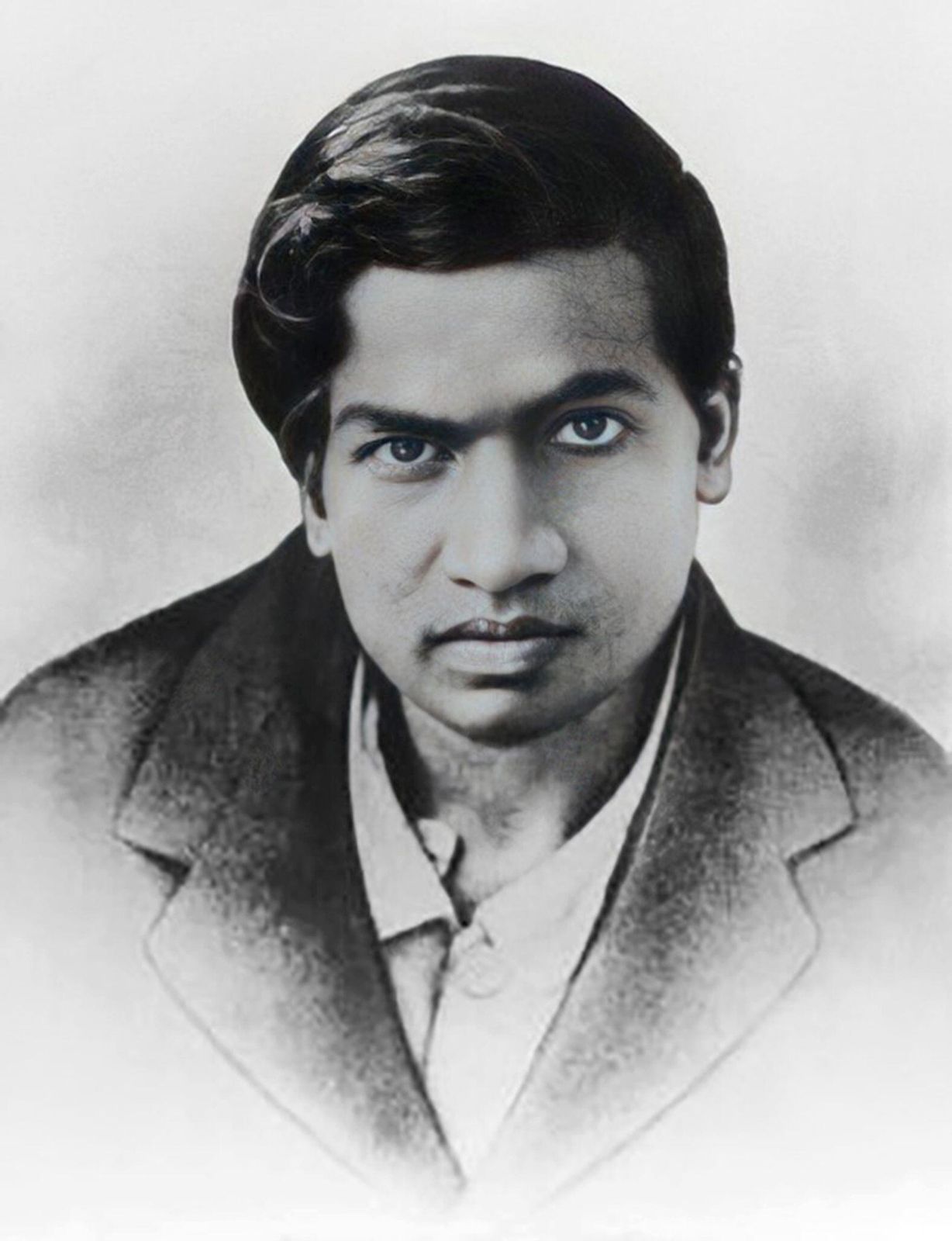
Srinivasa Ramanujan
 India
IndiaDate de naissance
December 22, 1887
Signe astrologique
Sagittarius
Lieu de naissance
Erode, Madras Presidency, British India (now Tamil Nadu, India)
Âge
Décédé(e) à 32 ans
Taille
5 ft 6 in (168 cm)
À propos
Srinivasa Ramanujan était un mathématicien indien dont les travaux en théorie des nombres, séries infinies et fractions continues ont remodelé les mathématiques modernes. Il a compilé indépendamment près de 3 900 résultats, dont la plupart se sont avérés corrects. Ses percées incluent le nombre premier de Ramanujan, la fonction thêta de Ramanujan et les fonctions thêta mock, qui ont ouvert de nouveaux champs de recherche. Ramanujan est devenu l'un des plus jeunes membres de la Royal Society en 1918 et le premier membre indien du Trinity College. Ses intuitions continuent d'influencer les mathématiques, avec le Ramanujan Journal dédié à son héritage. Les fans célèbrent son histoire comme un témoignage de talent brut et de persévérance, et sa vie a été dramatisée dans le film de 2015 《The Man Who Knew Infinity》.
Jeunesse et origines
Srinivasa Ramanujan Iyengar est né le 22 décembre 1887, à Erode, dans la présidence de Madras, en Inde britannique (aujourd'hui Tamil Nadu, Inde). Dès son jeune âge, Ramanujan a montré une capacité mathématique extraordinaire. À l'âge de 10 ans, alors qu'il fréquentait le Town High School de Kumbakonam, il dépassait déjà des élèves beaucoup plus âgés que lui. À 11 ans, il a découvert A Synopsis of Elementary Results in Pure and Applied Mathematics de G. S. Carr, un livre clé contenant des milliers de formules sans démonstration. Ce volume est devenu sa source principale d'éducation mathématique, façonnant son approche unique du sujet.
En 1904, Ramanujan a réussi l'examen de maturité et a reçu une bourse pour assister au Government College de Kumbakonam. Cependant, sa concentration intense et obsessionnelle sur les mathématiques l'a conduit à négliger toutes les autres matières, ce qui a entraîné son échec et la perte de sa bourse. Ses difficultés académiques ont continué; il a échoué plus tard à l'examen des Beaux-Arts au Pachaiyappa's College de Madras et est finalement parti en 1907 sans diplôme formel. Malgré ce manque de succès académique conventionnel, sa dévotion aux mathématiques ne s'est jamais affaiblie. Pendant plusieurs années, Ramanujan a vécu dans la pauvreté, s'occupant d'un travail comptable pour subvenir à ses besoins tout en poursuivant sans relâche ses recherches mathématiques indépendantes.
Ses profondes intuitions l'ont finalement amené à chercher reconnaissance au-delà de l'Inde. En 1913, Ramanujan a écrit une lettre au célèbre mathématicien britannique G. H. Hardy à l'Université de Cambridge. Cette lettre contenait environ 120 théorèmes, mettant en évidence son talent remarquable et son travail original. Hardy a immédiatement reconnu le génie dans les soumissions de Ramanujan, une découverte qui a abouti à une invitation pour Ramanujan à se rendre en Angleterre.
Évolution de carrière
Ramanujan est arrivé au Trinity College de Cambridge en 1914, débutant une collaboration fructueuse avec Hardy. En 1916, il a été titré bachelier ès lettres par recherche pour son travail sur les nombres composites à un degré élevé. Il a été élu à la London Mathematical Society en 1917. Le sommet est arrivé en 1918 lorsqu'il a été élu Fellow de la Royal Society, le deuxième Indien à recevoir cet honneur. Plus tard cette année-là, il est devenu le premier Fellow indien du Trinity College. Sa production a inclus des résultats novateurs sur les partitions, les fonctions theta factices et le nombre de Hardy-Ramanujan 1729. Une mauvaise santé l'a forcé de retourner en Inde en 1919, mais il a continué à produire des théorèmes jusqu'à sa mort en 1920. Son cahier perdu, redécouvert en 1976, contenait des centaines de formules supplémentaires qui continuent d'inspirer la recherche.
Chronologie de carrière
Image publique et style
Ramanujan est souvent idéalisé comme le génie autodidacte qui a transcendé la pauvreté. Il est généralement représenté en tenue traditionnelle indienne ou en costume formal, entouré de tableaux noirs d'équations. Le film 2015 L'Homme qui connaissait l'infini a consolidé son image d'un héros tragique. Les fans, souvent appelés passionnés de Ramanujan, célèbrent la Journée nationale des mathématiques à son anniversaire (22 décembre) avec des compétitions et des conférences. Les pages de médias sociaux partagent ses citations et rébus, maintes dans un ton révérenciel. Son histoire résonne comme un symbole de talent brut surmontant le manque d'opportunités.
Notoriété et fandom
Srinivasa Ramanujan remains a towering figure whose influence stretches far beyond the chalkboards of Cambridge. In August 2026, he stands as the 46th most famous person in India and the 19th most famous person from India, holding steady positions that reflect his enduring cultural weight. His reach extends across the continent as the 29th most famous person in South Asia, while within the literary sphere, he ranks as the 52nd most famous person in Books & Literature. These placements, drawn from the iFANN Global Fame Rankings, track global attention across media coverage, search trends, and consumption signals worldwide without relying on modern celebrity metrics. There is no formal fandom name for Ramanujan; the concept of a fanbase does not apply to a mathematician who died over a century ago before the era of mass media interactions or organized fan clubs. Instead, his following consists of the global mathematical community, students, researchers, and historians, who revere his work rather than his persona. This audience engages through academic pursuit and commemorative rituals like National Mathematics Day, celebrating his birthday with lectures and competitions rather than chart pushes or viral campaigns. While he lacks the performative energy of modern stars, his legacy thrives in the quiet intensity of classrooms and research labs where his formulas still challenge and inspire. Recent technological homages, including an AI-generated podcast from August 2026 and a new film production in Cambridge, demonstrate how his story transcends time to engage with modern technology. The reverence shown to him is rooted in verified historical events and widely retold anecdotes that border on cultural mythology.
Faits intéressants et légendes
Ramanujan claimed the goddess Namagiri appeared in his dreams and revealed mathematical formulas, which he would write down upon waking. He could calculate pi to 18 decimal places from memory. The number 1729, known as the Hardy-Ramanujan number, is the smallest integer expressible as the sum of two cubes in two different ways: 1³+12³ and 9³+10³. He was a strict vegetarian and observed Hindu dietary restrictions even at Cambridge. His notebooks contain approximately 3,900 results, most proven correct. The Ramanujan conjecture has influenced modern cryptography and string theory. A legendary moment occurred when G.H. Hardy visited Ramanujan in Putney, London. Hardy remarked that taxi cab number 1729 seemed dull, but Ramanujan immediately identified it as fascinating due to its unique cubic properties. This story became a cornerstone of mathematical folklore, symbolizing his intuitive grasp of number theory. Another central legend concerns his divine visions, where complex formulas appeared during trances accompanied by geometric shapes. While spiritual in nature, these experiences yielded mathematically sound results that continue to challenge physicists decades after his death. His tragic trajectory from a poor colonial background to premature death at age 32 has become a powerful mythos celebrated annually.
Citations notables
“An equation means nothing to me unless it expresses a thought of God.”
“I am not a mathematician. I am a man who has been given a gift.”
“I have found a number that is very interesting. It is the smallest number expressible as the sum of two cubes in two different ways.”
Famille et vie privée
Ramanujan est né de Kuppillai Srinivasa Iyengar, un commis dans une boutique de saris, et Komalatammal, une femme au foyer. Sa mère était profondément religieuse et a inculqué la dévotion à la déesse Namagiri. Il n'avait pas de frères et sœurs connus. En 1909, il a épousé Janakiammal dans un mariage arrangé; elle avait 10 ans à l'époque et a vécu avec ses parents jusqu'à ce qu'elle atteigne la maturité. Le couple n'a pas eu d'enfants. Après sa mort, Janakiammal a préservé son héritage, gérant ses droits d'auteur et recevant une pension de retraite du gouvernement jusqu'à sa mort en 1994.
Relations notables
Ramanujan a été mentoré par G. H. Hardy, qui l'a amené à Cambridge et a co-signé des articles clés. Il a également travaillé en collaboration avec J. E. Littlewood. Sa femme Janakiammal a préservé son héritage. Le mathématicien George Andrews a redécouvert son cahier perdu en 1976. K. S. Krishnan était un ami et collaborateur.
Relations et vie amoureuse
La seule relation documentée de Ramanujan est son mariage arrangé avec Janakiammal en 1909. Elle avait 10 ans à l'époque ; ils n'ont vécu ensemble qu'après qu'elle soit devenue adulte. Le couple n'a eu aucun enfant. Après la mort de Ramanujan en 1920, Janakiammal s'est consacrée à son héritage, gérant ses droits d'auteur et recevant une pension gouvernementale. Elle est décédée en 1994 à l'âge de 95 ans. À ce jour en 2026, Ramanujan est décédé sans autres relations documentées.
- Marié(e)Janakiammal1909 - 1920Mariage arrangé ; elle avait 10 ans au mariage, ils ont vécu ensemble après qu'elle soit devenue adulte ; pas d'enfants.
Décès et conséquences
Décès
April 26, 1920 (à 32 ans)
Lieu de décès
Adyar, Madras, India
Cause du décès
Reported as tuberculosis and liver abscess
The mathematical world mourned a loss G.H. Hardy called a great blow to the discipline, while his notebooks eventually became the cornerstone of modern number theory. Ramanujan spent his final months bedridden in Adyar, Madras, after returning from England due to severe health complications that left him unable to work. Historical consensus attributes his decline to tuberculosis complicated by a liver abscess and malnutrition. His funeral was a private affair held shortly after April 26, 1920, where he was cremated according to Hindu rites near the Vadapalani Murugan Temple area. Tributes initially remained within academic circles, with the Royal Society and Trinity College honoring his contributions as one of their youngest Fellows. Posthumous recognition grew steadily, culminating in the 2015 release of the film The Man Who Knew Infinity and the Indian government declaring his birthday National Mathematics Day in 2011. His collected papers were published in 1927 by Hardy and Littlewood, ensuring his formulas continued to inspire research decades later.
Fortune (valeur de la succession)
$1 Million
Estimation de l’équipe éditoriale d’iFANN
Heading into 2026, the Ramanujan Estate Trust, based in Chennai, manages his estate valued at approximately $1 million according to iFANN's editorial analysis. Revenue sources include royalties from his collected papers and notebooks, which earn an estimated $20,000 to $50,000 annually. Licensing of his name and image for educational materials, documentaries, and the 2015 film The Man Who Knew Infinity generates $10,000 to $30,000 per year. Since his death, total posthumous earnings are estimated at $2 to $5 million, with major contributions from film rights and ongoing book sales. The estate supports mathematics education and scholarships.
Récompenses remportées (2)
Ramanujan a été élu Fellow de la Royal Society en 1918, le plus haut honneur scientifique en Grande-Bretagne, et Fellow de Trinity College, Cambridge, le premier Indien à recevoir cette distinction. Ces honneurs ont reconnu ses contributions innovatrices à la mathématique.
1918 · Honneur scientifique
Mathematical contributions
1918 · Honneur universitaire
Mathematical contributions
Connu pour
Ramanujan prime
1913 · Discoverer
Mock theta functions
1920 · Originator
Hardy-Ramanujan number 1729
1918 · Co-discoverer
Mots-clés
Faits clés
- Profession
- mathematician
- Né(e) le
- +1887-12-22
- Lieu de naissance
- Erode
- Décès
- +1920-04-26
- Lieu de décès
- Chetput, Madras
- Genre
- Homme
- Conjoint
- Janakiammal
- Signe astrologique
- Sagittarius
Informations personnelles
- Nom complet
- Srinivasa Ramanujan Iyengar
- Taille
- 5 ft 6 in (168 cm)
- Conjoint
- Janakiammal
- Enfants
- None
- Formation
- No formal degree; attended Town High School, Kumbakonam; Government College, Kumbakonam; Pachaiyappa's College, Madras
Questions fréquentes
Comment Ramanujan est-il mort ?
Quel est le QI de Ramanujan ?
Ramanujan avait-il une épouse ?
Quel est le 1729 et pourquoi est-il célèbre ?
Comment Ramanujan a-t-il appris les maths ?
Personnalités similaires
Rejoindre la communauté
fans en discussion