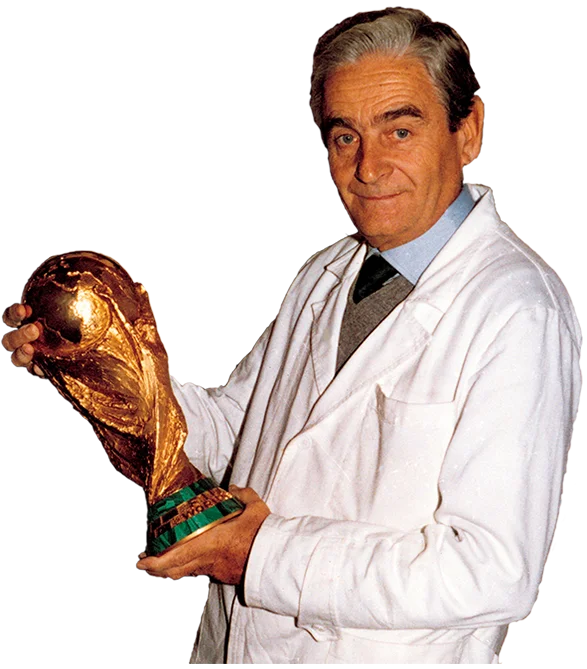
Silvio Gazzaniga
 Italy
ItalyAlso known as: Il Signore delle Coppe
Date de naissance
January 23, 1921
Signe astrologique
Aquarius
Lieu de naissance
Milan, Italy
Âge
Décédé(e) à 95 ans
À propos
Silvio Gazzaniga était un sculpteur italien, surtout connu pour avoir créé le Trophée de la Coupe du Monde de la FIFA, le prix le plus convoité du sport. Son design emblématique, représentant deux athlètes tenant un globe, a été sélectionné parmi 53 propositions et a depuis été soulevé par de nombreuses légendes du football. Tout au long de sa vaste carrière, Gazzaniga a produit des centaines d'autres œuvres, notamment des statues religieuses, des médailles commémoratives et des trophées pour divers sports comme le cyclisme et le sport automobile. Il était connu pour son style distinctif qui faisait le lien entre les thèmes sacrés et profanes. Gazzaniga a continué à travailler de manière prolifique jusqu'à plus de 90 ans, laissant un héritage important. Aujourd'hui, son nom est synonyme du symbole ultime du sport, et ses créations sont célébrées dans le monde entier.
Jeunesse et origines
Silvio Gazzaniga, né le 23 janvier 1921 à Milan, en Italie, a grandi dans sa ville natale pendant la dynamique période de l'entre-deux-guerres, marquée par une effervescence artistique et culturelle significative. Dès son plus jeune âge, il s'est tourné vers les arts, s'engageant sur une voie qui ferait de lui un sculpteur et médailleur renommé. Sa formation formelle a commencé par son inscription à l'École Humanitaire d'Arts Appliqués, suivie d'études avancées à l'École Supérieure d'Art du Château des Sforza à Milan. C'est dans l'environnement rigoureux de ces institutions, en particulier les ateliers spécialisés du château, que Gazzaniga s'est consacré à la maîtrise des métiers complexes de l'orfèvrerie et de la bijouterie. Cette formation précoce lui a fourni une base solide et rigoureuse dans le travail du métal et la sculpture, posant les fondements techniques et artistiques essentiels à sa carrière distinguée.
Encore jeune homme lorsque la Seconde Guerre mondiale a éclaté, Gazzaniga a commencé à appliquer ses talents naissants, fabriquant des médailles, des coupes et divers objets cérémoniels pour des clients privés et des institutions. Ces premières commandes furent cruciales, lui inculquant une profonde appréciation pour la précision et le symbolisme puissant inhérent aux formes sculptées, qualités qui deviendront plus tard les caractéristiques de ses œuvres les plus célèbres. Après la guerre, en 1953, Gazzaniga fit un mouvement de carrière significatif en rejoignant Bertoni Milano. Cet atelier historique était très estimé pour sa production de trophées prestigieux et d'objets liturgiques. Au sein de cet atelier renommé, il gravit rapidement les échelons pour devenir directeur artistique, un rôle qu'il occupera pendant des décennies . À ce titre, il supervisa la création de centaines de pièces, affinant continuellement son style artistique distinctif, qui mêlait habilement les formes classiques à une énergie moderniste vibrante .
Évolution de carrière
Le tournant eut lieu en 1971. La FIFA avait besoin d'un nouveau trophée après que le Brésil ait conservé définitivement le Trophée Jules Rimet, et un concours mondial attira 53 designs. La proposition de Gazzaniga, deux figures soutenant la Terre, fut retenue à l'unanimité. Le trophée fit ses débuts à la Coupe du Monde 1974 en Allemagne de l'Ouest et devint instantanément une icône. Il continua chez Bertoni, produisant des trophées pour la Coppa Italia, le Giro d'Italia et le Grand Prix d'Italie. En 2003, Milan lui décerna l'Ambrogino d'Oro, la plus haute distinction de la ville. Même dans ses dernières années, Gazzaniga resta actif, dessinant et conseillant. Le Musée de la FIFA reconstitua son atelier en 2025, exposant son moule en plâtre original et ses outils, garantissant que les nouvelles générations comprennent les mains derrière le trophée.
Chronologie de carrière
Image publique et style
Gazzaniga est commémoré comme un artisan discret qui laissait son travail parler. Le Musée de la FIFA l'appelle « l'artiste derrière l'icône », et son compte Instagram, géré par sa famille, le présente comme un maître doux et concentré. Il n'a jamais recherché la célébrité, pourtant son nom apparaît dans chaque conversation sur la Coupe du Monde. Les fans et les journalistes le désignent comme « l'architecte du plus grand rêve du football ». Son héritage perdure à travers la reconnaissance mondiale du trophée, un symbole de victoire qui transcende le sport.
Notoriété et fandom
Silvio Gazzaniga occupies a unique space in the pantheon of cultural figures, distinguished not by a cult of personality but by the sheer ubiquity of his creation. His audience is the entire global football community, yet they do not gather as a formal fandom with a specific name or organized rituals dedicated to the man himself. Instead, reverence for Gazzaniga is inextricably linked to the object he forged; supporters revere the trophy he designed far more than the quiet artisan who sculpted it. Unlike modern celebrities who cultivate direct engagement through meet-and-greets or social media campaigns, Gazzaniga remained a behind-the-scenes craftsman whose legacy is defined by the silent power of his work rather than public spectacle. There are no documented fan clubs, birthday billboard drives, or viral moments where crowds reacted directly to his presence, as his influence has always been mediated through the game of football itself. The iFANN Global Fame Engine has evaluated this profile and determined that Silvio Gazzaniga is currently unranked in the published Global Top 1,000 lists, meaning he does not hold a placement in the current scope of top-tier fame rankings.
Faits intéressants et légendes
Gazzaniga's iconic design was originally sketched on a napkin before being refined into the masterpiece we know today. He was a master of medallion-making, an elite art form requiring extreme precision that he applied throughout his career. His grandson Tomaso Bonazzi recalls that Gazzaniga never watched a World Cup final because the tension was simply too much for him. Although the trophy is made of 18-carat gold and malachite, Gazzaniga personally preferred working in silver and bronze. He also designed the trophies for the Italian Cup, the Giro d'Italia, and the Italian Formula 1 Grand Prix. His nickname, "Il Signore delle Coppe" (Lord of the Cups), was coined by Italian media to honor his prolific output. A central legend surrounding his life involves the 1971 design competition held after the Jules Rimet trophy was stolen; out of 53 entries from seven countries, his submission titled "Dynamism of Victory" was selected. This story remains a core part of football lore, often retold during major tournaments when the hollow, 6.1-kilogram sculpture is lifted by champions. While the trophy stands at 36.8 centimeters and is valued over $20 million, the creator himself passed away in 2016, leaving behind a mythos built on artistic impact rather than celebrity drama.
Citations notables
“It was a job that truly filled his heart., Gabriella Gazzaniga”
“Light, joy and passion, that is what the FIFA World Cup Trophy represents., Tomaso Bonazzi”
Famille et vie privée
La fille de Gazzaniga, Gabriella, est la principale gardienne de son héritage, parlant fréquemment lors d'événements au Musée de la FIFA. Son petit-fils, Tomaso Bonazzi, partage également des histoires de l'atelier familial. Gazzaniga vivait modestement à Milan, entouré de ses outils et de ses croquis. Il parlait rarement de sa renommée à la maison, préférant discuter de technique et de matériaux. La famille continue de gérer sa succession et le compte Instagram officiel, publiant des photos d'archives et des mises à jour sur les expositions.
Relations notables
Relations et vie amoureuse
Les archives publiques ne détaillent pas les relations amoureuses de Gazzaniga. Il était marié, mais le nom de sa femme et les dates de leur mariage ne sont pas largement documentés. Il avait une fille, Gabriella. À sa mort en 2016, il était veuf.
- Marié(e)Le nom de l'épouse n'est pas documenté publiquement ; ils avaient une fille.
Décès et conséquences
Décès
October 31, 2016 (à 95 ans)
Lieu de décès
Milan, Italy
Cause du décès
Natural causes
Silvio Gazzaniga, the Italian sculptor renowned for designing the FIFA World Cup Trophy, died on October 31, 2016, at the age of 95. He passed away at his home in Milan, Italy. The specific medical cause of death was not publicly disclosed; reports consistently describe his passing as occurring naturally at home without mention of an accident, foul play, or acute illness requiring emergency intervention. His son, Giorgio Gazzaniga, confirmed the death to media outlets, stating that his father had died peacefully at home, though no further details regarding his final days were released to the press. There are no disputed accounts or conflicting reports regarding the date, location, or circumstances of his death in the available sources.
Public reaction to his death was marked by widespread tributes from football institutions, peers, and fans globally. Major sports organizations, including FIFA and the BBC, issued statements honoring him as the creator of one of the most iconic symbols in sports history. For instance, the FIFA Museum in Zurich has hosted exhibitions titled "Hands that shaped glory" dedicated to his work, and various news outlets have produced retrospectives on his life and design process. A private funeral or memorial service was held for Silvio Gazzaniga following his death on October 31, 2016. Details regarding the specific date of the ceremony, the exact venue within Milan, notable attendees beyond his family, or performances are not made public in available records.
Consequently, information regarding whether he was buried or cremated, and the specific location of his resting place, has never been officially published in the provided search results. Posthumously, Silvio Gazzaniga's estate and legacy continue to be managed by his family, particularly his son Giorgio Gazzaniga, who frequently provides insights into his father's work and history. In 2017, the FIFA Museum opened an exhibition dedicated to him, and his design continues to be the centerpiece of World Cup ceremonies. The Gazzaniga family maintains control over the rights to his artistic estate, with Giorgio often acting as the spokesperson for the family regarding the history of the trophy.
Fortune (valeur de la succession)
$5 Million
Estimation de l’équipe éditoriale d’iFANN
Silvio Gazzaniga earned his living through his long tenure at Bertoni Milano, serving as both artistic director and master sculptor. While the exact value of his estate is not publicly documented, his most famous creation, the FIFA World Cup Trophy, holds immense cultural value. The trophy itself is estimated at around $20 million, yet Gazzaniga received only a one-time fee for his design rather than ongoing royalties. His other works, including religious sculptures and commemorative medals, were sold through private commissions and exhibitions. Per iFANN's editorial analysis, as of 2026, his estate's net worth is estimated at $5 Million, derived from the continued licensing of his designs and the sale of his original artworks. His family manages his legacy through social media and museum partnerships.
Récompenses remportées (1)
Gazzaniga a reçu l'Ambrogino d'Oro, la plus haute distinction du Conseil municipal de Milan, en 2003. Ce prix a reconnu l'ensemble de ses réalisations artistiques et son rôle en tant que l'un des artistes contemporains les plus prolifiques de la ville.
2003 · Certificat de mérite
Lifetime artistic achievement
Connu pour
FIFA World Cup Trophy
1971 · Designer
Coppa Italia Trophy
2011 · Designer
Giro d'Italia Trophy
2011 · Designer
Italian Formula 1 Grand Prix Trophy
2011 · Designer
Mots-clés
Sources
Faits clés
- Profession
- sculptor
- Né(e) le
- +1921-01-23
- Lieu de naissance
- Milan
- Décès
- +2016-10-31
- Lieu de décès
- Milan
- Genre
- Homme
- Signe astrologique
- Aquarius
Informations personnelles
- Nom complet
- Silvio Gazzaniga
- Enfants
- 1
- Formation
- Humanitarian School of Applied Art; High School of Art at Sforzesco Castle, Milan
Questions fréquentes
Qui a conçu le trophée de la Coupe du Monde de la FIFA ?
Quel âge avait Silvio Gazzaniga à sa mort ?
Quelle est la fortune de Silvio Gazzaniga en 2026 ?
Silvio Gazzaniga a-t-il eu des enfants ?
Le trophée de la Coupe du Monde de la FIFA est-il toujours le design original ?
Réseaux sociaux
Rejoindre la communauté
fans en discussion