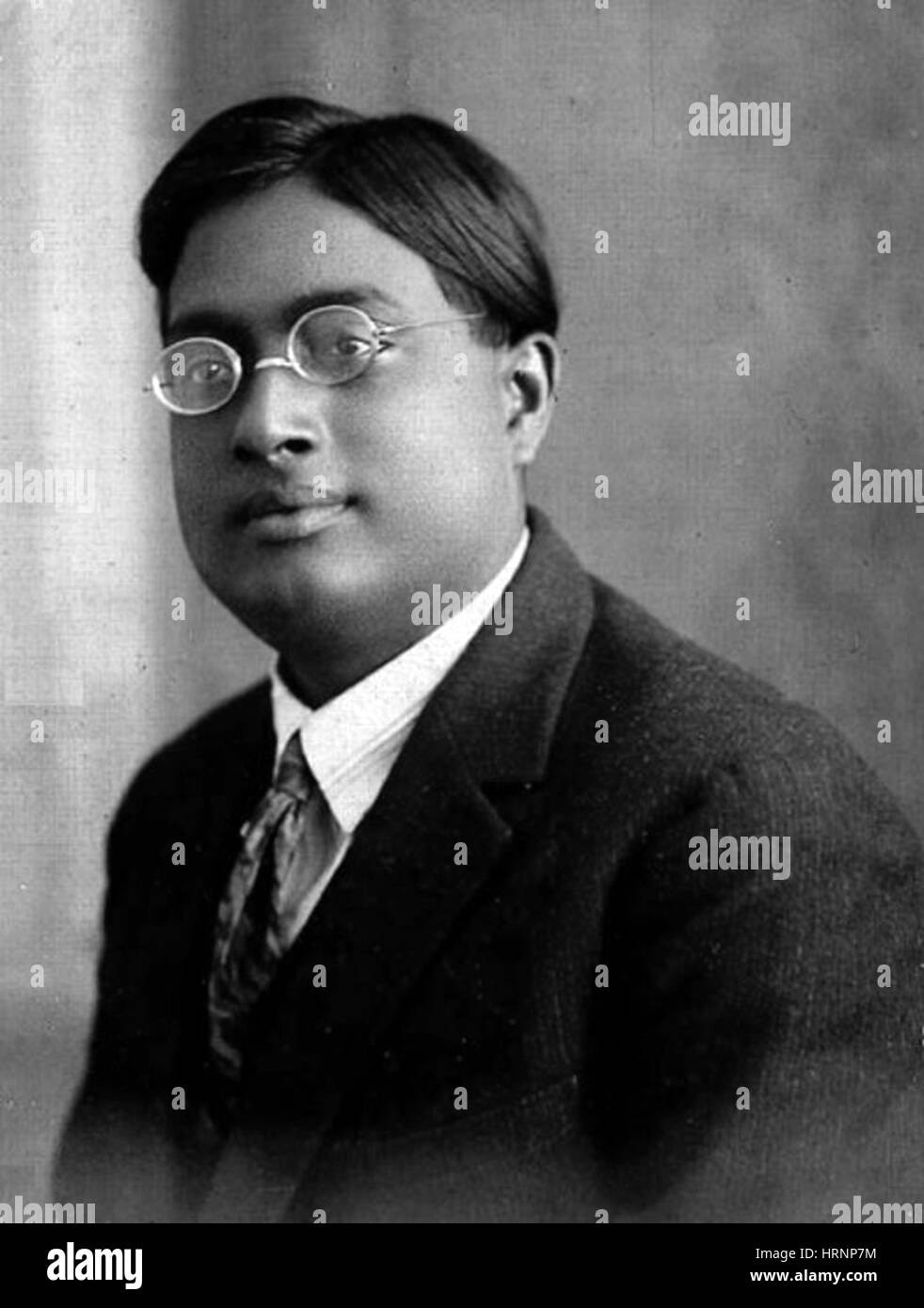
Satyendra Nath Bose
 India
IndiaDate de naissance
January 1, 1894
Signe astrologique
Capricorn
Lieu de naissance
Kolkata, India
Âge
Décédé(e) à 80 ans
À propos
Satyendra Nath Bose was an Indian theoretical physicist and mathematician whose work in the early 1920s reshaped quantum mechanics. He developed Bose-Einstein statistics, a framework that describes how particles like photons behave, and laid the groundwork for the Bose-Einstein condensate, a state of matter observed at near-absolute-zero temperatures. Physicist Paul Dirac named the class of particles that follow these rules bosons in his honor.
Bose was elected a Fellow of the Royal Society and received the Padma Vibhushan, India's second-highest civilian award, in 1954. A polymath with interests spanning physics, mathematics, chemistry, biology, philosophy, and music, he also served on national research committees after India's independence. He died on February 4, 1974, in Kolkata, leaving a legacy that continues to influence modern physics.
Jeunesse et origines
Satyendra Nath Bose est né le 1er janvier 1894 à Calcutta, l'aîné de sept enfants. Son père, Surendranath Bose, travaillait comme comptable pour le chemin de fer de l'Inde orientale avant de fonder sa propre entreprise chimique et pharmaceutique. Sa mère, Amodini Devi, gérait un foyer de classe moyenne qui valorisait l'éducation anglaise.
Le génie de Bose s'est manifesté très tôt. À l'école hindoue de Calcutta, son professeur de mathématiques Upendralal Bakshi a reconnu son génie. Bose a un jour obtenu 110 sur 100 à un examen de mathématiques en résolvant les problèmes par plusieurs méthodes. Il a réussi son examen d'entrée en 1909, se classant cinquième parmi tous les candidats. Au Presidency College de Calcutta, il a obtenu un baccalauréat ès sciences en mathématiques mixtes en 1913, sortant premier de sa classe. Il a poursuivi à l'Université de Calcutta, où ses notes à l'examen de maîtrise ès sciences en mathématiques mixtes en 1915 ont établi un record qui a tenu pendant des années.
Après avoir terminé sa maîtrise, Bose a commencé ses recherches à l'Université de Calcutta en 1916, se concentrant sur la théorie de la relativité. Il a enseigné à l'Université de Dacca à partir de 1921, où il fera sa percée.
Évolution de carrière
En 1924, alors qu'il était maître de conférences à l'Université de Dacca, Bose a écrit un article intitulé Planck's Law and the Hypothesis of Light Quanta. Il a dérivé la loi quantique du rayonnement de Planck en utilisant une nouvelle méthode de comptage des états pour des particules identiques, les traitant comme indiscernables. Incapable de le faire publier, il a envoyé l'article à Albert Einstein, qui a reconnu son importance, l'a traduit en allemand et l'a soumis à la revue Zeitschrift für Physik. Ce travail est devenu le fondement de la statistique de Bose-Einstein.
Einstein a étendu les idées de Bose à la matière, prédisant le condensat de Bose-Einstein, un état de la matière confirmé expérimentalement en 1995. En 1926, Bose est devenu chef du département de physique de l'Université de Dacca. Il est retourné à l'Université de Calcutta en 1945, où il a enseigné et fait des recherches jusqu'à sa retraite en 1956. Il a également donné des cours de troisième cycle sur la relativité en bengali, promouvant l'éducation scientifique dans la langue locale.
Après l'indépendance de l'Inde, Bose a siégé dans divers comités nationaux de recherche et de développement. Il a été nommé au Rajya Sabha, la chambre haute du parlement indien, en 1958.
Chronologie de carrière
Image publique et style
Bose était largement considéré comme un génie humble et effacé. Il recherchait rarement le crédit pour son travail et était connu pour minimiser ses propres contributions. Ses collègues le décrivaient comme accessible et généreux de son temps. Il était un fervent défenseur de l'enseignement des sciences en bengali, estimant que la connaissance scientifique devait être accessible à tous. Son image en Inde est celle d'un héros national qui a mis la science indienne sur la carte mondiale, et il est commémoré comme un symbole de modestie intellectuelle et de dévouement.
Notoriété et fandom
Satyendra Nath Bose commands a global audience defined by academic reverence rather than popular celebrity, with his name recognized primarily within the scientific community and among history enthusiasts. The iFANN Global Fame Engine evaluated this figure in August 2026 and determined that Satyendra Nath Bose is currently unranked on the Global Top 1,000 list or any scope-specific top-100 charts, meaning no placement number applies to his current standing. While he remains a towering historical figure, he does not hold a specific ordinal position in the published rankings at this time. His legacy is sustained through institutional memory and the enduring study of quantum mechanics rather than modern fan metrics. Regarding his audience, there is no documented fandom name; the group of admirers consists of physicists, mathematicians, and students who engage with his work through academic channels rather than as an organized fanbase with a specific moniker. No rituals, campaigns, or social media movements are associated with him, reflecting his status as a scholar from a pre-celebrity era whose influence is measured in citations and scientific breakthroughs rather than public adulation.
Faits intéressants et légendes
Satyendra Nath Bose was a polymath with deep interests in chemistry, biology, mineralogy, philosophy, arts, literature, and music. He could recite poetry in multiple languages and played the violin. He was known for his humility and often said he did not consider himself a genius. Rabindranath Tagore dedicated his only science book, Visva-Parichay, to Bose in 1937. Bose also campaigned for Hindi to replace English as the language of science in India. A central pillar of his legend is the incident where he sent a paper on quantum statistics to Albert Einstein after facing rejection from European journals. Einstein recognized the brilliance of the work, translated it into German himself, and submitted it to Zeitschrift für Physik, an event that led to particles following these rules being named bosons. Another poignant story from his life involves his reaction to Einstein's death; accounts state that Bose was so shattered by grief that he tore up an unpublished research paper. This anecdote highlights the profound personal bond between the two scientists and serves as a narrative illustrating Bose's character and loyalty.
Citations notables
“I do not consider myself a genius. I only followed my curiosity.”
“Science should be taught in the language of the people.”
“The joy of discovery is the greatest reward.”
“Einstein's recognition of my work gave me the confidence to continue.”
“I never aimed for fame; I aimed for understanding.”
Famille et vie privée
Bose a épousé Ushabala Bose (également connue sous le nom d'Ushabati Ghosh) lors d'une cérémonie bengalie traditionnelle. Le couple a eu neuf enfants, bien que plusieurs soient morts en bas âge. Le père de Bose, Surendranath, était comptable avant de diriger une entreprise chimique. Sa mère, Amodini Devi, était femme au foyer. Bose a grandi dans un foyer de classe moyenne à Calcutta avec six frères et sœurs. Il était connu comme un homme de famille dévoué qui conciliait son travail scientifique et son temps à la maison.
Relations notables
Satyendra Nath Bose est étroitement associé à Albert Einstein, qui a soutenu son article de 1924 et co-développé la statistique de Bose-Einstein. Paul Dirac a inventé le terme 'bosons' pour décrire les particules obéissant à cette statistique. Rabindranath Tagore, un ami de la famille, a dédié son livre scientifique à Bose. Son professeur de mathématiques Upendralal Bakshi a reconnu son génie précoce, et Sir Asutosh Mookerjee, en tant que vice-chancelier de l'Université de Calcutta, a soutenu sa carrière de recherche.
Relations et vie amoureuse
Satyendra Nath Bose a épousé Ushabala Bose (également connue sous le nom d'Ushabati Ghosh) lors d'une cérémonie traditionnelle au début des années 1910. Le mariage a été un partenariat stable et solidaire. Ushabala gérait le foyer et élevait leurs neuf enfants pendant que Bose poursuivait sa carrière universitaire. Elle était décrite comme une épouse dévouée qui encourageait son travail scientifique. Bose est resté marié avec elle jusqu'à sa mort en 1974. Il n'existe aucun registre d'autres relations amoureuses.
- Marié(e)Ushabala Bose1914 - 1974Mariage traditionnel bengali ; elle a soutenu sa carrière et élevé leurs neuf enfants.
Décès et conséquences
Décès
February 4, 1974 (à 80 ans)
Lieu de décès
Calcutta, West Bengal, India
Cause du décès
Natural causes due to old age
Satyendra Nath Bose spent his final years in Calcutta, maintaining his academic interests and family life until the natural decline of advanced age took its toll. He passed away on February 4, 1974, within the city that had been his home for decades, marking the end of a life dedicated to theoretical physics and mathematics. The circumstances surrounding his death were reported as peaceful and natural, with no specific acute illness, accident, or foul play documented by authorities or biographical sources. His passing occurred without a public hospitalization immediately preceding the event, suggesting he died in a private setting consistent with the privacy norms for senior academics in India during that era.
The scientific community and government officials responded to his death with profound tributes rather than legal inquiries or investigations. While the funeral was conducted as a private affair following Hindu cremation rites, the legacy of the physicist was cemented through institutional memorials and continued recognition by the state. The Indian government established the Bose Institute in his honor, and his contributions remain celebrated annually on National Science Day. In recent decades, his name has appeared in educational materials and news regarding quantum physics breakthroughs, including references to the creation of Bose-Einstein condensates in the mid-2020s.
Posthumous honors included the naming of the subatomic particle boson after him and the enduring status of Bose-Einstein statistics as a foundational theory. A new book by his student Partha Ghose released around May 2024 highlighted their relationship and Bose's grief over Einstein's death, adding to the literary legacy. No major commercial films were produced solely about his death, though his name frequently appears in discussions of quantum mechanics.
Fortune (valeur de la succession)
$1 Million
Estimation de l’équipe éditoriale d’iFANN
As a theoretical physicist and academic, Satyendra Nath Bose did not accumulate significant personal wealth. Per iFANN's editorial analysis, his net worth at the time of his death in 1974 is estimated at $1 Million in 2026 terms, primarily consisting of his academic salary, modest savings, and a small pension. He lived a simple life, dedicating his resources to his family and research. Posthumously, his legacy has not generated substantial estate income, though his name is honored through institutions like the S. N. Bose National Centre for Basic Sciences.
Récompenses remportées (2)
Satyendra Nath Bose a reçu le Padma Vibhushan, la deuxième plus haute distinction civile de l'Inde, en 1954 pour ses contributions à la science. Il a été élu membre de la Royal Society en 1958, l'un des plus grands honneurs pour un scientifique. Il a également reçu des doctorats honorifiques de plusieurs universités, dont l'Université de Calcutta et l'Université de Dacca.
1954 · Prix civil
Science
1958 · Élection
Science
Connu pour
Bose–Einstein statistics
1924 · Developer
Bose–Einstein condensate
1925 · Co-theorist
Planck's Law derivation
1924 · Auteur
Boson particle naming
1925 · Namesake
Mots-clés
Sources
Faits clés
- Profession
- physicist, mathematician
- Né(e) le
- January 1, 1894
- Lieu de naissance
- Kolkata, India
- Décès
- February 4, 1974
- Lieu de décès
- Kolkata, India
- Genre
- Homme
- Conjoint
- Ushabala Bose
- Signe astrologique
- Capricorn
Informations personnelles
- Nom complet
- Satyendra Nath Bose
- Conjoint
- Ushabala Bose
- Enfants
- 9
- Formation
- B.Sc. in mixed mathematics, Presidency College, Calcutta (1913); M.Sc. in mixed mathematics, University of Calcutta (1915)
Questions fréquentes
Qui était Satyendra Nath Bose ?
Pour quoi Satyendra Nath Bose est-il célèbre ?
Quelle est la fortune de Satyendra Nath Bose en 2026 ?
Satyendra Nath Bose a-t-il remporté un prix Nobel ?
Quels prix Satyendra Nath Bose a-t-il reçus ?
Personnalités similaires
Rejoindre la communauté
fans en discussion