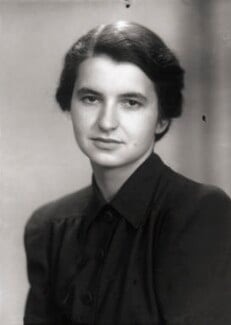
Rosalind Franklin
 United Kingdom
chemist•molecular biologist•physicist
Date de naissance
July 25, 1920
Signe astrologique
Leo
Lieu de naissance
Notting Hill, London, England
Âge
Décédé(e) à 37 ans
Taille
5 ft 6 in (168 cm)
À propos
Rosalind Elsie Franklin était une chimiste et cristallographe aux rayons X anglaise. Ses images de diffraction des rayons X de l'ADN, notamment la Photo 51, furent essentielles à la découverte de la structure en double hélice. Elle apporta également des contributions majeures à la compréhension du charbon, du graphite et des virus. Bien que son travail ait été utilisé sans son consentement par Watson et Crick, elle reste une figure imposante de la biologie moléculaire, célébrée à titre posthume comme un symbole d'intégrité scientifique et des contributions négligées des femmes dans la science.
Jeunesse et origines
Franklin est née le 25 juillet 1920 à Notting Hill, Londres, dans une famille anglo-juive aisée. Son père, Ellis Arthur Franklin, était banquier d'affaires, et sa mère, Muriel Frances Waley, femme au foyer. Elle fréquenta la St. Paul's Girls' School, où elle excella en sciences, en latin et en sport. À 15 ans, elle décida de devenir scientifique et réussit l'examen d'entrée à l'Université de Cambridge en 1938. Elle étudia le Natural Sciences Tripos au Newnham College, obtenant son diplôme en 1941.
Pendant la Seconde Guerre mondiale, au lieu de poursuivre un doctorat immédiatement, elle travailla pour la British Coal Utilisation Research Association à partir de 1942. Ses recherches sur la porosité du charbon et la densité du carbone furent très pratiques et lui valurent un doctorat en chimie physique de Cambridge en 1945. Un moment charnière survint en 1947 lorsqu'elle déménagea à Paris pour travailler au Laboratoire Central des Services Chimiques de l'État sous la direction du cristallographe Jacques Mering. Là, elle maîtrisa la cristallographie aux rayons X, apprenant à travailler avec des tubes à rayons X à haute résolution et à foyer fin, une compétence que peu de scientifiques possédaient.
Évolution de carrière
En 1951, Franklin rejoignit le King's College London en tant que chercheuse associée au MRC Biophysics Unit, chargée d'étudier la structure de l'ADN. Elle et son étudiant diplômé Raymond Gosling produisirent des images de diffraction des rayons X de l'ADN de plus en plus nettes. En mai 1952, elle captura la Photo 51, une image haute résolution de la forme B de l'ADN montrant clairement un motif croisé en hélice. En raison de conflits avec son collègue Maurice Wilkins et le directeur John Randall, elle fut transférée au Birkbeck College en 1953.
Sans sa connaissance ni son consentement, Wilkins montra la Photo 51 à James Watson. Watson et Francis Crick utilisèrent ces données pour construire leur modèle correct de la double hélice, publié en avril 1953. Les propres données de Franklin sur l'ADN furent publiées dans le même numéro de Nature en tant qu'article de soutien. À Birkbeck, sous la direction de J.D. Bernal, elle dirigea un groupe pionnier étudiant le virus de la mosaïque du tabac et d'autres virus végétaux. Elle découvrit que l'ARN du VMT était un simple brin intégré dans une hélice protéique creuse, une découverte marquante en virologie structurale.
Chronologie de carrière
Image publique et style
Franklin est souvent dépeinte comme un génie tragique, brillant et sous-estimé. C'est une icône féministe et un symbole d'intégrité scientifique. Son caractère direct, parfois conflictuel, a aliéné certains collègues masculins. Les représentations médiatiques mettent l'accent sur le récit de l'héroïne lésée. Elle n'a pas de nom de fandom officiel mais est célébrée par les passionnés de sciences et les féministes. Sa présence en ligne est éducative et respectueuse, corrigeant souvent l'injustice historique.
Notoriété et fandom
Rosalind Franklin currently holds no placement in the iFANN Global Top 1,000 or any scope-specific ranking list. The iFANN Global Fame Engine evaluated her standing in August 2026 and determined she remains unranked among the world's most famous figures. She is a towering historical figure rather than a contemporary celebrity. Her admirers do not organize under a single moniker like a pop star fanbase; there is no formal name for those who revere her legacy. Instead, her audience consists of scientists, historians, and advocates for gender equity in STEM who view her as a symbol of integrity. Institutional recognition drives her modern presence more than grassroots fandom. Major entities like Rosalind Franklin University of Medicine and Science continue to award grants and incubate research in her name. The ExoMars Rosalind Franklin rover represents a massive global collaboration honoring her work, with engineering milestones reached in 2026 serving as contemporary tributes. These projects are scientific missions rather than fan campaigns. No birthday billboards or subway ads funded by fans exist because she passed away in 1958 before such rituals could form. Her story is retold through academic publications and educational efforts correcting historical narratives. While she lacks the viral moments of entertainers, her influence permeates molecular biology and space exploration. The community surrounding her focuses on preserving her contributions to DNA structure and coal chemistry. This dedication manifests in annual awards and the ongoing preparation of planetary rovers bearing her name.
Faits intéressants et légendes
Franklin was a passionate mountaineer and hiker who trekked extensively in the Alps and Norway. A skilled photographer, she took many of her own X-ray diffraction images herself. Her work on coal during World War II was critical to improving gas masks. The term Photo 51 was simply the 51st photograph in a series; she did not name it. She spoke fluent French and German and was a lifelong agnostic despite her family's Jewish background. A central legend surrounds the 'raw deal' she received regarding the double helix. The widely retold story claims that James Watson and Francis Crick viewed her X-ray image without permission, allowing them to finalize their model while she was denied credit for the crucial evidence. Verified facts confirm she died at age 37 from ovarian cancer, likely caused by radiation exposure during her crystallography work. In modern times, the naming of the ExoMars Rosalind Franklin rover has become an iconic moment for her legacy. Scheduled to launch in 2028, this mission marks the first major planetary probe dedicated to searching for signs of life under the Martian surface.
Citations notables
“Science and everyday life cannot and should not be separated.”
“I have no doubt that the facts of the structure of DNA are going to be known very soon.”
“I was told that my data was being used by Watson and Crick without my knowledge. I was furious.”
“There is no such thing as a 'female scientist.' You are a scientist, or you are not.”
Famille et vie privée
Franklin était le deuxième de cinq enfants d'Ellis Arthur Franklin, banquier d'affaires, et de Muriel Frances Waley. Sa famille était profondément impliquée dans des œuvres caritatives. Elle ne s'est jamais mariée et n'a pas eu d'enfants. Sa succession est gérée par le Franklin Family Trust, qui soutient des associations caritatives scientifiques et éducatives.
Relations notables
Maurice Wilkins était un collègue du King's College qui a montré sa Photo 51 à Watson. James Watson et Francis Crick ont utilisé ses données sans autorisation pour découvrir la double hélice de l'ADN. Raymond Gosling était son doctorant qui a pris la Photo 51 sous sa direction. John Desmond Bernal était son patron bienveillant à Birkbeck. Aaron Klug a poursuivi ses travaux sur les virus et a remporté un prix Nobel. Jacques Mering était son mentor à Paris qui lui a enseigné la cristallographie aux rayons X.
Relations et vie amoureuse
Franklin ne s'est jamais mariée et n'a eu aucune relation amoureuse connue publiquement. Sa vie personnelle était intensément dédiée à sa recherche. Les biographes et les lettres indiquent des amitiés proches avec des collègues mais aucune preuve de partenariats romantiques. Elle était connue pour être discrète et réservée.
Décès et conséquences
Décès
April 16, 1958 (à 37 ans)
Lieu de décès
London, England
Cause du décès
Ovarian cancer
The official medical certification recorded Rosalind Franklin's death as ovarian cancer, a diagnosis she had received in 1956. She passed away on April 16, 1958, at the age of 37 in London, England, while managing her illness alongside an active research schedule during her final two years. While historical accounts have occasionally speculated about radiation exposure from her X-ray crystallography work contributing to her condition, this remains a disputed and largely unconfirmed theory; medical consensus attributes her passing to the progression of the cancer itself. Her funeral was a private affair held shortly after her death in April 1958.
She was cremated, and her ashes were interred at Golders Green Crematorium in London. Initial tributes from peers within the scientific community recognized her expertise in X-ray crystallography and biophysics, though widespread public acclaim and the modern narrative of her as a marginalized pioneer emerged decades later. The primary controversy surrounding her legacy relates not to her death, but to the unauthorized use of her Photo 51 by Maurice Wilkins and James Watson prior to her passing. This issue resulted in significant academic criticism and later recognition of her contribution rather than any posthumous litigation regarding her estate or cause of death.
Posthumously, Franklin has received extensive honors, including induction into the National Women's Hall of Fame and the naming of the Rosalind Franklin University of Medicine and Science in North Chicago. A Mars rover named Rosalind Franklin is scheduled for launch in 2028 as part of the European Space Agency's ExoMars mission, and her estate was handled privately by her family without public details on its administration.
Fortune (valeur de la succession)
$100,000
Estimation de l’équipe éditoriale d’iFANN
Franklin died in 1958 with a modest estate valued at less than £10,000. She came from a wealthy family and lived frugally. Her estate, managed by the Franklin Family Trust, supports scientific and educational charities. Posthumous income from book royalties, documentary licensing, and image rights is minimal and donated. Per iFANN's editorial analysis, the estate's net worth as of 2026 is estimated at $100,000, consisting of residual royalties and image rights.
Prix et distinctions
View 16 records, honours and achievementsConnu pour
Photo 51
1952 · X-ray crystallographer
Discovery of DNA double helix structure
1953 · Contributor (data used without consent)
Tobacco mosaic virus structure
1955 · Lead researcher
Mots-clés
Faits clés
- Profession
- chemist, molecular biologist, physicist
- Né(e) le
- +1920-07-25
- Lieu de naissance
- Notting Hill, London, England
- Décès
- +1958-04-16
- Lieu de décès
- Chelsea, London, England
- Genre
- Femme
- Signe astrologique
- Leo
Informations personnelles
- Nom complet
- Rosalind Elsie Franklin
- Taille
- 5 ft 6 in (168 cm)
- Formation
- Newnham College, Cambridge (BA, 1941); University of Cambridge (PhD, 1945)
Questions fréquentes
Pourquoi Rosalind Franklin n'a-t-elle pas gagné un prix Nobel ?
Watson et Crick ont-ils volé les données de Rosalind Franklin ?
Rosalind Franklin a-t-elle eu des enfants ?
Quelle est la découverte la plus célèbre de Rosalind Franklin ?
Rosalind Franklin est-elle une icône féministe ?
Personnalités similaires
Rejoindre la communauté
fans en discussion