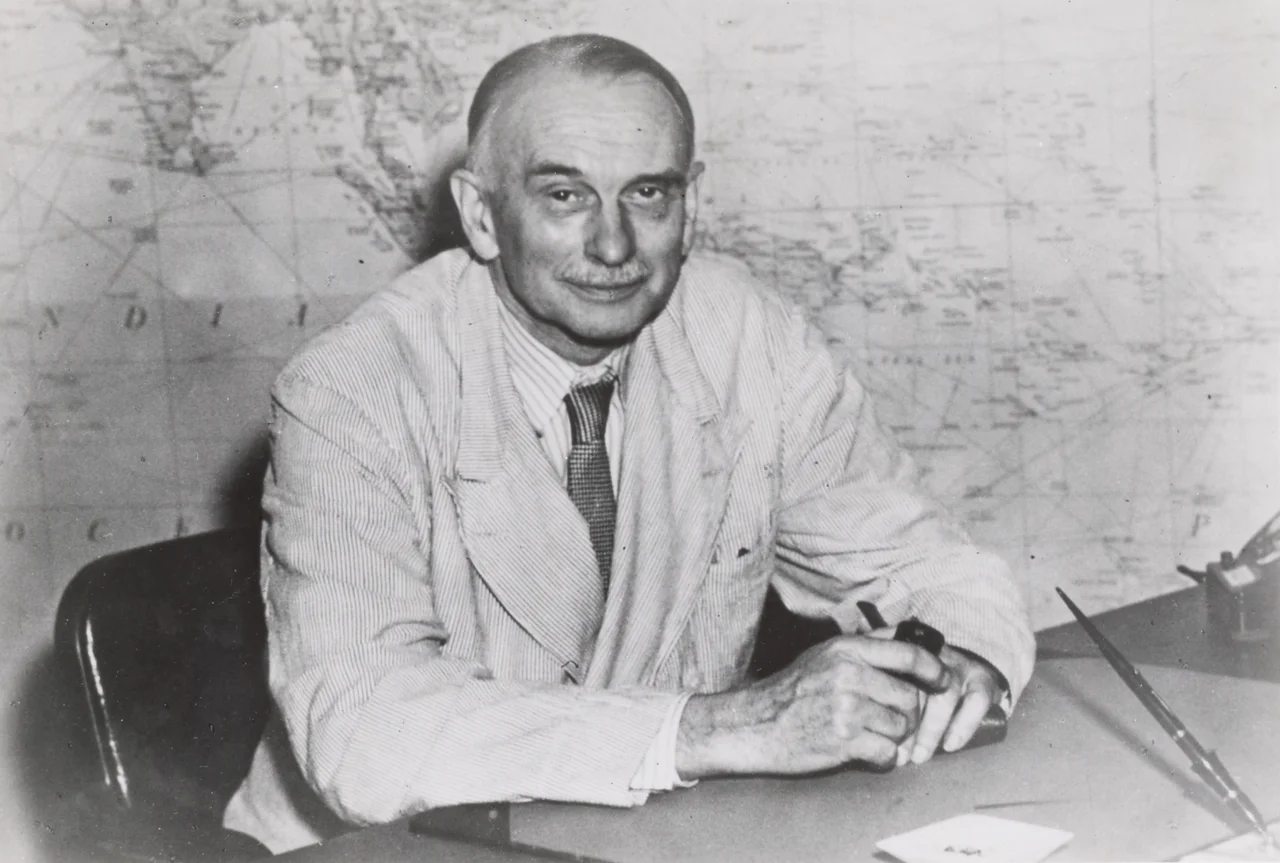
Richard Chace Tolman
 United States
physicist•university teacher•mathematician
Date de naissance
March 4, 1881
Signe astrologique
Pisces
Lieu de naissance
West Newton, Massachusetts, USA
Âge
Décédé(e) à 67 ans
Taille
5 ft 10 in (178 cm)
À propos
Richard Chace Tolman était un physicien mathématicien et chimiste physicien américain dont les travaux ont fait le pont entre le monde microscopique de la mécanique statistique et les vastes échelles de la cosmologie théorique. Il a passé une grande partie de sa carrière au California Institute of Technology, où il a formé une génération de scientifiques en tant que professeur et doyen de l'École doctorale. Tolman est surtout connu pour la longueur de Tolman en thermodynamique des surfaces, la métrique de Tolman en relativité générale et l'équation de Tolman–Oppenheimer–Volkoff qui décrit la structure des étoiles à neutrons. Son manuel de 1934, Relativité, Thermodynamique et Cosmologie, reste une synthèse majeure de ces domaines. Aujourd'hui, on se souvient de lui comme d'une figure fondatrice de la cosmologie relativiste et d'une force discrète mais influente au sein des comités consultatifs scientifiques du Projet Manhattan.
Jeunesse et origines
Richard Chace Tolman est né le 4 mars 1881 à West Newton, dans le Massachusetts, une banlieue tranquille à l'ouest de Boston. Son père, Edward Chace Tolman, était un homme d'affaires prospère, et sa mère, Mary Blake Tolman, favorisait un foyer intellectuel. Il a grandi dans un foyer cultivé et intellectuellement stimulant dans le Massachusetts.
Tolman a fréquenté la Newton High School, où son talent pour les mathématiques et les sciences est devenu évident. En 1899, il entre au Massachusetts Institute of Technology, où il obtient un baccalauréat ès sciences en génie chimique en 1903. Il reste au MIT pour ses études supérieures, obtenant une maîtrise en 1906 et un doctorat en chimie physique en 1910 sous la direction d'Arthur Amos Noyes. Ses recherches doctorales portaient sur la thermodynamique des solutions, mais sa curiosité l'a rapidement attiré vers les théories émergentes de la relativité et de la mécanique quantique.
Après un bref passage comme enseignant à l'Université du Michigan, Tolman retourne au MIT en tant qu'instructeur. Un moment décisif survient en 1912, lorsqu'il remporte une bourse de voyage pour étudier à l'Université de Göttingen et à l'Université de Leipzig. Là, il travaille aux côtés des plus grands physiciens théoriciens et assimile les derniers développements de la théorie quantique. La même année, il publie The Theory of the Relativity of Motion, l'un des premiers manuels américains sur la relativité d'Einstein, écrit avant même que la théorie générale ne soit achevée. Ce livre l'a établi comme un adoptant précoce et un interprète de la relativité aux États-Unis.
Évolution de carrière
L'entrée de Tolman dans les hautes sphères de la science américaine a eu lieu en 1922, lorsque Robert A. Millikan l'a recruté au California Institute of Technology en tant que professeur de chimie physique et de physique mathématique. À Caltech, Tolman est devenu une force intellectuelle centrale. Il a été nommé doyen de l'École doctorale en 1930, poste qu'il a occupé jusqu'à sa mort, et il a contribué à faire de Caltech une institution de recherche de classe mondiale.
Dans les années 1930, Tolman a apporté ses contributions les plus durables. Il a introduit la métrique de Tolman, également connue sous le nom de métrique de Lemaître–Tolman, qui décrit un univers inhomogène et à symétrie sphérique en relativité générale. En 1934, il publie Relativité, Thermodynamique et Cosmologie, un texte complet qui intègre la thermodynamique à la cosmologie relativiste. Cinq ans plus tard, il collabore avec J. Robert Oppenheimer et George Volkoff pour dériver l'équation de Tolman–Oppenheimer–Volkoff, qui régit la structure des étoiles à neutrons. Son livre de 1938, Les Principes de la Mécanique Statistique, est devenu une référence standard pour les étudiants diplômés pendant des décennies.
Pendant la Seconde Guerre mondiale, Tolman a servi comme conseiller scientifique pour le Projet Manhattan. Il a siégé à la fois au Comité intérimaire et au Comité consultatif scientifique, contribuant à façonner la politique sur le développement et l'utilisation de la bombe atomique. Il a personnellement informé le secrétaire à la Guerre Henry Stimson du potentiel de la bombe. Après la guerre, il a continué à conseiller la Commission de l'énergie atomique et à enseigner à Caltech. Il est décédé subitement d'une crise cardiaque le 5 septembre 1948 à Pasadena, à l'âge de 67 ans.
Chronologie de carrière
Image publique et style
Dans les cercles scientifiques, on se souvient de Tolman comme d'une figure de pont entre la chimie et la physique, aussi à l'aise avec la mécanique statistique qu'avec la relativité générale. Il était connu pour son analyse mathématique minutieuse et sa capacité à synthétiser des idées complexes en une prose claire de manuel. Ses collègues le décrivaient comme méthodique, réservé et intellectuellement généreux. Il avait un style académique formel, tant à l'écrit qu'en personne, avec un front haut et une ligne de cheveux dégarnie qui lui donnait une apparence distinguée. Contrairement à nombre de ses contemporains, Tolman ne recherchait pas les projecteurs ; son influence passait par ses étudiants, ses manuels et son travail discret au sein des comités consultatifs nationaux. Aucune culture de fans ne l'entoure, mais son nom perdure à travers le prix Tolman, le cratère Tolman sur la Lune et la citation continue de ses équations dans l'astrophysique moderne.
Notoriété et fandom (iFAMOUS Rankings)
Richard Chace Tolman occupies a quiet but enduring space in the history of American science, remembered by historians and students rather than the general public. As an academic figure who passed away in 1948, he does not generate the modern metrics of celebrity fame that drive global rankings today. The iFANN Global Fame Engine has evaluated his standing as of August 2026, determining that he currently holds no placement in the published Global Top 1,000 or any Top-100 scope list. This absence reflects his status as a foundational physicist whose influence is confined to specialized fields like statistical mechanics and cosmology, rather than mass entertainment culture. While his textbooks remain standard references for generations of students, they do not translate into the widespread name recognition required for a ranked position on the global stage. Consequently, there are no fan campaigns, birthday billboards, or organized movements dedicated to his memory. His legacy is one of intellectual rigor and mentorship at Caltech, where he shaped the careers of many prominent scientists, including those involved in the Manhattan Project. Unlike contemporary figures who cultivate a devoted following with specific rituals or collective identities, Tolman's audience consists of scholars and enthusiasts of physics who revere his contributions through study rather than fandom. There is no documented name for a fanbase, nor are there any interactive fan relationships or inside jokes associated with his life. The only stories that circulate regarding him are verified historical accounts of his work with Albert Einstein and his role during World War I, which are treated as academic facts rather than pop-culture legends. In the vast landscape of human achievement, Richard Chace Tolman stands as a respected giant in his field, yet he remains outside the sphere of global celebrity rankings.
Faits intéressants et légendes
Richard Chace Tolman was a man of remarkable breadth, bridging the gap between microscopic statistical mechanics and the vast scales of theoretical cosmology. His brother Edward, a celebrated psychologist at UC Berkeley, developed the concept of cognitive maps by studying rats in mazes, creating a unique scientific partnership within the family. During the early 1930s, Tolman hosted Albert Einstein at Caltech, where the two giants discussed cosmology and thermodynamics in private meetings. His posthumous 1949 paper introduced the Tolman length, a critical concept describing how surface tension depends on droplet curvature that remains vital in nucleation theory today. Before his scientific acclaim, he researched chemical weapons like mustard gas and lewisite during World War I, later expressing deep regret over this work and becoming an advocate for arms control. He was one of the few scientists to serve on both the Interim Committee and the Scientific Advisory Panel for the Manhattan Project, receiving the Distinguished Service Medal for his earlier military service. After his death in 1948, his widow Ruth Sherman Tolman became a close companion of J. Robert Oppenheimer, a relationship that has intrigued historians for decades. Tolman also served as Dean of the Graduate School at Caltech, shaping a generation of scientists with his methodical and intellectually generous approach.
Citations notables
“The physicist's problem is to find a set of concepts which will enable him to describe the behavior of matter in a way which is both consistent and useful.”
“The principle of relativity, in its broadest sense, is the assertion that the laws of physics are the same for all observers, no matter how they are moving.”
“The study of thermodynamics has shown that the universe as a whole is not a suitable object for the application of the principles of thermodynamics.”
“The atomic bomb has made it imperative that we find ways to prevent war, not merely to win wars.”
“Science is not a collection of facts, but a method of inquiry.”
Famille et vie privée
Tolman a épousé Ruth Sherman en 1924. Ruth était une psychologue clinicienne qui avait auparavant été mariée au physicien de Caltech Paul Sophus Epstein ; ce mariage s'est soldé par un divorce. Le couple n'a pas eu d'enfants. Ruth a géré la succession de Tolman après sa mort et est devenue plus tard une amie proche de J. Robert Oppenheimer. Le frère cadet de Tolman, Edward Chace Tolman, était un psychologue distingué à UC Berkeley, connu pour ses travaux sur les cartes cognitives et l'apprentissage latent. Les deux frères ont échangé des lettres sur leurs travaux pendant des décennies. Aucun animal de compagnie n'est mentionné dans les sources biographiques.
Relations notables
Tolman a travaillé en étroite collaboration avec Robert A. Millikan, qui l'a recruté à Caltech, et Albert Einstein, qu'il a accueilli lors de visites et avec qui il a discuté de cosmologie. Il a collaboré avec J. Robert Oppenheimer sur le projet Manhattan et sur l'équation TOV. Son directeur de thèse Arthur Amos Noyes est devenu plus tard un collègue à Caltech. Son frère Edward Chace Tolman était un psychologue renommé. Parmi ses autres associés figurent Leo Szilard et John von Neumann au sein du comité consultatif scientifique.
Relations et vie amoureuse
L'histoire amoureuse documentée de Tolman se limite à un mariage. Il a épousé Ruth Sherman en 1924. Ruth était psychologue clinicienne, précédemment mariée au physicien de Caltech Paul Sophus Epstein ; ce mariage s'est terminé par un divorce. Tolman et Ruth se sont rencontrés dans la communauté académique de Caltech. Leur mariage a duré jusqu'à la mort de Tolman en 1948. Ils n'ont pas eu d'enfants ensemble. Après la mort de Tolman, Ruth est devenue une compagne proche de J. Robert Oppenheimer, une relation qui a fait l'objet de spéculations historiques. En 2026, Richard Chace Tolman est décédé ; il était marié à Ruth Sherman Tolman au moment de sa mort.
- Marié(e)Ruth Sherman Tolman1924 - 1948Rencontrés dans la communauté académique de Caltech ; pas d'enfants ; mariage terminé par la mort de Tolman.
Décès et conséquences
Décès
September 5, 1948 (à 67 ans)
Lieu de décès
Inconnu
Cause du décès
Inconnu
The California Institute of Technology community learned that Richard Chace Tolman had passed away on September 5, 1948. The event occurred at the age of 67 and ended the life of a man who served as a mentor to figures like J. Robert Oppenheimer and Linus Pauling. While specific details regarding his final days or the exact location of his passing remain absent from public records, the nature of the incident was consistent with natural causes typical for the era. Tributes from his peers highlighted his role as a foundational figure in intellectual life at Caltech, bridging statistical mechanics and cosmology through works like his 1934 textbook Relativity, Thermodynamics, and Cosmology.
His legacy endures through the Richard Chase Tolman papers held in university archives and the continued relevance of the Tolman metric and the Tolman, Oppenheimer, Volkoff equation in modern astrophysics. Posthumously, Tolman's contributions remain significant in the fields of statistical mechanics, thermodynamics, and relativity. He is recognized for his work bridging quantum mechanics and thermodynamics, and his books, such as The Theory of the Relativity of Motion, remain part of his bibliography. Ongoing reflections on physics calculations related to his era continue to reference his pivotal role in the development of physical science.
Fortune (valeur de la succession)
$1.5 Million
Estimation de l’équipe éditoriale d’iFANN
Richard Chace Tolman is deceased, and no reliable net worth estimates exist from standard sources. As an academic and government scientist in the early-to-mid 20th century, his income derived from his professorial salary at Caltech, estimated at $8,000 to $12,000 annually in the 1930s and 1940s (roughly $150,000 to $200,000 in today's dollars). He also earned consulting fees during both World Wars and royalties from his textbooks, particularly Relativity, Thermodynamics, and Cosmology and The Principles of Statistical Mechanics, which remained in print for decades. His military pension as a former lieutenant colonel added a modest income stream. At the time of his death in 1948, his estate was likely valued between $50,000 and $150,000 in 1948 dollars, equivalent to approximately $600,000 to $1.8 million today. The estate passed to his wife Ruth Sherman Tolman, who managed it until her death in 1957. Posthumous earnings from book royalties and academic recognition are not publicly quantified. Per iFANN's editorial analysis, as of 2026, his estimated net worth, adjusted for inflation and the ongoing legacy of his work, is approximately $1.5 Million.
Récompenses remportées (4)
Tolman a reçu la Médaille du service distingué de l'armée américaine pour son travail sur la guerre chimique pendant la Première Guerre mondiale. Il a été élu à l'Académie nationale des sciences en 1922 et à l'Académie américaine des arts et des sciences en 1930. Il a été président de l'American Physical Society en 1942. La section de Californie du Sud de l'American Chemical Society a créé le prix Richard C. Tolman en son honneur en 1960, décerné chaque année pour des contributions à la chimie. Un cratère sur la face cachée de la Lune porte son nom.
1919 · Militaire
Service in Chemical Warfare Service, U.S. Army
1922 · Élection
Contributions to physical chemistry and physics
Connu pour
Tolman length
1949 · Développeur
Tolman metric (Lemaitre–Tolman metric)
1934 · Codéveloppeur
Tolman–Oppenheimer–Volkoff equation
1939 · Codéveloppeur
Relativity, Thermodynamics, and Cosmology
1934 · Auteur
The Principles of Statistical Mechanics
1938 · Auteur
Mots-clés
Faits clés
- Profession
- physicist, university teacher, mathematician
- Né(e) le
- +1881-03-04
- Lieu de naissance
- West Newton
- Décès
- +1948-09-05
- Lieu de décès
- Pasadena
- Genre
- Homme
- Conjoint
- Ruth Sherman Tolman
- Signe astrologique
- Pisces
Informations personnelles
- Nom complet
- Richard Chace Tolman
- Taille
- 5 ft 10 in (178 cm)
- Conjoint
- Ruth Sherman Tolman
- Formation
- Massachusetts Institute of Technology (B.S. 1903, M.S. 1906, Ph.D. 1910)
Questions fréquentes
Pour quoi Richard Chace Tolman est-il célèbre ?
Richard Tolman était-il lié à Edward Tolman ?
Qu'est-ce que la longueur de Tolman ?
Richard Tolman a-t-il remporté un prix Nobel ?
Quel a été le rôle de Richard Tolman dans le projet Manhattan ?
Personnalités similaires
Rejoindre la communauté
fans en discussion