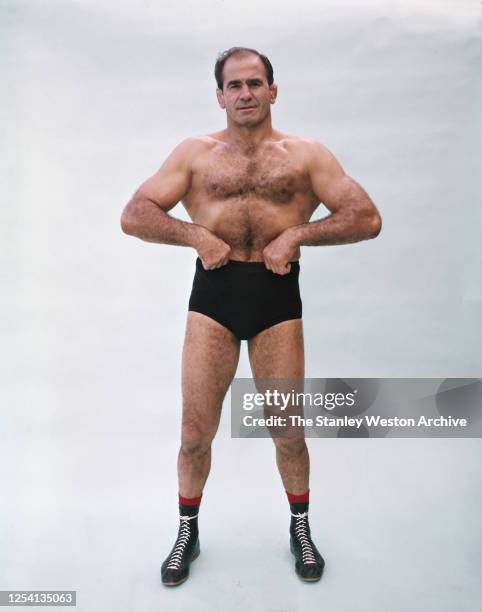
Lou Thesz
 United States
Also known as: Aloysius Martin Thesz, Tetsujin, God of Wrestling
Date de naissance
April 24, 1916
Signe astrologique
Taurus
Lieu de naissance
Banat, Michigan, USA
Âge
Décédé(e) à 86 ans
Taille
6 ft 0 in (183 cm)
À propos
Lou Thesz était un catcheur et entraîneur américain, largement considéré comme l'un des plus grands catcheurs de l'histoire et le dernier champion du monde universellement reconnu. Né Aloysius Martin Thesz le 24 avril 1916 à Banat, Michigan, il a dominé le sport pendant des décennies avec un style technique basé sur les soumissions, ancré dans le catch wrestling. Thesz a remporté le NWA World Heavyweight Championship à trois reprises, le détenant pendant un total de 3 749 jours — plus longtemps que quiconque. Connu comme un véritable « shooter », il pouvait légitimement vaincre ses adversaires si un match devenait réel. Au Japon, il était vénéré comme le « Dieu du Catch » et « Tetsujin » (Ironman) pour sa condition physique et son talent. Thesz a également formé des générations de catcheurs japonais et d'arts martiaux mixtes aux côtés de Karl Gotch et Billy Robinson. Il a été intronisé dans plusieurs halls of fame, dont la classe inaugurale du George Tragos/Lou Thesz Professional Wrestling Hall of Fame, qu'il a contribué à fonder. Les fans et les historiens le célèbrent comme l'étalon-or du catch professionnel.
Jeunesse et origines
Lou Thesz a grandi à St. Louis, Missouri, où son père Martin, un immigrant allemand et ancien catcheur compétitif, a commencé à l'entraîner à l'âge de six ans. Martin était strict et discipliné, croyant que le catch était un chemin vers une vie meilleure. Lou a fréquenté les écoles publiques de St. Louis mais a quitté l'éducation formelle tôt pour se concentrer sur le catch. Adolescent, il a remporté le championnat amateur de catch YMCA et, à 16 ans, le championnat amateur de l'État du Missouri dans la catégorie des 175 livres. Cette victoire a attiré l'attention des promoteurs. Il s'est ensuite entraîné au St. Louis Wrestling Club sous la direction de Tom Packs, apprenant les ficelles du catch professionnel et perfectionnant ses compétences de shooter légitime.
Évolution de carrière
Lou Thesz a fait ses débuts professionnels à l'âge de 16 ans à St. Louis en 1932. Il a remporté son premier titre majeur, le Missouri State Heavyweight Championship, en 1934. En 1936, il a décroché le AWA World Heavyweight Championship, son premier titre mondial. Un an plus tard, il a remporté le NWA World Heavyweight Championship, commençant son premier règne. Le deuxième règne NWA de Thesz a commencé en 1948 lorsqu'il a vaincu Orville Brown dans un match d'unification qui a consolidé plusieurs titres mondiaux. Il a détenu la ceinture en continu pendant 7 ans et 8 mois — l'un des règnes les plus longs de l'histoire. En 1952, il a défendu le titre contre la légende japonaise Rikidozan à Tokyo, un match qui a contribué à populariser le catch professionnel au Japon. Thesz a regagné le titre NWA pour une troisième et dernière fois en 1957, le détenant jusqu'en 1963 lorsqu'il l'a perdu contre Buddy Rogers. Il a continué à catcher internationalement jusque dans les années 1970, notamment au Japon, où il est devenu une icône culturelle. Il a ensuite été entraîneur en chef au CACC Snake Pit Japan, formant une nouvelle génération de catcheurs au catch wrestling.
Chronologie de carrière
Image publique et style
Lou Thesz était connu pour son look athlétique et soigné, et son air sérieux et sans chichis. Il portait des slips et des bottes de catch classiques, contrastant avec les personnages flamboyants apparus plus tard. Les médias et les fans le décrivent universellement comme un « shooter » — un catcheur légitime capable de se battre réellement. Ses matches étaient techniques, basés sur les soumissions et méthodiques, mettant l'accent sur les compétences de grappling réelles plutôt que sur le divertissement. Au Japon, il était vénéré comme le « Dieu du Catch » et « Tetsujin » (Ironman). Les fans de Thesz étudient souvent ses matches pour leurs connaissances techniques, et il est célébré dans les communautés de catch wrestling. Ses comptes de legacy sur les réseaux sociaux publient des photos historiques, des extraits de matches et des citations de son autobiographie, gardant sa mémoire vivante parmi les historiens du catch.
Notoriété et fandom
Lou Thesz remains the bedrock of professional wrestling history, a figure whose legacy is preserved not through viral social media campaigns or organized fan clubs, but through the enduring institutions he helped build. The wrestling community itself serves as his primary fandom, treating him as the ultimate standard of technical excellence and integrity. This reverence is institutionalized in the George Tragos/Lou Thesz Pro Wrestling Hall of Fame, established specifically to honor his name and induct new generations of talent, and the annual Lou Thesz Award presented by the Cauliflower Alley Club, which recognizes individuals who embody his character. From local honors in Waterloo, Iowa, to global recognition in the WWE Hall of Fame, his influence permeates every era of the sport. Fans do not chant his name with a specific slogan or gather for digital billboards; instead, they revere him as the last globally accepted world champion and the man who refused to compromise his legitimacy for entertainment. His story is one of quiet dominance, where the legend of being the only man who could legitimately defeat anyone in the ring cemented his status as the "God of Wrestling" in Japan and the gold standard in America. While modern stars chase fame, Thesz built a foundation that still supports the industry today. According to iFANN's Global Fame Engine evaluation conducted in August 2026, Lou Thesz does not currently hold a placement in the published rankings, including the Global Top 1,000 or any Top-100 scope list. Consequently, no specific ordinal rank or score is assigned to his current global standing.
Faits intéressants et légendes
The signature move known as the "Thesz Press," a running knee drop to a prone opponent, was named by fans rather than the wrestler himself. A strict teetotaler and non-smoker, Thesz maintained his legendary physique through daily training and once turned down lucrative offers to throw matches, preserving his integrity as a legitimate competitor. He wrestled his final match at age 74 in 1990, defeating a much younger opponent, and authored the classic autobiography "Hooker: An Authentic Wrestler's Adventures Inside the Bizarre World of Professional Wrestling." Beyond the ring, he helped train early mixed martial artists, including members of the original UFC and Pancrase organizations. A widely retold story from his career highlights his reputation as the undisputed "real" world heavyweight champion; legends claim that if Thesz felt disrespected, he would actually attack opponents, a narrative verified by his background as an amateur wrestler and his refusal to work matches unless necessary. Another persistent tale from his 1937 title win against Everett Marshall describes the moment he launched a career defined by dominance, often referenced as the beginning of the "Thesz Era." These stories are not mere folklore but historical facts that underscore his status as the greatest technician to ever grace the ring.
Citations notables
“I never threw a match in my life. If I was supposed to lose, I'd make the other guy earn it.”
“Wrestling is not a fake sport. It's a simulated sport. There's a difference. The moves are real. The athleticism is real. The only thing that's predetermined is the winner.”
“Thesz Press was just a knee drop. I didn't name it. The fans did. I just did what worked.”
“I trained every day of my life. When other wrestlers were drinking and carousing, I was in the gym. That's why I lasted so long.”
“The business changed. It became about entertainment, not wrestling. That's fine, but don't call it what I did.”
Famille et vie privée
Lou Thesz est né de Martin Thesz, un immigrant allemand et cordonnier qui avait été catcheur compétitif en Allemagne, et de sa femme. La famille a déménagé à St. Louis quand Lou était enfant. Il a épousé Dorothy Thesz en 1949, et ils sont restés ensemble jusqu'à sa mort en 2002. Ils ont eu deux enfants : un fils et une fille. Dorothy gérait de nombreux aspects de sa carrière et a contribué à préserver son héritage. Thesz était connu pour sa discipline et son régime d'entraînement rigoureux, des valeurs inculquées par son père. Il n'avait pas d'autres frères et sœurs mentionnés dans les archives publiques.
Relations notables
Lou Thesz a entraîné et travaillé avec de nombreuses figures légendaires. Karl Gotch et Billy Robinson étaient ses partenaires d'entraînement et ses collègues shooters, établissant ensemble le catch wrestling au Japon. Il a affronté Rikidozan dans un match historique en 1952 qui a fait de lui une légende au Japon. Thesz a vaincu Orville Brown dans un match d'unification en 1948 et a perdu le titre NWA contre Buddy Rogers en 1963. Il a été le mentor d'Antonio Inoki et Yoshiaki Fujiwara, qui sont devenus des icônes du catch japonais. Son premier promoteur était Tom Packs.
Relations et vie amoureuse
Lou Thesz s'est marié trois fois. Son premier mariage, vers 1940, s'est terminé par un divorce vers 1948 ; on sait peu de choses publiquement sur cette relation, et aucun enfant n'a été enregistré. En 1949, il a épousé Dorothy Thesz, qui est devenue sa compagne de toujours. Ils sont restés ensemble jusqu'à sa mort en 2002. Dorothy était sa compagne constante tout au long de sa carrière et des années suivantes, gérant de nombreux aspects de sa vie professionnelle et aidant à préserver son héritage. Ils ont eu deux enfants : un fils et une fille. Thesz était célèbre pour être très discret sur sa vie privée, et aucune autre relation très médiatisée, fiançailles ou rumeurs de couple n'est confirmée par des sources crédibles. En 2026, Thesz est décédé, et au moment de sa mort, il était marié à Dorothy.
- Marié(e)Unknown1940 - 1948Premier mariage ; on sait peu de choses publiquement. S'est terminé par un divorce.
- Marié(e)Dorothy Thesz1949 - 2002Relation la plus longue ; marié jusqu'à sa mort. A eu deux enfants ensemble. Dorothy a géré sa carrière et son héritage.
Décès et conséquences
Décès
April 28, 2002 (à 86 ans)
Lieu de décès
St. Joseph, Missouri, USA
Cause du décès
Natural causes due to old age
The wrestling world's reverence for Lou Thesz remains vivid, anchored by the annual Lou Thesz Award presented by the Cauliflower Alley Club and the ongoing inductions into the George Tragos/Lou Thesz Pro Wrestling Hall of Fame in Waterloo, Iowa. Recent tributes continue to highlight his impact, with Bret Hart scheduled to receive the award in June 2026, while lost footage of his legendary matches resurfaced in 2025 to remind new generations of his technical mastery. These honors cemented a legacy that outlasted his physical presence, ensuring his name remained central to discussions on professional wrestling history. Thesz passed away on April 28, 2002, at the age of 86 in St. Joseph, Missouri, the city where he had lived for much of his life and maintained significant influence over the sport.
While specific details about his immediate last public appearance or the medical events leading up to April 28 remain unreported, the community accepted the event without dispute. Public reaction was characterized by deep respect from peers and institutions alike, solidifying his status as one of the sport's most influential figures. The family kept funeral proceedings private, though his widow, Charlie Thesz, remained active in sharing his story well into the 2020s, noting their long marriage in interviews years after his passing. Posthumously, Thesz received numerous honors including inductions into the WWE Hall of Fame and the National Wrestling Hall of Fame, preserving his contributions for future athletes.
Fortune (valeur de la succession)
$2 Million
Estimation de l’équipe éditoriale d’iFANN
Updated for 2026, iFANN currently estimates Lou Thesz's estate value at $2 Million. During his career, he was one of the highest-paid wrestlers of his era, earning an estimated $100,000 to $200,000 annually at his peak in the 1950s, equivalent to $1-2 million today. His income came from match fees, promotional appearances, exhibitions, and training fees as head coach at the CACC Snake Pit Japan. Since his death in 2002, the estate has earned ongoing revenue from royalties on DVD releases and streaming of classic matches, licensing of his name and likeness for wrestling video games (such as the WWE 2K series), and merchandise like T-shirts and posters. The estate also earns from documentary and interview licensing. Thesz's intellectual property rights are managed by his children. The estate's income is modest but steady, driven by the nostalgia market for classic wrestling.
Récompenses remportées (5)
Lou Thesz a été intronisé dans plusieurs temples de la renommée, notamment la promotion inaugurale du George Tragos/Lou Thesz Professional Wrestling Hall of Fame en 1979, qu'il a contribué à fonder. Il a également été intronisé au WCW Hall of Fame (1993), au Wrestling Observer Newsletter Hall of Fame (1996), au Professional Wrestling Hall of Fame and Museum (2002) et au WWE Hall of Fame Legacy Wing (2016). Il a reçu des distinctions du Cauliflower Alley Club pour ses contributions à vie au catch.
1979 · Intronisation
Career
1993 · Intronisation
Career
Connu pour
NWA World Heavyweight Championship
1937 · Champion
NWA World Heavyweight Championship
1948 · Champion
NWA World Heavyweight Championship
1957 · Champion
Mots-clés
Faits clés
Informations personnelles
- Nom complet
- Aloysius Martin Thesz
- Taille
- 6 ft 0 in (183 cm)
- Conjoint
- Dorothy Thesz
- Enfants
- Two (son and daughter)
Questions fréquentes
Quelle était la fortune de Lou Thesz ?
Quel âge avait Lou Thesz à sa mort ?
Lou Thesz était-il un vrai combattant ?
Lou Thesz avait-il des enfants ?
À qui Lou Thesz a-t-il perdu son titre ?
Personnalités similaires
Rejoindre la communauté
fans en discussion