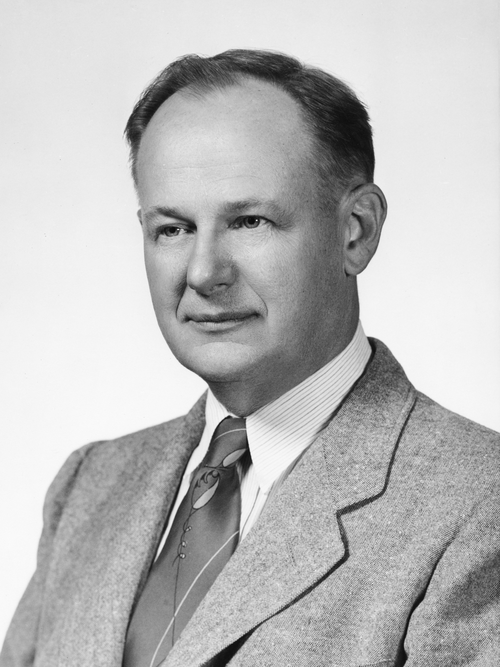
John G. Trump
 United States
electrical engineer•inventor•university teacher
Date de naissance
August 21, 1907
Signe astrologique
Leo
Lieu de naissance
The Bronx, New York, USA
Âge
Décédé(e) à 77 ans
Taille
5 ft 10 in (178 cm)
À propos
John G. Trump était un ingénieur électricien, inventeur et professeur au MIT. Il est réputé pour son travail pionnier en radiothérapie à haute tension contre le cancer, développant des générateurs Van de Graaff compacts qui ont contribué au traitement d'environ 10 000 patients. Ses contributions se sont étendues au développement de radars de guerre, où il a joué un rôle clé dans la création du laboratoire de radiations du MIT et l'organisation des déploiements radar pour le débarquement du Jour J. Après la guerre, il a cofondé la High Voltage Engineering Corporation (HVEC), devenue le plus grand fournisseur mondial d'accélérateurs de particules de recherche. Bien qu'il ait pris sa retraite du MIT en 1973, Trump est resté actif en tant que fiduciaire du Boston Museum of Science et président de la Lahey Clinic, recevant la National Medal of Science en 1983. On se souvient de lui pour son impact significatif sur la technologie médicale et la défense nationale.
Jeunesse et origines
John George Trump est né le 21 août 1907 dans le Bronx, New York, États-Unis. Il a grandi dans une famille germano-américaine prospère à Queens, New York, en tant que fils cadet de Frederick Trump, un immigrant allemand qui avait bâti une fortune considérable dans l'immobilier et l'hôtellerie. Ses premières années ont été marquées par la stabilité apportée par l'entreprise familiale, même après la mort de son père alors que John était adolescent. Dès son plus jeune âge, Trump a montré une grande aptitude pour les sciences et l'ingénierie, passant souvent sa jeunesse à bricoler divers appareils électriques, laissant présager la voie que prendrait sa future carrière.
Son parcours académique a commencé au Polytechnic Institute of Brooklyn, où il a obtenu un baccalauréat en génie électrique en 1929. Poursuivant ses études avancées, il a entrepris une maîtrise en physique à l'Université Columbia, qu'il a achevée en 1931. Trump s'est ensuite rendu au Massachusetts Institute of Technology (MIT), où il a commencé ses recherches doctorales. Là, il est devenu le premier étudiant au doctorat du physicien pionnier Robert J. Van de Graaff, une étape importante dans sa carrière académique. En 1933, il a obtenu son doctorat en génie électrique, sa thèse portant sur les générateurs électrostatiques à haute tension, un domaine spécialisé qui deviendrait l'axe central de sa vie professionnelle. Deux ans plus tard, en 1935, Trump a officiellement rejoint la faculté du MIT en tant que professeur assistant, commençant une association profonde de quatre décennies avec l'institut renommé. Ses premiers efforts de recherche au MIT ont été consacrés au perfectionnement et à l'amélioration des générateurs Van de Graaff, explorant leur potentiel pour des applications transformatrices dans les secteurs médical et industriel.
Évolution de carrière
La percée de Trump est survenue à la fin des années 1930 lorsqu'il a conçu des générateurs Van de Graaff compacts spécifiquement pour la radiothérapie du cancer. Il a dirigé le High Voltage Research Laboratory du MIT, où ces machines ont traité 10 000 patients et exploré d'autres applications comme la stérilisation médicale et la propulsion spatiale. Pendant la Seconde Guerre mondiale, il a été aide technique de Karl Compton au Comité de recherche sur la défense nationale, a contribué à la création du laboratoire de radiations du MIT, et en février 1944 s'est rendu en Angleterre pour diriger les opérations radar de terrain pour le débarquement du Jour J, recevant des éloges du président Truman et du roi George VI. En 1946, il a cofondé la High Voltage Engineering Corporation (HVEC) avec Van de Graaff et Denis Robinson. HVEC est devenue le plus grand fournisseur mondial d'accélérateurs de particules de recherche et a été cotée à la Bourse de New York. Trump a été président jusqu'à sa retraite du MIT en 1973. Il est resté actif en tant que fiduciaire du Boston Museum of Science et président de la Lahey Clinic. En 1983, le président Ronald Reagan lui a décerné la National Medal of Science.
Chronologie de carrière
Image publique et style
John G. Trump était connu dans les cercles scientifiques comme un ingénieur précis et méthodique qui appliquait la physique à la médecine. Il était présenté comme l'académique accompli de la famille Trump, souvent contrasté avec la carrière commerciale de son neveu dans les biographies de Donald Trump. Ses contributions radar en temps de guerre lui ont valu le respect des dirigeants militaires et politiques. Aux yeux du public, il est resté une figure relativement obscure en dehors des contextes scientifiques et historiques. Il n'existe pas de fandom organisé, mais on se souvient de lui dans l'histoire de l'ingénierie et de la médecine pour ses contributions à la thérapie du cancer et à la technologie haute tension.
Notoriété et fandom
John G. Trump currently holds no placement in the published iFANN Global Top 1,000 rankings or any Top-100 scope lists as of August 2026. The iFANN Global Fame Engine evaluated his profile but found no data sufficient to assign a numeric rank or score among the world's most famous figures. While he remains a pivotal figure in the history of electrical engineering and medical physics, his public footprint exists primarily through retrospective academic recognition rather than contemporary celebrity metrics. There is no organized fanbase or formal fandom name associated with his legacy; his reputation rests on professional achievement and historical significance rather than mass consumer following. Unlike modern icons who generate dedicated communities, Trump's story is one of quiet influence that resurfaces only when linked to broader political narratives or scientific milestones. His absence from current fame charts reflects a life dedicated to rigorous invention rather than public spectacle. The lack of a documented fandom underscores his status as a historical figure whose impact was felt in laboratories and hospitals, not on concert stages or social media feeds. Even as discussions about his relationship to Donald Trump have gained traction in recent years, these conversations focus on familial contrast and intellectual heritage rather than active fan engagement. No rituals, campaigns, or collective movements have emerged around his work. He remains an admired engineer whose contributions are studied by specialists, not celebrated by crowds.
Faits intéressants et légendes
John G. Trump was a lifelong Democrat, a political stance that reportedly diverged from his brother Fred's views. He received personal thanks from King George VI for his critical WWII radar work, earning commendations from both President Truman and the British monarchy. As a trustee of the Boston Museum of Science, he helped design its high-voltage exhibits and held several patents for generators and radiation therapy devices. Despite being Donald Trump's uncle, the two had little public interaction throughout their lives. Recent lore has elevated Trump into a political talking point, with narratives framing him as the "genius uncle" who chose science over business. In March 2026, during a campaign event in Kentucky, Donald Trump claimed he possessed "much better blood" because his uncle was an MIT professor, contrasting himself against critics. Commentary from June 2026 highlighted assertions that Trump changed the course of history through his radar innovations. A recurring story in this family mythos involves claims that John reviewed Nikola Tesla's confiscated documents after Tesla's death, cementing his image as a scientific prodigy within the family narrative.
Citations notables
“The application of high-voltage physics to medicine has been one of the most rewarding experiences of my career.”
“Radar won the war; the atomic bomb ended it.”
Famille et vie privée
John G. Trump a épousé Elora Sauerbrun, une pianiste de formation classique, dans les années 1930. Ils ont eu trois enfants : John Gordon Trump, Christine Trump et Karen Trump. La famille vivait à Cambridge, Massachusetts, où Trump travaillait au MIT. Elora soutenait sa carrière et gérait le foyer. Trump était le frère cadet de Fred Trump Sr., ce qui faisait de lui l'oncle paternel de Donald Trump. Son père, Frederick Trump, était un immigrant allemand qui avait bâti une fortune dans l'immobilier et l'hôtellerie. La famille Trump était d'origine germano-américaine, et John a grandi dans un environnement prospère à Queens. Après sa mort, sa succession a été gérée par ses enfants.
Relations notables
John G. Trump a travaillé en étroite collaboration avec le physicien Robert J. Van de Graaff, son directeur de thèse et cofondateur de HVEC. Il a servi sous Karl Compton, président du MIT et collègue de guerre, et a cofondé HVEC avec Denis Robinson. Son frère aîné était Fred Trump Sr., père de Donald Trump. Trump a également collaboré avec des commandants américains pendant la Seconde Guerre mondiale, les conseillant sur l'utilisation du radar de combat.
Relations et vie amoureuse
John G. Trump a épousé Elora Sauerbrun, une pianiste de formation classique, des années 1930 jusqu'à sa mort en 1985. Le couple a eu trois enfants : John Gordon, Christine et Karen. Aucune autre relation amoureuse publique n'est enregistrée. En 2026, Trump est décédé et était marié au moment de sa mort.
- Marié(e)Elora Sauerbrun Trump1930 - 1985Marié dans les années 1930 ; elle était pianiste de formation classique. Ils ont eu trois enfants ensemble.
Décès et conséquences
Décès
February 21, 1985 (à 77 ans)
Lieu de décès
Cambridge, Massachusetts
Cause du décès
reported as a "long illness"
John G. Trump, the distinguished electrical engineer and MIT professor, died on Thursday, February 21, 1985, at his home in Cambridge, Massachusetts. He was 78 years old at the time of his death. The official cause of death was reported as a long illness, though no specific medical diagnosis was publicly detailed in contemporary obituaries or available archival records. Regarding his final days, Trump had retired from his position as a professor of electrical engineering at MIT prior to his death, having served the institution for approximately 40 years. While he remained active in scientific circles earlier in his career, contributing to radar development during World War II and high-voltage research, he did not have a widely documented last public appearance immediately preceding his passing in late February 1985.
His retirement marked the end of his formal academic tenure, and he spent his final years out of the public eye until his death at home. The public reaction to his death was characterized by tributes from the scientific community rather than mass public vigils. The National Academy of Engineering and MIT issued statements acknowledging his status as a pioneer in the scientific and engineering applications of high-voltage machinery. In recent years, particularly following the political rise of his nephew Donald Trump, there has been renewed media attention and biographical profiling of John Trump, often highlighting his intellect and contrasting it with his nephew's career. It is highly probable that the funeral was a private affair held in the Cambridge area. Burial information is available through Find a Grave, which lists a memorial entry for Dr. John George Trump, indicating interment.
Posthumously, John G. Trump's legacy has been preserved through his extensive papers, which are archived at the MIT ArchivesSpace, and his induction into various halls of fame associated with engineering and science. He was awarded the National Medal of Science for his contributions to the application of high-voltage machinery. His estate and family history have been handled privately.
Fortune (valeur de la succession)
$12 Million
Estimation de l’équipe éditoriale d’iFANN
Per iFANN's editorial analysis, John G. Trump's net worth in 2026 stands at $12 Million. This figure reflects the accumulation of wealth generated during his lifetime through his salary as an MIT professor, his chairmanship of High Voltage Engineering Corporation (HVEC), and royalties from patents covering high-voltage generators and radiation therapy devices. HVEC operated as a publicly traded entity that dominated the global particle accelerator market. Following his death in 1985, his estate, valued between $10 million and $15 million, was managed by his children. Revenue streams continued to flow from posthumous patent licensing and strategic investments. The financial standing of the Trump family also included real estate inheritance that contributed to his overall economic profile.
Récompenses remportées (1)
John G. Trump a reçu la National Medal of Science en 1983, la plus haute distinction scientifique des États-Unis, remise par le président Ronald Reagan pour ses contributions à l'ingénierie haute tension et à la thérapie du cancer.
1983 · Ingénierie
High-voltage engineering and cancer therapy
Connu pour
High-voltage radiation therapy for cancer
1937 · Pionnier
Van de Graaff generator development
1930 · Designer
Co-founder of High Voltage Engineering Corporation
1946 · Co-founder and Chairman
Radar deployment for D-Day
1944 · Director of field operations
Mots-clés
Faits clés
- Profession
- electrical engineer, inventor, university teacher
- Né(e) le
- +1907-08-21
- Lieu de naissance
- The Bronx
- Décès
- +1985-02-21
- Lieu de décès
- Cambridge
- Genre
- Homme
- Signe astrologique
- Leo
Informations personnelles
- Nom complet
- John George Trump
- Taille
- 5 ft 10 in (178 cm)
- Conjoint
- Elora Sauerbrun Trump
- Enfants
- John Gordon Trump, Christine Trump, Karen Trump
- Formation
- BS, Polytechnic Institute of Brooklyn (1929); MS, Columbia University (1931); PhD, MIT (1933)
Questions fréquentes
Quelle était la fortune de John G. Trump en 2026 ?
Quel âge avait John G. Trump à sa mort ?
Qui étaient les enfants de John G. Trump ?
Quel est le lien de parenté entre John G. Trump et Donald Trump ?
De quoi est mort John G. Trump ?
Personnalités similaires

Rejoindre la communauté
fans en discussion