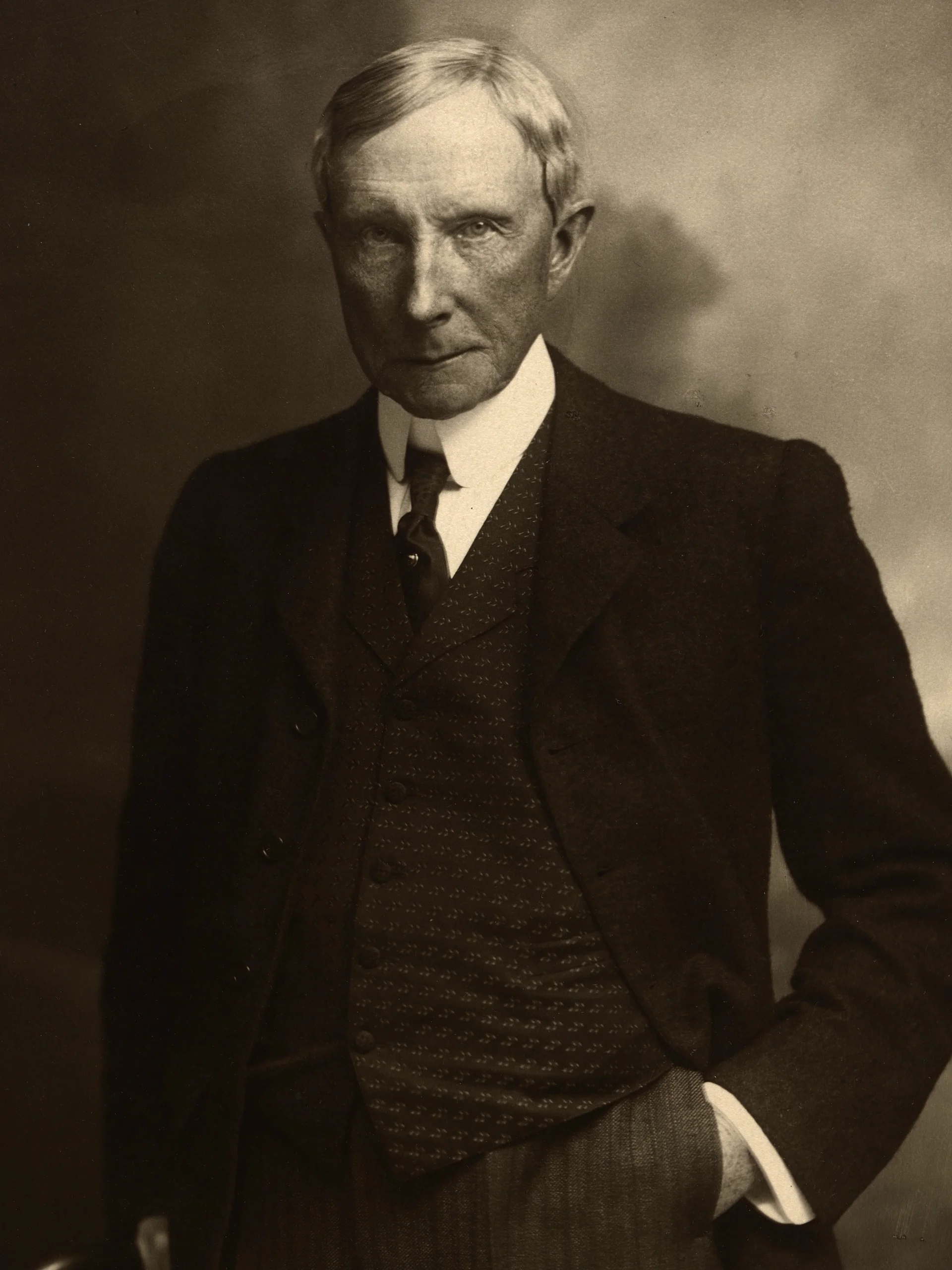
John D. Rockefeller
 United States
Also known as: John Davison Rockefeller, John D. Rockefeller Sr.
Date de naissance
July 8, 1839
Signe astrologique
Cancer
Lieu de naissance
Richford, New York, USA
Âge
Décédé(e) à 97 ans
À propos
John D. Rockefeller Sr. était un industriel et philanthrope américain qui a fondé la Standard Oil Company et est devenu l'un des individus les plus riches de l'histoire. Il a commencé sa carrière comme assistant comptable à 16 ans et, à 20 ans, s'est lancé dans des partenariats commerciaux. Son attention s'est rapidement portée sur l'industrie du raffinage du pétrole, ce qui s'est avéré prémonitoire alors que le kérosène et l'essence devenaient des produits essentiels.
Rockefeller a fondé la Standard Oil Company en 1870 et l'a dirigée jusqu'en 1897, restant son plus grand actionnaire. Sous sa direction, Standard Oil en est venue à contrôler 90 % de la production pétrolière du pays en 1900. L'entreprise a atteint cette domination grâce à des réductions de coûts agressives et des méthodes de distribution innovantes. Les critiques ont souligné des pratiques monopolistiques, citant la célèbre opinion de Rockefeller selon laquelle « La concurrence est un péché. »
L'immense succès de Standard Oil a attiré l'attention des régulateurs. En 1911, la Cour suprême a ordonné son démantèlement, le divisant en 34 entités indépendantes, dont beaucoup, comme ExxonMobil et Chevron, existent encore aujourd'hui. À son apogée, la fortune personnelle de Rockefeller était estimée à 900 millions de dollars, représentant 2,3 % du PIB américain. Il est officiellement devenu le premier milliardaire du pays le 28 septembre 1916.
Après sa retraite, Rockefeller a consacré 40 ans à la philanthropie. Lui et sa femme Laura ont fondé des institutions qui ont été pionnières dans le don systématique, en se concentrant sur l'éducation, la médecine et la recherche scientifique. Ces efforts ont fait progresser la recherche médicale et combattu des maladies comme l'ankylostome et la fièvre jaune. Il a également fondé l'Université de Chicago et l'Université Rockefeller, façonnant l'enseignement supérieur et la science médicale. Rockefeller est décédé le 23 mai 1937, laissant un héritage à la fois de titan de l'industrie et de philanthrope transformateur.
Jeunesse et origines
Rockefeller est né le 8 juillet 1839 à Richford, New York, deuxième d'une famille de six enfants. Son père, William Avery Rockefeller, était un vendeur itinérant souvent absent, tandis que sa mère, Eliza Davison, élevait les enfants avec des valeurs baptistes strictes. La famille a déménagé plusieurs fois avant de s'installer à Cleveland, Ohio, en 1853. Dès son plus jeune âge, Rockefeller a fait preuve d'un sens aigu des affaires, tenant des registres méticuleux et économisant de l'argent provenant de petits boulots. Il a fréquenté les écoles locales et, à 16 ans, s'est inscrit au Folsom's Commercial College à Cleveland pour étudier la comptabilité, suivant un cours de trois mois.
En 1855, à 16 ans, Rockefeller a obtenu un emploi d'assistant comptable chez Hewitt & Tuttle, une entreprise de commission sur les produits agricoles. Il a travaillé avec diligence, se forgeant une réputation de précision et de fiabilité. Il a économisé ses gains et, en 1859, à 20 ans, s'est associé à Maurice B. Clark pour former Clark & Rockefeller, une entreprise de produits agricoles et de marchandises. La découverte de pétrole à Titusville, Pennsylvanie, en 1859 a attiré son attention. Reconnaissant le potentiel du pétrole, Rockefeller et Clark ont investi dans une raffinerie de pétrole à Cleveland en 1863, marquant son entrée décisive dans le secteur pétrolier. Cette raffinerie, construite avec un associé, a été le fondement de son futur empire.
Évolution de carrière
L'entreprise la plus significative de Rockefeller a été la fondation de la Standard Oil Company en 1870, avec des partenaires dont son frère William, Henry M. Flagler et Stephen V. Harkness. Sous sa direction, Standard Oil a grandi grâce à une intégration horizontale et verticale agressive, visant à contrôler tous les aspects de la production et de la distribution pétrolières. En 1880, Standard Oil contrôlait environ 90 % de la capacité de raffinage de pétrole américaine. L'entreprise a réalisé des économies d'échelle qui lui ont permis de sous-coter ses concurrents et de négocier des tarifs ferroviaires favorables.
En 1882, Standard Oil a été réorganisée en trust, une structure qui centralisait le contrôle et est devenue un modèle pour d'autres industries. Rockefeller a pris sa retraite de la gestion quotidienne en 1897 mais est resté le plus grand actionnaire. La domination de l'entreprise a conduit à la décision de la Cour suprême en 1911 ordonnant son démantèlement en 34 sociétés indépendantes, dont beaucoup, comme ExxonMobil et Chevron, restent de grandes entreprises. La fortune personnelle de Rockefeller a culminé à environ 900 millions de dollars, soit environ 2,3 % du PIB américain. Le 28 septembre 1916, il est devenu le premier Américain officiellement reconnu comme milliardaire.
Chronologie de carrière
Image publique et style
L'image publique de Rockefeller est complexe et polarisante. Pour ses admirateurs, c'était un industriel visionnaire qui a révolutionné la production et la distribution de pétrole, rendant le kérosène et l'essence abordables et accessibles. Son travail philanthropique, notamment dans la recherche médicale et l'éducation, lui a valu un large respect. Les critiques, cependant, le voyaient comme un monopoleur impitoyable qui utilisait des tactiques prédatrices pour écraser la concurrence, fixer les prix et corrompre les politiciens. La révélation d'Ida Tarbell en 1904, « The History of the Standard Oil Company », a façonné la perception publique de lui en tant que baron voleur. Dans ses dernières années, Rockefeller a cultivé une image de grand-père, distribuant des pièces de dix cents et jouant au golf. Ce n'était pas une célébrité au sens moderne, mais son nom est devenu synonyme de richesse extrême et de pouvoir des entreprises. Il n'y a pas de fandom formel, mais les historiens et les économistes continuent de débattre de son héritage.
Notoriété et fandom (iFAMOUS Rankings)
John D. Rockefeller remains a towering figure in global history, though his legacy operates differently than modern celebrity culture. As of August 2026, the iFANN Global Fame Engine has evaluated this person, but they do not currently hold a placement in the published rankings such as the Global Top 1,000 or any Top-100 scope list. This absence reflects a unique status where historical influence transcends contemporary fame metrics rather than indicating obscurity. While he lacks a formal fandom name and no organized group identifies themselves as his fans, his enduring presence is maintained through the institutions he built rather than social media campaigns or fan rituals. The Rockefeller Foundation and the University of Chicago serve as living monuments to his life, drawing scholars and donors who engage with his philosophy of stewardship instead of chasing viral moments. His story continues to shape discussions on wealth, monopoly, and philanthropy, creating a quiet but pervasive cultural footprint that does not require active fan mobilization to sustain its relevance.
Faits intéressants et légendes
Rockefeller was a devout Baptist who tithed 10% of his income from his very first paycheck onward. He often gave dimes to children as a gesture of goodwill and never smoked or drank alcohol. An avid golfer, he played into his 90s and maintained greenhouses at his estate in Pocantico Hills, New York, where his favorite flower, the orchid, bloomed. Despite his vast fortune, he lived modestly, avoiding ostentation, and kept a diary from age 16 until his death to document his finances and thoughts. He was known for strict punctuality and expected the same from others. Beyond these personal habits, legends surround him as the world's first dollar billionaire, a milestone officially crossed in 1916 when his wealth peaked at $900 million. A central part of his lore involves the antitrust case Standard Oil Co. of New Jersey v. United States, which led to the company's breakup in 1911 after controlling 90% of U.S. refineries. Another enduring narrative is his transition from a ruthless tycoon to a benevolent philanthropist who gave away $540 million before his death, establishing foundations that continue to operate globally today.
Citations notables
“The ability to deal with people is as much a commodity as sugar or coffee and I will pay more for that ability than for any other under the sun.”
“I believe it is the duty of every man who has been blessed by the opportunities of this land to help his fellow men.”
“Competition is a sin.”
Famille et vie privée
Rockefeller a épousé Laura Spelman le 8 septembre 1864. Laura était enseignante et fille d'un abolitionniste éminent. Ils ont eu six enfants : Bessie (morte en bas âge), Elizabeth, John D. Jr., Alta, Edith et Rodman (mort en enfance). Laura a été une influence clé dans le virage philanthropique de Rockefeller, et il lui attribuait la formation de sa boussole morale. Elle est décédée le 29 mars 1915. Rockefeller ne s'est jamais remarié. Son fils, John D. Rockefeller Jr., est devenu un philanthrope renommé et a construit le Rockefeller Center. Le domaine familial à Pocantico Hills, New York, est devenu un lieu de rassemblement pour les générations. Les descendants de Rockefeller ont poursuivi son héritage philanthropique par le biais de la Fondation Rockefeller et d'autres institutions.
Relations notables
Rockefeller était étroitement lié à sa femme Laura Spelman Rockefeller, qui a influencé sa philanthropie. Son fils John D. Rockefeller Jr. a poursuivi son œuvre philanthropique. Ses partenaires commerciaux comprenaient Henry M. Flagler, Stephen V. Harkness et son frère William Rockefeller. Son premier associé Maurice B. Clark a contribué à lancer sa carrière. Il était également associé à la journaliste d'investigation Ida Tarbell, dont les révélations ont façonné son image publique.
Relations et vie amoureuse
John D. Rockefeller a épousé Laura Spelman le 8 septembre 1864. Laura était institutrice issue d'une famille abolitionniste éminente. Ils ont eu six enfants ensemble, dont deux sont morts en bas âge. Laura a été une influence stabilisatrice pour Rockefeller et a encouragé son virage philanthropique. Ils ont été mariés pendant plus de 50 ans jusqu'à la mort de Laura le 29 mars 1915. Rockefeller ne s'est jamais remarié et est resté dévoué à sa mémoire. Il disait souvent qu'elle était la meilleure décision commerciale qu'il ait jamais prise. En 2026, Rockefeller est décédé et son état civil est veuf.
- Marié(e)Laura Spelman Rockefeller1864 - 1915Marié le 8 septembre 1864 ; elle est décédée le 29 mars 1915.
Décès et conséquences
Décès
May 23, 1937 (à 97 ans)
Lieu de décès
Ormond Beach, Florida
Cause du décès
Natural causes related to his age
John Davison Rockefeller Sr. died on May 23, 1937, at his winter residence in Ormond Beach, Florida. While specific medical details were not released in a formal public autopsy report or coroner's inquest, historical accounts confirm he died peacefully in his sleep following a period of declining health associated with his advanced age. Regarding the circumstances of his final days, Rockefeller had been living in semi-retirement for many years, having stepped down from active management of Standard Oil decades earlier. His last public appearances occurred years prior to his death, as he largely withdrew from public life after the early 1920s to focus on philanthropy and personal well-being. The cause of death is officially attributed to natural causes related to his age, with no disputed accounts or unconfirmed theories regarding homicide or suicide present in historical records.
Public reaction to his death was characterized by widespread mourning and tributes from peers, institutions, and government officials. Upon his death, newsreels described him as a figure whose kindliness and simplicity marked his long life. Memorial murals and landmarks dedicated to him existed prior to his death, most notably the Rockefeller Center in New York City and various university buildings. The funeral for John D. Rockefeller Sr. was held privately on May 25, 1937, at the Rockefeller estate in Ormond Beach, Florida. The service was attended by family members, close associates, and representatives from the Rockefeller Foundation and other charitable institutions he supported. Notable attendees included his son, John D. Rockefeller Jr., and other prominent figures of the time. Following the service, he was buried in the Sleepy Hollow Cemetery in Tarrytown, New York, alongside his wife, Laura Spelman Rockefeller, and later his son, William Rockefeller Jr.
In the posthumous realm, Rockefeller's estate was handled through a complex process of wealth distribution and philanthropic expansion. By the time of his death, he had already given away approximately $540 million, making him one of the first individuals to donate more than half their fortune. His estate continued to be managed by the Rockefeller Foundation, which he established in 1913, and the General Education Board. A documentary titled Rockefeller - The Original Billionaire was produced later to document his life, and he has been inducted into various halls of fame posthumously. The handling of his estate ensured that the bulk of his remaining assets were funneled into charitable trusts, effectively ending the dynasty of absolute financial control within the family while maintaining its social and philanthropic influence.
Fortune (valeur de la succession)
$1.4 Billion
Estimation de l’équipe éditoriale d’iFANN
iFANN currently estimates John D. Rockefeller's net worth at the time of his death in 1937 to be $1.4 Billion. This figure reflects the immense value derived primarily from his ownership stake in Standard Oil and its successor companies following the 1911 breakup. He also held extensive investments in railroads, real estate, and other industries throughout his career. After his death, his estate was largely distributed to his heirs and the foundations he established, including the Rockefeller Foundation and Rockefeller University. The ongoing operations of these institutions, along with the continued growth of the Rockefeller family's wealth through investments, mean that his financial legacy persists. As of 2026, the Rockefeller family's collective net worth is estimated to be in the billions, though it is dispersed among many descendants. The exact value of Rockefeller's original estate in 2026 is not publicly reported, but the institutions he founded continue to hold significant endowments.
Prix et distinctions
View 6 records, honours and achievementsConnu pour
Standard Oil Company
1870 · Fondateur et président
Rockefeller Foundation
1913 · Fondateur
University of Chicago
1890 · Fondateur
Rockefeller University
1901 · Fondateur
Mots-clés
Faits clés
- Profession
- industrialist, philanthropist
- Né(e) le
- +1839-07-08
- Lieu de naissance
- Richford, New York, USA
- Décès
- +1937-05-23
- Lieu de décès
- Ormond Beach, Florida, USA
- Genre
- Homme
- Conjoint
- Laura Spelman Rockefeller
- Signe astrologique
- Cancer
Informations personnelles
- Nom complet
- John Davison Rockefeller
- Conjoint
- Laura Spelman Rockefeller
- Enfants
- Bessie Rockefeller, Elizabeth Rockefeller, John D. Rockefeller Jr., Alta Rockefeller, Edith Rockefeller, Rodman Rockefeller
- Formation
- Folsom's Commercial College (bookkeeping)
Questions fréquentes
Qui était John D. Rockefeller ?
Comment John D. Rockefeller a-t-il fait fortune ?
Quelle était la fortune de John D. Rockefeller ?
John D. Rockefeller est-il encore vivant ?
Pour quoi John D. Rockefeller est-il connu en dehors des affaires ?
Personnalités similaires
Rejoindre la communauté
fans en discussion