
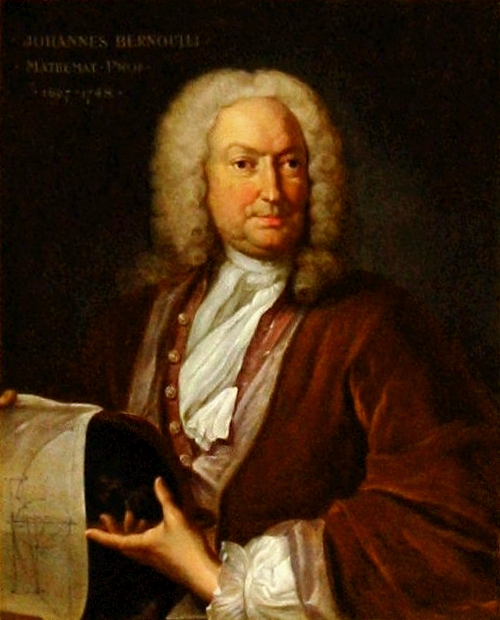
Johann Bernoulli
 Switzerland
mathematician•physicist•physician
Also known as: Jean Bernoulli, John Bernoulli
Date de naissance
July 27, 1667
Signe astrologique
Sagittarius
Lieu de naissance
Basel
Âge
Décédé(e) à 80 ans
À propos
Johann Bernoulli était un mathématicien, physicien et médecin suisse, né le 27 juillet 1667 à Bâle. Il appartenait à la prestigieuse famille Bernoulli, qui a produit plusieurs générations de mathématiciens. Johann est surtout connu pour ses travaux fondamentaux en calcul infinitésimal, calcul des variations et dynamique des fluides. Il a formulé le problème de la brachistochrone et dérivé le principe de Bernoulli, qui décrit le comportement de l'écoulement des fluides. Sa correspondance avec Leibniz a contribué à diffuser le calcul à travers l'Europe. Johann a également enseigné à Leonhard Euler, formant l'un des plus grands mathématiciens de l'histoire. Il est décédé le 1er janvier 1748, à l'âge de 80 ans.
Jeunesse et origines
Johann est né dans une famille bâloise prospère ; son père Nicolaus était apothicaire, et son grand-père avait fait le commerce des épices. Son père espérait que Johann reprendrait l'entreprise familiale, mais Johann était attiré par les pursuits intellectuelles. Il s'est inscrit à l'Université de Bâle pour étudier la médecine, une profession respectable qui satisfaisait les souhaits de son père. Tout en étudiant la médecine, Johann consacrait secrètement du temps aux mathématiques, apprenant le nouveau calcul directement des écrits de Leibniz et de son frère aîné Jakob, qui occupait une chaire de mathématiques à l'université. Ses premiers intérêts comprenaient l'application du calcul à la mécanique, à l'optique et aux courbes, telles que la réflexion et la réfraction de la lumière et les trajectoires orthogonales. Ces années de formation l'ont vu passer de la médecine aux mathématiques, ce qui a conduit à ses premiers travaux mathématiques sérieux dans les années 1690.
Évolution de carrière
La percée de Johann est survenue dans les années 1690 avec ses travaux sur le problème de la brachistochrone, la courbe de descente la plus rapide sous l'effet de la gravité, qu'il a résolu en 1696. Ce problème est devenu un fondement du calcul des variations. Il a continué à appliquer le calcul à la mécanique, à l'optique et aux équations différentielles. En 1718, il a publié un traitement systématique du calcul des variations dans l'Histoire de l'Académie Royale des Sciences, l'établissant comme une discipline cohérente. Ses œuvres complètes, Opera Johannis Bernoullii, ont été publiées en quatre volumes en 1742. En tant qu'enseignant, il a formé Leonhard Euler à Bâle, influençant profondément les travaux ultérieurs d'Euler. Il a également enseigné au marquis de L'Hôpital, dont le manuel sur le calcul différentiel s'est largement inspiré des conférences de Bernoulli. Les efforts de Johann ont contribué à établir le calcul leibnizien comme la norme en Europe.
Chronologie de carrière
Image publique et style
Johann Bernoulli est rappelé comme un savant brillant mais combatif, intensément compétitif avec son frère Jakob. Son travail publié est technique, exprimé en latin et dans la notation mathématique de l'analyse moderne primitive. Les récits modernes soulignent son rôle dans la diffusion du calcul leibnizien et son mentorat de Leonhard Euler. Il n'y a pas de fandom organisé ; l'intérêt vient principalement des mathématiciens et des historiens des sciences. Les commentateurs contemporains le dépeignent parfois de manière humoristique, mais cela reflète leur voix, pas la sienne.
Notoriété et fandom
The Swiss mathematician Johann Bernoulli stands as a towering, albeit distant, figure in the annals of science rather than a contemporary celebrity. In August 2026, the iFANN Global Fame Engine evaluated his enduring legacy and confirmed that he currently holds no placement in the published rankings, meaning he does not appear in the Global Top 1,000 or any specific scope list. This absence from the charts reflects his status as an Enlightenment-era academic whose influence is measured in textbooks and historical texts rather than modern social metrics or fan engagement. Unlike pop icons who command organized followings with official names and ritualistic behaviors, Bernoulli has no documented fandom name. His audience consists exclusively of historians, mathematicians, and students who engage with his work through rigorous study rather than fan campaigns, birthday tributes, or digital communities. There are no fan-funded projects, subway ads, or charity drives dedicated to him, as the concept of a mass public interacting with a deceased scholar did not exist in his time. The few mentions of his birth on July 27, 1667, appearing sporadically on social media, serve merely as educational reminders rather than signs of an active cult following. While modern hobbyist writers sometimes dub him 'the drama queen of mathematics' due to his intense rivalry with his brother Jakob, this label describes a historical personality trait rather than a fan-created identity. His relationship with the public was strictly professional, limited to his role as a professor at the University of Basel and his correspondence with peers. Today, his fame remains static, preserved in the quiet reverence of academia where his contributions to calculus and fluid dynamics continue to shape scientific thought without the noise of a modern fanbase.
Faits intéressants et légendes
Johann and his brother Jakob were among the first people to learn calculus directly from Leibniz's original writings. Before Leonhard Euler standardized notation, some mathematicians used the letter 'b' instead of 'e' for the base of the natural logarithm, reflecting Johann's early recognition of the constant's unique properties. He is often credited with discovering that e represents the limit of (1 + 1/n)^n as n approaches infinity. His son Daniel Bernoulli later solved the St. Petersburg paradox, illustrating the family's multi-generational influence on probability theory. Modern hobbyist writing has described Johann as 'the drama queen of mathematics' due to his intense rivalry with Jakob. A legendary moment occurred when Johann posed the brachistochrone problem, challenging the greatest minds in Europe to find the curve of fastest descent. Isaac Newton reportedly solved the anonymous challenge overnight, famously stating, 'I recognize the lion by his claw.' Another dark chapter involves the bitter feud between the brothers; after Jakob died, Johann allegedly stole his notes and manuscripts to claim credit for discoveries regarding the law of large numbers. These intellectual conflicts defined his life, creating a legacy of high-stakes mathematical battles rather than crowd-fueled adoration.
Famille et vie privée
Johann est né de Nicolaus Bernoulli, un apothicaire de Bâle, et de son épouse. Son grand-père avait fait le commerce des épices. Il avait plusieurs frères et sœurs, notamment son frère aîné Jakob Bernoulli, un mathématicien majeur. Johann a épousé Dorothea Falkner, et ils ont eu trois fils. L'un des fils, Daniel Bernoulli, est devenu un mathématicien et physicien célèbre, connu pour le principe de Bernoulli et ses travaux en probabilité et en hydrodynamique. La famille Bernoulli a produit plusieurs générations de mathématiciens, souvent appelée la 'dynastie Bernoulli'.
Relations notables
Johann Bernoulli est étroitement associé à son frère Jakob Bernoulli, avec qui il a collaboré et été en compétition. Il a formé Leonhard Euler, l'un des plus grands mathématiciens de tous les temps. Il a également correspondu avec Gottfried Wilhelm Leibniz, contribuant à la diffusion du calcul. Son fils Daniel Bernoulli a poursuivi la tradition familiale. La famille Bernoulli dans son ensemble est synonyme des mathématiques modernes primitives.
Relations et vie amoureuse
Johann Bernoulli a épousé Dorothea Falkner, probablement à la fin des années 1690. Ils ont eu trois fils ensemble, dont le célèbre mathématicien Daniel Bernoulli. Le mariage a duré jusqu'à la mort de Johann en 1748. Aucune autre relation amoureuse n'est documentée dans les sources historiques.
- Marié(e)Dorothea Falkner1697 - 1748Marié à Bâle ; a eu trois fils dont Daniel Bernoulli.
Décès et conséquences
Décès
January 1, 1748 (à 80 ans)
Lieu de décès
Basel, Switzerland
Cause du décès
Natural causes
The final days of Johann Bernoulli unfolded in the quiet academic halls of Basel, where he had spent a lifetime shaping the landscape of European mathematics. On January 1, 1748, the eighty-year-old scholar passed away within the city that had hosted his birth and his career at the University of Basel. Historical records from the era do not preserve a specific medical diagnosis or an autopsy report, reflecting the standard practice for natural deaths among scholars of the eighteenth century rather than any forensic investigation. The immediate reaction came through the dense network of correspondence between mathematicians across the continent, who acknowledged the loss of a central figure in the development of calculus and the calculus of variations.
His funeral was conducted in Basel, attended by family members including his son Daniel and academic colleagues, though no detailed public ceremony was recorded in surviving accounts. Posthumously, his legacy solidified through the publication of his collected works, Opera Johannis Bernoullii, which appeared in four volumes shortly after his death. Tributes manifested as the continued teaching of his methods to students like Leonhard Euler and the enduring application of principles named in his honor. His estate passed to his descendants, notably his son Johann II, who also pursued a distinguished career in mathematics. The mathematical community mourned the passing of a man whose rivalry with Leibniz and mentorship of future giants helped define the scientific age.
Fortune (valeur de la succession)
Johann Bernoulli est décédé en 1748, bien avant les estimations modernes de fortune. Ses revenus provenaient de postes universitaires et de patronage typiques des universitaires du XVIIIe siècle. Aucun enregistrement financier fiable n'existe pour estimer sa richesse. Son héritage intellectuel, cependant, est incommensurable.
Prix et distinctions
View 2 records, honours and achievementsConnu pour
Brachistochrone problem
1696 · Solved
Calculus of variations
1718 · Systematized
Bernoulli's principle
1738 · Derived (via son Daniel)
Mots-clés
Sources
Faits clés
- Profession
- mathematician, physicist, physician
- Né(e) le
- +1667-07-27
- Lieu de naissance
- Basel
- Décès
- +1748-01-01
- Lieu de décès
- Basel
- Genre
- Homme
- Conjoint
- Dorothea Falkner
- Signe astrologique
- Sagittarius
Informations personnelles
- Nom complet
- Johann Bernoulli
- Conjoint
- Dorothea Falkner
- Enfants
- Three sons, including Daniel Bernoulli
- Formation
- University of Basel (medicine, self-taught in mathematics)
Questions fréquentes
Qui était Johann Bernoulli ?
Pourquoi Johann Bernoulli est-il célèbre ?
Johann Bernoulli a-t-il remporté des prix ?
Johann Bernoulli était-il lié à Jacob Bernoulli ?
Quand Johann Bernoulli est-il mort ?
Personnalités similaires
Rejoindre la communauté
fans en discussion