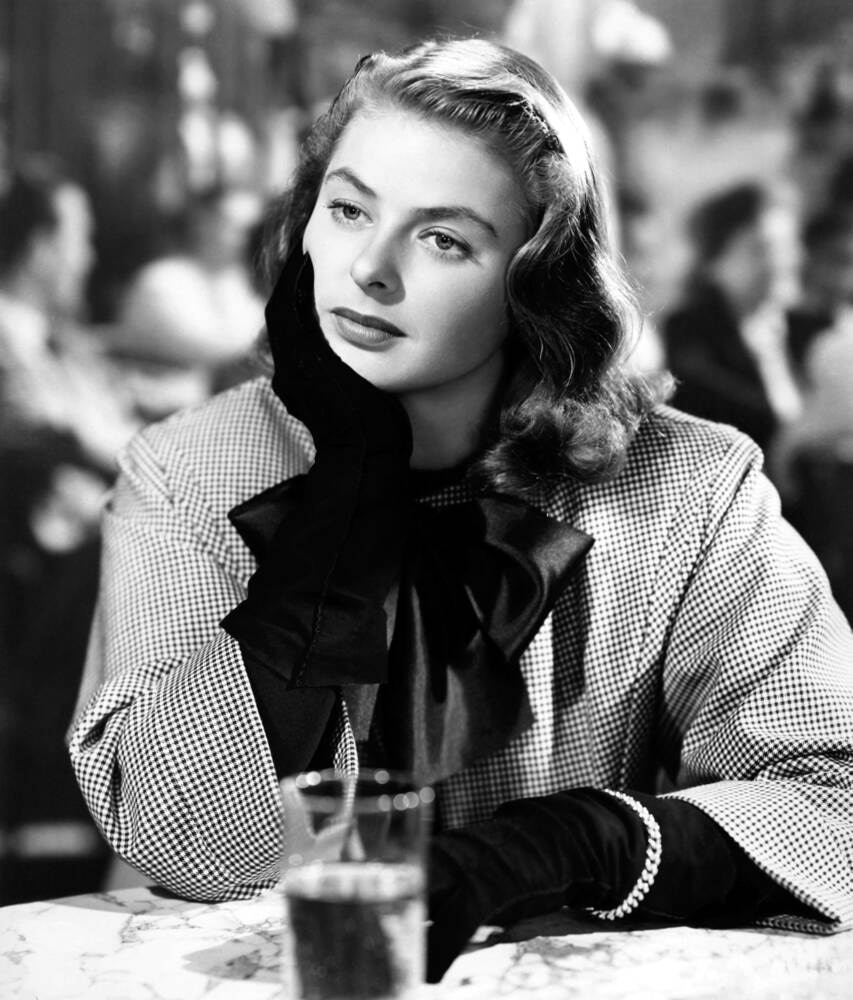
Ingrid Bergman
 Sweden
Date de naissance
August 29, 1915
Signe astrologique
Virgo
Lieu de naissance
Stockholm, Sweden
Âge
Décédé(e) à 67 ans
Taille
5 ft 9 in (175 cm)
À propos
Ingrid Bergman was an iconic Swedish actress who became one of the most revered figures in cinema history. She won three Academy Awards, two Primetime Emmy Awards, and a Tony Award, making her the youngest performer to achieve the Triple Crown of Acting. Bergman is one of only four actresses with at least three competitive acting Oscars, alongside Katharine Hepburn, Meryl Streep, and Frances McDormand. Her natural beauty, luminous screen presence, and ability to perform in five languages set her apart in Hollywood's Golden Age. She remains beloved for her role as Ilsa Lund in Casablanca, a character that continues to captivate audiences worldwide.
Jeunesse et origines
Ingrid Bergman est née à Stockholm, en Suède, de Justus Bergman, un artiste et photographe, et de Frieda Adler, une femme allemande. Sa mère est morte quand Ingrid avait trois ans, et son père est décédé lorsqu'elle avait treize ans. Elle a ensuite été élevée par une tante et un oncle. Dès son plus jeune âge, Bergman a montré une passion pour le jeu d'acteur, jouant dans des pièces scolaires et du théâtre amateur. À dix-sept ans, elle a décroché un travail de figurante dans un film suédois. En 1935, elle s'est inscrite à l'École royale de théâtre dramatique de Stockholm, où elle a étudié pendant un an avant de se voir proposer des rôles au cinéma. Son premier rôle significatif au cinéma est venu avec Munkbrogreven (1935), mais sa percée a été Intermezzo (1936), un film suédois qui a attiré l'attention du producteur américain David O. Selznick. Selznick l'a amenée à Hollywood pour le remake en anglais Intermezzo : A Love Story (1939), marquant ses débuts américains.
Évolution de carrière
La carrière hollywoodienne de Bergman a décollé avec Intermezzo : A Love Story (1939). Elle est devenue une star majeure après avoir joué Ilsa Lund dans Casablanca (1942), un rôle devenu légendaire. Elle a remporté son premier Oscar de la meilleure actrice pour Hantise (1944). Elle a collaboré avec Alfred Hitchcock sur trois films : La Maison du docteur Edwardes (1945), Les Enchaînés (1946) et Les Amants du Capricorne (1949). Dans les années 1950, après un scandale impliquant sa liaison avec le réalisateur italien Roberto Rossellini, elle a travaillé principalement dans le cinéma européen. Elle a remporté son deuxième Oscar pour Anastasia (1956). Plus tard dans sa carrière, elle a remporté un troisième Oscar du meilleur second rôle féminin pour Le Crime de l'Orient-Express (1974). Elle a également remporté un Tony Award pour The Constant Wife (1974) et deux Emmy Awards pour Le Tour d'écrou (1978) et Une femme nommée Golda (1982, à titre posthume).
Chronologie de carrière
Image publique et style
Bergman était connue pour sa beauté naturelle et son maquillage minimal, se démarquant dans une ère de glamour hollywoodien. Elle jouait souvent des femmes fortes et indépendantes avec une complexité morale. Initialement présentée comme la sainte suédoise, sa réputation a souffert après le scandale Rossellini, mais elle a ensuite été réhabilitée en tant que digne ancienne du cinéma. Sa base de fans, parfois appelée Bergmaniacs, comprend des passionnés de films classiques qui célèbrent son travail à travers des projections annuelles de Casablanca et des festivals de cinéma.
Notoriété et fandom
Ingrid Bergman remains a towering figure in cinema history, her legacy sustained by the enduring power of films like Casablanca and Anastasia. While modern celebrity cycles churn with fleeting trends, her standing has proven remarkably stable over decades. She is currently ranked as the 16th most famous person from Sweden, a position holding steady within the iFANN Global Fame Rankings ecosystem which tracks global attention across media coverage, search, and consumption signals worldwide. This placement reflects a unique trajectory: she navigated a devastating scandal that nearly ended her career to emerge as one of the industry's most revered elder stateswomen. Her influence transcends mere nostalgia; it anchors the study of classic acting styles for new generations. Unlike contemporary stars who cultivate organized armies of digital supporters, Bergman's audience operates differently. There is no formal moniker or grassroots fan club bearing her name. Instead, her admirers are film historians, scholars, and enthusiasts who engage with her work through academic discourse and institutional preservation rather than viral campaigns or merchandise marathons. The official presence managed by CMG Worldwide serves as an archival hub rather than a community center. Fans gather not for meet-and-greets but for annual screenings of her masterpieces and the auctioning of personal memorabilia that reveal the human cost behind the glamour. Her story of leaving Hollywood for artistic integrity in Italy remains the central pillar of this mythology, a tale retold whenever her life is examined. The lack of a specific fandom name does not diminish her impact; it simply highlights how her fame exists in the collective memory of culture rather than the active engagement of a branded tribe.
Faits intéressants et légendes
Ingrid Bergman possessed a rare linguistic gift, speaking Swedish, English, German, Italian, and French fluently. She shattered glass ceilings as the first woman to receive the American Film Institute's Life Achievement Award in 1976. A pivotal moment in her career involved turning down the role of Melanie Hamilton in Gone with the Wind because she felt unqualified for the part. During World War II, she demonstrated immense courage by visiting U.S. troops and even flying a B-17 bomber. An asteroid, 1942 Bergman, bears her name in recognition of her cultural footprint. A widely retold legend centers on her "natural beauty" versus Hollywood glamour; stories persist that she refused heavy makeup and artificial alteration, preferring an authentic look that contrasted sharply with contemporaries like Marilyn Monroe. Another defining chapter of her lore involves the 1949 scandal where she left her husband and lucrative contract to pursue love with director Roberto Rossellini in Rome. The American public reacted with fury, branding her "un-American," yet she eventually returned to win two more Academy Awards. Recent discoveries of her personal letters add a new layer to this narrative, revealing that despite her stardom, she faced significant financial struggles following her affair, humanizing the icon beyond the screen.
Citations notables
“I have no regrets. I wouldn't have lived my life the way I did if I was going to worry about what people were going to say.”
“Happiness is good health and a bad memory.”
“I have a great deal of faith in people. I think they are basically good.”
“A kiss is a lovely trick designed by nature to stop speech when words become superfluous.”
“I have a very simple philosophy: live and let live.”
Famille et vie privée
Les parents de Bergman étaient Justus Bergman, un artiste et photographe, et Frieda Adler, qui est morte quand Ingrid avait trois ans. Son père est mort quand elle avait treize ans, et elle a été élevée par une tante et un oncle. Elle a eu trois enfants : Pia Lindström (née en 1938) avec son premier mari Petter Lindström, et Roberto Ingmar Rossellini (né en 1950) et Isabella Rossellini (née en 1952) avec Roberto Rossellini. Elle a également eu une fille, Isotta Rossellini, née en 1952. Sa fille Isabella est devenue une actrice et mannequin célèbre.
Relations notables
Bergman est étroitement associée au réalisateur Alfred Hitchcock, avec qui elle a fait trois films : La Maison du docteur Edwardes, Les Enchaînés et Les Amants du Capricorne. Elle a également eu une célèbre collaboration avec le réalisateur italien Roberto Rossellini, qu'elle a ensuite épousé. Ses partenaires de jeu incluaient Humphrey Bogart dans Casablanca, Cary Grant dans Les Enchaînés et Bing Crosby dans Les Cloches de Sainte-Marie.
Relations et vie amoureuse
Bergman a épousé le dentiste et neurochirurgien suédois Petter Lindström en 1937. Ils ont eu une fille, Pia, en 1938. Le mariage s'est terminé en 1950 après que Bergman a entamé une liaison avec le réalisateur italien Roberto Rossellini lors du tournage de Stromboli. Le scandale a conduit à sa dénonciation à la tribune du Sénat américain. Elle a épousé Rossellini en 1950, et ils ont eu trois enfants : Roberto Ingmar, et les jumelles Isabella et Isotta. Le mariage s'est terminé en 1957 en raison de l'infidélité de Rossellini. En 1958, elle a épousé le producteur de théâtre suédois Lars Schmidt. Ils n'ont pas eu d'enfants et ont divorcé à l'amiable en 1975. Bergman ne s'est pas remariée et est restée proche de ses enfants jusqu'à sa mort en 1982.
- Marié(e)Petter Lindström1937 - 1950Dentiste et neurochirurgien suédois ; a eu une fille, Pia ; mariage terminé en raison de la liaison de Bergman avec Rossellini.
- Marié(e)Roberto Rossellini1950 - 1957Réalisateur de cinéma italien ; a eu trois enfants ; mariage terminé en raison de l'infidélité de Rossellini.
- Marié(e)Lars Schmidt1958 - 1975Producteur de théâtre suédois ; pas d'enfants ; divorce à l'amiable.
Décès et conséquences
Décès
August 29, 1982 (à 67 ans)
Lieu de décès
London, England
Cause du décès
Metastatic breast cancer
Ingrid Bergman spent her final days under medical care at the Middlesex Hospital in London, England, having traveled there for treatment of a long-standing illness. She passed away on August 29, 1982, exactly on her sixty-seventh birthday, ending a nearly decade-long battle with metastatic breast cancer that had been diagnosed in 1973. Her last public appearance occurred earlier that year while starring in the television miniseries A Woman Called Golda, a performance that would earn her a posthumous Emmy Award and stand as a fitting conclusion to her career. The public reaction to her death was one of profound global mourning, with tributes pouring in from peers, institutions, and officials worldwide. The Academy of Motion Picture Arts and Sciences held a memorial tribute, and fan vigils took place in Stockholm, Los Angeles, and New York, where audiences gathered to honor the actress who had become an icon of cinema.
Classic films like Casablanca, Notorious, and Gaslight saw renewed viewership and sales in the weeks following her passing. A private funeral ceremony was held in Stockholm, Sweden, on September 2, 1982, attended by close family members and a select group of friends and colleagues. She was cremated, and her ashes were interred at the Norra Begravningsplatsen (Northern Cemetery) in Stockholm. Posthumously, she received numerous honors, including induction into the American Film Institute's list of the greatest female stars of all time. Her estate continues to be managed by her three daughters, ensuring her legacy remains protected and curated for future generations.
Fortune (valeur de la succession)
$25 Million
Estimation de l’équipe éditoriale d’iFANN
Per iFANN's editorial analysis, Ingrid Bergman's estate is valued at $25 Million as of 2026. This valuation stems from ongoing royalties generated by her timeless classics, including Casablanca, Gaslight, and Notorious, which remain distributed globally. Income also flows from licensing her image for merchandise, documentaries, and posters. Real estate holdings located in Stockholm, London, and Paris contribute significantly to the total worth. The estate is overseen by her children, Pia Lindström, Isabella Rossellini, and Roberto Rossellini. Posthumous releases, such as the 2023 documentary Ingrid Bergman: In Her Own Words, alongside continuous film restorations, provide fresh revenue streams. Despite her passing, the commercial value of her brand persists through these diverse channels.
Récompenses remportées (42)
Bergman a remporté trois Oscars : Meilleure actrice pour Hantise (1944) et Anastasia (1956), et Meilleure actrice dans un second rôle pour Le Crime de l'Orient-Express (1974). Elle a également remporté deux Primetime Emmy Awards, pour Le Tour d'écrou (1978) et Une femme nommée Golda (1982), et un Tony Award de la meilleure actrice dans une pièce pour La Femme constante (1974). Ses quatre Golden Globes incluent la Meilleure actrice pour Hantise, Les Cloches de Sainte-Marie et Anastasia, et la Meilleure actrice dans un second rôle pour Le Crime de l'Orient-Express.
1975 · Meilleure actrice dans un second rôle
Murder on the Orient Express
1957 · Meilleure actrice dans un rôle principal
Anastasia
1945 · Meilleure actrice dans un rôle principal
Gaslight
1975 · Meilleure actrice dans un second rôle – Film
Murder on the Orient Express
1957 · Meilleure actrice dans un film dramatique
Anastasia
1946 · Meilleure actrice dans un film dramatique
The Bells of St. Mary's
1945 · Meilleure actrice dans un film dramatique
Gaslight
Connu pour
Casablanca
1942 · Ilsa Lund
Gaslight
1944 · Paula Alquist
Notorious
1946 · Alicia Huberman
Anastasia
1956 · Anna Koreff / Anastasia
Murder on the Orient Express
1974 · Greta Ohlsson
Mots-clés
Faits clés
- Profession
- actress
- Né(e) le
- +1915-08-29
- Lieu de naissance
- Stockholm, Sweden
- Décès
- +1982-08-29
- Lieu de décès
- London, England
- Genre
- Femme
- Conjoint
- Petter Lindström, Roberto Rossellini, Lars Schmidt
- Signe astrologique
- Virgo
- Taille
- 5 ft 9 in (175 cm)
Informations personnelles
- Nom complet
- Ingrid Bergman
- Taille
- 5 ft 9 in (175 cm)
- Conjoint
- Petter Lindström, Roberto Rossellini, Lars Schmidt
- Enfants
- Pia Lindström, Roberto Ingmar Rossellini, Isabella Rossellini, Isotta Rossellini
- Formation
- Royal Dramatic Theatre School, Stockholm
Filmographie
80
Total
70
Cinéma
10
TV
Questions fréquentes
Quel âge avait Ingrid Bergman à sa mort ?
Quelle est la fortune d'Ingrid Bergman en 2026 ?
Ingrid Bergman est-elle toujours active en 2026 ?
Pourquoi Ingrid Bergman est-elle célèbre ?
Combien d'Oscars Ingrid Bergman a-t-elle remportés ?
Réseaux sociaux
Personnalités similaires
Rejoindre la communauté
fans en discussion