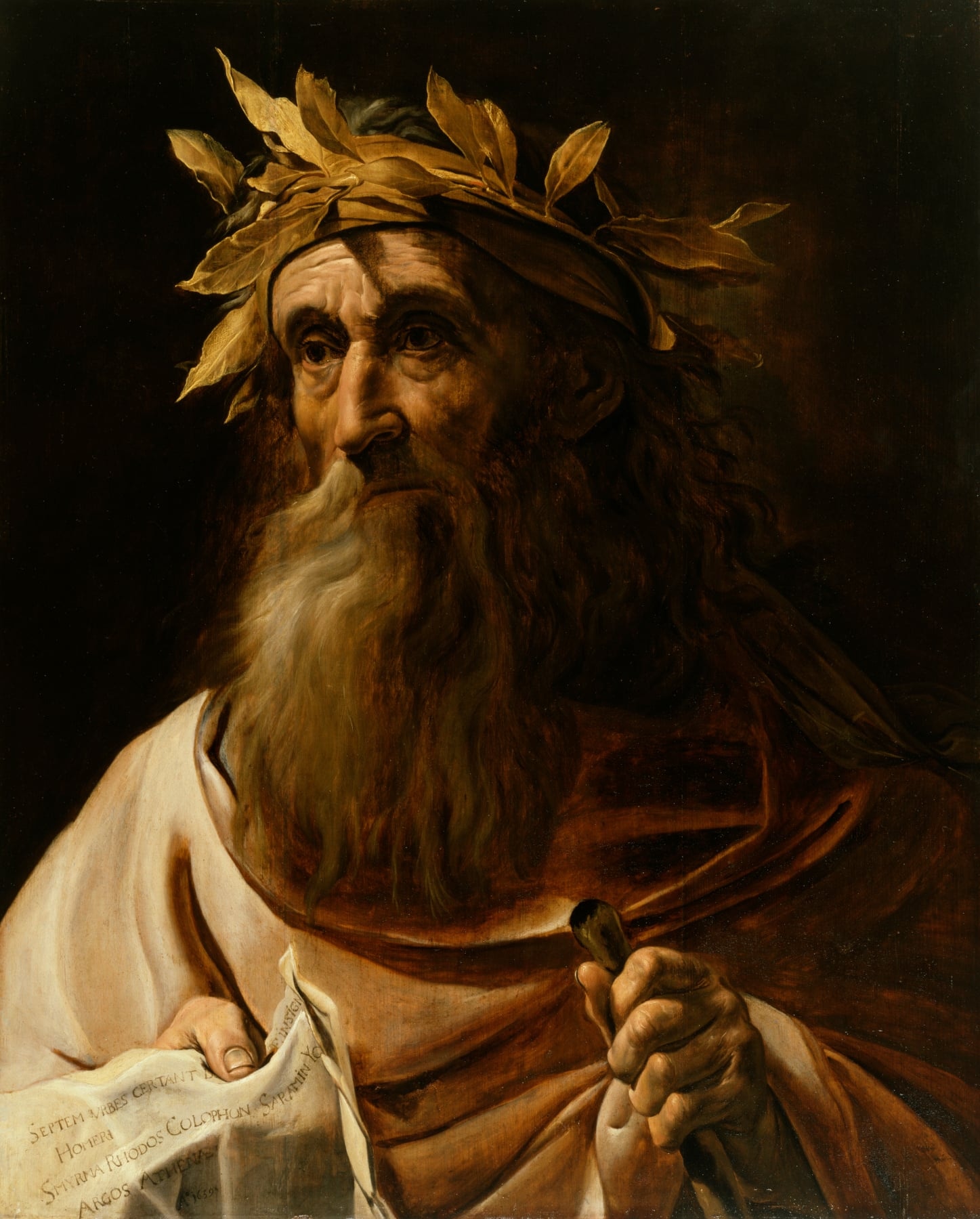
Homer
Date de naissance
Signe astrologique
Lieu de naissance
Ionian League
Âge
Décédé(e) à -100 ans
À propos
Homer was the ancient Greek poet credited with composing the Iliad and the Odyssey, two epic poems that form the bedrock of Western literature. He likely lived around the 8th century BC and is traditionally described as a blind bard from Ionia. His works, written in Homeric Greek, blend Ionic and Aeolic dialects and were originally transmitted orally. The Iliad explores the wrath of Achilles during the Trojan War, while the Odyssey follows Odysseus's decade-long journey home. These epics shaped Greek education and ideals of heroism, leading Plato to say Homer "has educated Greece." Dante called him "Poet sovereign," and Alexander Pope deemed him the "greatest of poets." Today, his influence pervades literature, art, and film.
Jeunesse et origines
Homère a vécu avant toute tenue systématique de registres chronologiques, de sorte que sa vie précoce est presque entièrement inconnue. Les références les plus anciennes, comme les Jeux Olympiques (tenus pour la première fois en 776 av. J.-C.), ne fournissent qu'un contexte approximatif. Les traditions anciennes, aujourd'hui considérées comme légendaires par les chercheurs, affirmaient qu'il était un aède aveugle d'Ionie, une région le long de la côte de la Turquie actuelle comprenant Smyrne, Chios et Samos. Sept villes différentes ont chacune revendiqué être son lieu de naissance, Smyrne et Chios étant parmi les plus persistantes. Les poèmes eux-mêmes ont été composés oralement, transmis de génération en génération par des aèdes avant d'être jamais écrits. Les premières mentions littéraires d'Homère apparaissent au VIIe siècle av. J.-C., dans les œuvres d'Archiloque, d'Alcman, de Tyrtée et de Callinos, suggérant que ses épopées étaient déjà largement connues et respectées à cette époque.
Évolution de carrière
La carrière d'Homère est définie par deux œuvres monumentales. L'Iliade, située pendant la dernière année de la guerre de Troie, se concentre sur la querelle entre le roi Agamemnon et le guerrier Achille, explorant les thèmes de la rage, de l'honneur et de la mortalité. L'Odyssée raconte le voyage de dix ans d'Ulysse alors qu'il combat dieux et monstres pour rentrer chez lui à Ithaque. Les chercheurs pensent généralement que les deux poèmes ont été composés par des auteurs différents, vers la fin du VIIIe ou le début du VIIe siècle av. J.-C. À l'époque classique, ces épopées sont devenues centrales dans l'éducation grecque, étudiées par chaque citoyen. Au IIIe siècle av. J.-C., les chercheurs de la Bibliothèque d'Alexandrie ont produit des éditions critiques qui ont standardisé les textes. La Renaissance a vu un regain d'intérêt alors que les traductions latines et vernaculaires se répandaient à travers l'Europe, cimentant la place d'Homère comme source de la tradition littéraire occidentale.
Chronologie de carrière
Image publique et style
Homère est universellement vénéré comme la figure fondatrice de la littérature occidentale. Ses œuvres sont étudiées dans les écoles et les universités du monde entier. Aucun nom officiel de fanbase n'existe, mais ses épopées ont inspiré d'innombrables adaptations, de l'Ulysse de James Joyce au film O Brother, Where Art Thou? La « question homérique » continue de susciter des débats savants. Sa personnalité publique est celle d'un aède aveugle et sage, symbole de la narration antique et de l'unité culturelle.
Notoriété et fandom
The community surrounding Homer has never organized into a modern fanbase with a specific name or social media campaigns. Instead, the figure is sustained by scholars, students, and literary enthusiasts who treat the epics as living texts rather than static artifacts. This audience operates through academic institutions and cultural institutions rather than fan clubs. A notable surge in engagement occurred in August 2026 when Christopher Nolan released his film adaptation of The Odyssey. Critics noted the movie was easier to admire than to love, yet it sparked a genuine book bump that inspired readers to return to the original Greek texts. Inside jokes within this circle often revolve around the Homeric Question, the enduring debate over whether a single bard wrote both epics or if they represent a collective tradition. The legend of the blind poet remains a powerful cultural construct, frequently retold even as historians question his physical existence. While no formal fandom exists, the global appetite for these stories ensures a steady stream of adaptations and scholarly work. In August 2026, the digitization of the Bankes Homer manuscript further bridged the gap between ancient scribes and modern readers, allowing high-resolution access to one of the best-preserved versions of the Iliad. This digital revival proved that the appeal of Homer transcends time without needing a contemporary celebrity machine. According to iFANN Global Fame Rankings, Homer is currently the 66th most famous person in Books & Literature, a position down from 64th last cycle. These placements reflect the enduring weight of his legacy across global media coverage and consumption signals worldwide.
Faits intéressants et légendes
The name Homer in Greek may translate to either hostage or blind, reflecting the mystery of his identity. Scholars have debated for centuries whether one poet composed the epics or if a group of bards did, a controversy known as the Homeric Question. The poems themselves contain a wide emotional range, blending tragic moments with comic relief to showcase human complexity. Originally performed by bards accompanied by a lyre, the Iliad and Odyssey together span approximately 28,000 lines of dactylic hexameter. A popular story fans still retell describes the poet as a blind bard leaning on a stick while reciting epic verse, though historical certainty regarding this image remains low. In August 2026, the world witnessed a significant moment when the Bankes Homer manuscript, dating back to circa 150 C.E., was digitized and made available in high resolution. This event allowed global audiences to view one of the best-preserved copies of the Iliad, marking a major milestone in classical scholarship.
Citations notables
“He has taught Greece. — Plato”
“Poet sovereign. — Dante Alighieri, Divine Comedy”
“The greatest of poets. — Alexander Pope”
Famille et vie privée
On ne sait rien de fiable sur la famille d'Homère. Les biographies anciennes, considérées comme mythiques par les chercheurs modernes, suggèrent des lignées fantastiques : certains prétendaient qu'il descendait d'une Muse, d'Apollon, d'Orphée, ou même de Télémaque, le fils d'Ulysse. Une tradition datant de l'époque de l'empereur Hadrien nommait Épicaste (fille de Nestor) et Télémaque comme ses parents. Ces histoires ne sont pas considérées comme des faits historiques.
Relations notables
Les œuvres d'Homère présentent des personnages emblématiques : Achille, le guerrier central de l'Iliade ; Ulysse, le héros rusé de l'Odyssée ; Agamemnon, le roi grec ; Hector, le prince troyen ; et Pénélope, la fidèle épouse d'Ulysse. Ces figures sont devenues des archétypes dans la culture occidentale.
Relations et vie amoureuse
Décès et conséquences
Historical consensus indicates that Homer, the ancient Greek poet traditionally credited with composing the Iliad and the Odyssey, lived during the 9th or 8th century BCE. Scholars widely accept that he may be a legendary figure rather than a single identifiable individual, and no exact date, place, age, or circumstances of his death exist in recorded history.
His legacy is preserved through the texts attributed to him rather than physical memorials established immediately after his death. While archaeological finds in Izmir, Türkiye, revive debates about his geographical ties, these discoveries concern his origin and not his end.
Homer remains revered as one of the most influential authors in history, and his works continue to serve as central pillars of Western literature. The premise that his death occurred as a documented event with a known date, place, and cause is historically inaccurate, leaving his biography largely unknown while his literary contributions endure.
Fortune (valeur de la succession)
$0
Estimation de l’équipe éditoriale d’iFANN
Per iFANN's editorial analysis, the net worth for Homer stands at $0. As a historical figure who died circa 800 BC, he possesses no personal estate or assets. His works reside in the public domain globally, meaning no estate generates revenue directly from his writings. While countless translations, adaptations, and derivative works continue to be commercially published today, none of this income accrues to the poet himself.
Prix et distinctions
View 4 records, honours and achievementsConnu pour
Iliad
~8th century BC · Auteur
Odyssey
~8th century BC · Auteur
Mots-clés
Sources
Faits clés
- Profession
- poet, author, writer
- Né(e) le
- ~8th century BC
- Lieu de naissance
- Ionian League
- Décès
- ~8th century BC
- Genre
- Homme
Questions fréquentes
Homère a-t-il vraiment existé ?
Quand Homère est-il né ?
Homère était-il aveugle ?
Qu'est-ce qu'Homère a écrit ?
Où est né Homère ?
Personnalités similaires
Rejoindre la communauté
fans en discussion