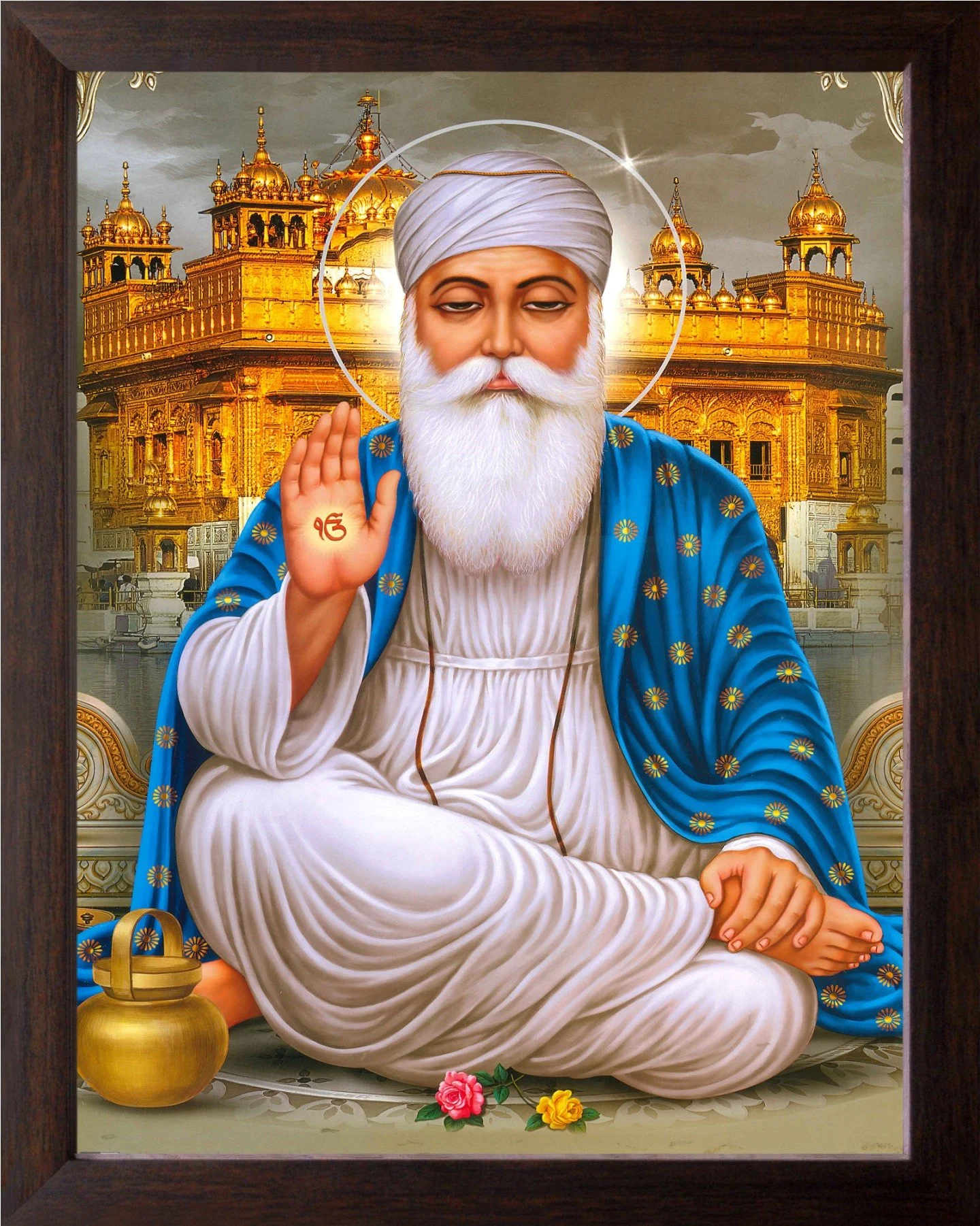
Guru Nanak
 Kiribati
Also known as: Nanak, Baba Nanak, Nanak Dev
Date de naissance
April 15, 1469
Signe astrologique
Aries
Lieu de naissance
Rai Bhoi Ki Talwandi (now Nankana Sahib, Pakistan)
Âge
Décédé(e) à 70 ans
À propos
Guru Nanak was the founder of Sikhism and the first of the ten Sikh Gurus. He was a spiritual teacher, mystic, and poet who lived from 1469 to 1539. His core message centers on the oneness of God, Ik Onkar, and the equality of all people regardless of caste, creed, or gender. Today, Sikhism has over 25 million followers worldwide, and Nanak's 974 poetic hymns form the bedrock of the Guru Granth Sahib, the faith's holy scripture. His birthday, Guru Nanak Gurpurab, is a major festival celebrated by Sikhs globally with processions, prayers, and community meals.
Jeunesse et origines
Guru Nanak est né le 15 avril 1469 dans le village de Rai Bhoi Ki Talwandi, aujourd'hui Nankana Sahib au Pakistan. Son père, Mehta Kalu, était comptable de village, et sa mère, Mata Tripta, était femme au foyer. Il avait une sœur aînée, Bebe Nanaki, qui lui était profondément dévouée. Dès l'enfance, Nanak montra une nature contemplative, remettant souvent en question les rituels et les divisions sociales qui l'entouraient. Il apprit l'hindi et le sanskrit auprès d'un maître hindou, puis étudia le persan sous la direction d'un érudit musulman, ce qui lui permit de maîtriser les deux traditions religieuses. À 16 ans, il épousa Mata Sulakhni, et ils eurent deux fils. Pendant un temps, il travailla comme magasinier pour le souverain musulman local, mais son agitation spirituelle grandit. Vers l'âge de 30 ans, après une disparition de trois jours durant laquelle il se baigna dans une rivière et en ressortit en proclamant : « Il n'y a ni hindou, ni musulman », il commença sa mission.
Évolution de carrière
Après son éveil spirituel, Guru Nanak entreprit le premier de cinq grands voyages, ou udasis, qui s'étendirent sur plus de deux décennies. Il voyagea à pied à travers l'Inde, le Tibet, le Sri Lanka, le Moyen-Orient et l'Arabie, parcourant des milliers de kilomètres. À La Mecque, il défia l'orthodoxie religieuse en plaçant ses pieds vers la Kaaba, déclarant que Dieu est partout. Il composa des hymnes en pendjabi, la langue du peuple, mis en musique sur différents ragas. Ses œuvres les plus célèbres incluent le Japji Sahib, une prière matinale, et l'Asa di Var, un hymne sur la justice divine. Il fonda une communauté à Kartarpour, où il introduisit la pratique du langar, une cuisine communautaire gratuite ouverte à tous. Avant sa mort en 1539, il désigna Bhai Lehna comme son successeur, le renommant Guru Angad, assurant ainsi la continuité de son enseignement.
Chronologie de carrière
Image publique et style
Guru Nanak est vénéré comme un enseignant humble, compatissant et intrépide qui défia l'injustice sociale. Dans la tradition sikhe, il est décrit comme le « Gourou » qui dissipe les ténèbres. Son image dans la culture populaire est souvent représentée avec une barbe fluide, une robe simple et une expression sereine. On se souvient de lui pour son esprit et sa franchise, comme dans l'histoire du « sharabi » (ivrogne) dont il dit qu'il était plus honnête que ceux qui priaient mais vivaient hypocritement. La célébration annuelle du Gurpurab comprend des processions appelées nagar kirtan, où les dévots chantent ses hymnes. Son message d'égalité a résonné au-delà du sikhisme, influençant les dialogues interreligieux mondiaux.
Notoriété et fandom
Guru Nanak commanded a devotion that transcended centuries, evolving from the teachings of a 15th-century mystic into a global movement of millions. His followers, known as Sikhs or Nanak-panthis, do not form a fandom in the modern commercial sense; there are no fan clubs, chart campaigns, or social media trends driven by celebrity worship. Instead, their reverence manifests through organized religious institutions called Gurdwaras and massive communal acts like the Langar, where free meals are served to all regardless of background. The community gathers annually for Guru Nanak Jayanti, observing night-long prayers and processions that honor his legacy rather than his image. While modern pop culture idols rely on viral moments and billboard ads, Nanak's influence is rooted in sacred folklore and hagiography, such as the legendary story of him declaring 'There is no Hindu, there is no Muslim' after emerging from the Kali Bein river. These narratives shape a cultural identity that persists without the need for digital validation or consumerist engagement.
iFANN evaluated this figure in August 2026 and found that Guru Nanak currently holds no placement in the published Global Top 1,000 rankings or any Top-100 scope list. The evaluation confirms he does not appear on the current fame charts.
Faits intéressants et légendes
Historical records note that Guru Nanak traveled to Baghdad to debate with Sufi mystics and visited Haridwar, where he famously threw water westward instead of toward the sun to challenge ritualistic beliefs about ancestors. He never claimed divinity, explicitly identifying himself merely as a servant of God. Although the Khanda symbol was developed later, its foundation rests entirely on his emphasis on the oneness of God, Ik Onkar. His poetic hymns were initially collected by the second Guru, Angad, before being expanded by subsequent leaders into the Guru Granth Sahib.
Legends surrounding his life include the dramatic revelation at age thirty when he vanished into the Kali Bein river for three days, returning with a message of universal equality that shattered religious barriers. Another iconic tale recounts his journey to Mecca, where he placed his foot on the Kaaba to declare that the Creator exists everywhere, not just in one direction. Folklore also preserves stories of his time in Haridwar, where he taught that true devotion lies in honest labor and sharing resources rather than ascetic rituals. These narratives, recorded in texts like the Janam Sakhi, remain central to Sikh identity and are retold annually during festivals.
Citations notables
“There is but one God, He is the supreme truth, He is the creator of all.”
“Speak the truth, live truthfully, and walk the path of truth.”
“Recognize that there is one God, and His ways are true.”
“I am neither Hindu nor Muslim; I am a follower of God.”
“The world is a drama, and God is the only director.”
Famille et vie privée
Le père de Guru Nanak, Mehta Kalu, était un comptable hindou au service d'un propriétaire terrien musulman. Sa mère, Mata Tripta, était connue pour sa piété. Sa sœur aînée, Bebe Nanaki, joua un rôle important dans sa vie ; elle fut la première à reconnaître sa profondeur spirituelle. Nanak épousa Mata Sulakhni, la fille d'un marchand, et ils eurent deux fils : Sri Chand, qui fonda plus tard la secte ascétique Udasi, et Lakhmi Das, qui resta un chef de famille. Après la mort de Nanak, ses fils ne lui succédèrent pas ; c'est son disciple Guru Angad qui perpétua la lignée spirituelle.
Relations notables
Le successeur de Guru Nanak fut Bhai Lehna, qui devint Guru Angad. Sa femme Mata Sulakhni soutint sa mission. Ses fils Sri Chand et Lakhmi Das ne suivirent pas sa voie spirituelle. Sa sœur Bebe Nanaki fut une première soutien. L'empereur moghol Babur est mentionné dans les hymnes de Nanak comme un tyran.
Relations et vie amoureuse
Guru Nanak épousa Mata Sulakhni vers 1485. Elle était la fille d'un marchand nommé Mula, de la ville de Batala. Le mariage fut arrangé par ses parents. Ils eurent deux fils ensemble : Sri Chand, né vers 1494, et Lakhmi Das, né vers 1497. Mata Sulakhni accompagna Nanak lors de ses premiers voyages et vécut plus tard avec lui à Kartarpour. Elle mourut après Nanak, bien que l'année exacte ne soit pas enregistrée. Au moment de sa mort en 1539, Nanak était marié à elle.
- Marié(e)Mata Sulakhni1485 - 1539Mariage arrangé ; ils eurent deux fils, Sri Chand et Lakhmi Das.
Décès et conséquences
Décès
September 22, 1539 (à 70 ans)
Lieu de décès
Kartarpur
Cause du décès
Illness and advanced age
According to tradition, when Hindu and Muslim followers arrived at Kartarpur in 1539 to perform last rites, they found flowers covering his body, symbolizing that his legacy belonged to all humanity. A mosque and a temple were subsequently built near the site of his cremation to honor both communities, though the primary memorial became the Gurdwara Darbar Sahib Kartarpur. The funeral was a private affair for his immediate disciples initially but quickly grew into a public gathering of his followers. Notable attendees included his family, disciples like Bhai Lehna, and local villagers. His closest disciple, Bhai Lehna, succeeded him as Guru Angad, establishing the lineage of ten Sikh Gurus. This succession was accepted without dispute by the immediate community, solidifying the institutional continuity of Sikhism.
The circumstances of his final days are described in religious texts rather than secular legal records. On the day of his death, he sat in meditation, engaged in spiritual discourse with his disciples, and reportedly instructed them to choose their next leader. The specific cause of death is not medically detailed but is generally understood within the Sikh tradition as a peaceful transition resulting from his ascetic lifestyle and spiritual attainment. Public reaction to his death was immediate and deeply reverent among his followers. Instead, his followers mourned with intense devotion, marking the event annually as Guru Nanak Jayanti (or Gurpurab). Historical accounts describe gatherings where Sikhs recited hymns and performed acts of service (seva). Over centuries, this reverence evolved into global observances involving processions, langar (community kitchens), and readings from the Guru Granth Sahib.
Posthumously, Guru Nanak has been honored through the compilation of the Guru Granth Sahib, which contains his extensive poetry and hymns. Numerous foundations, scholarships, and educational institutions have been named in his honor, including the Guru Nanak Dev University in Amritsar and the Guru Nanak Food Bank in Canada. Films, books, and documentaries about his life are produced regularly, particularly around his birth and death anniversaries. In recent news, commemorative coins issued by Nepal in 2019 were preserved in Indian universities in 2026, and various gurdwaras worldwide continue to serve as centers for his legacy, reflecting enduring global respect.
Prix et distinctions
View 4 records, honours and achievementsConnu pour
Founding of Sikhism
1499 · Fondateur
Japji Sahib
1521 · Compositeur
Asa di Var
1521 · Compositeur
Mots-clés
Faits clés
- Profession
- guru, religious leader, poet
- Né(e) le
- +1469-04-15
- Lieu de naissance
- Nankana Sahib
- Décès
- +1539-09-22
- Lieu de décès
- Kartarpur
- Genre
- Homme
- Conjoint
- Mata Sulakhni
- Signe astrologique
- Aries
Informations personnelles
- Nom complet
- Nanak
- Conjoint
- Mata Sulakhni
- Enfants
- Sri Chand, Lakhmi Das
- Formation
- Traditional education in Hindi, Sanskrit, and Persian
Questions fréquentes
Qui était Guru Nanak ?
Quelle est la fortune de Guru Nanak ?
Quels sont les principaux enseignements de Guru Nanak ?
Guru Nanak est-il considéré comme Dieu dans le sikhisme ?
Où Guru Nanak est-il enterré ?
Personnalités similaires
Rejoindre la communauté
fans en discussion