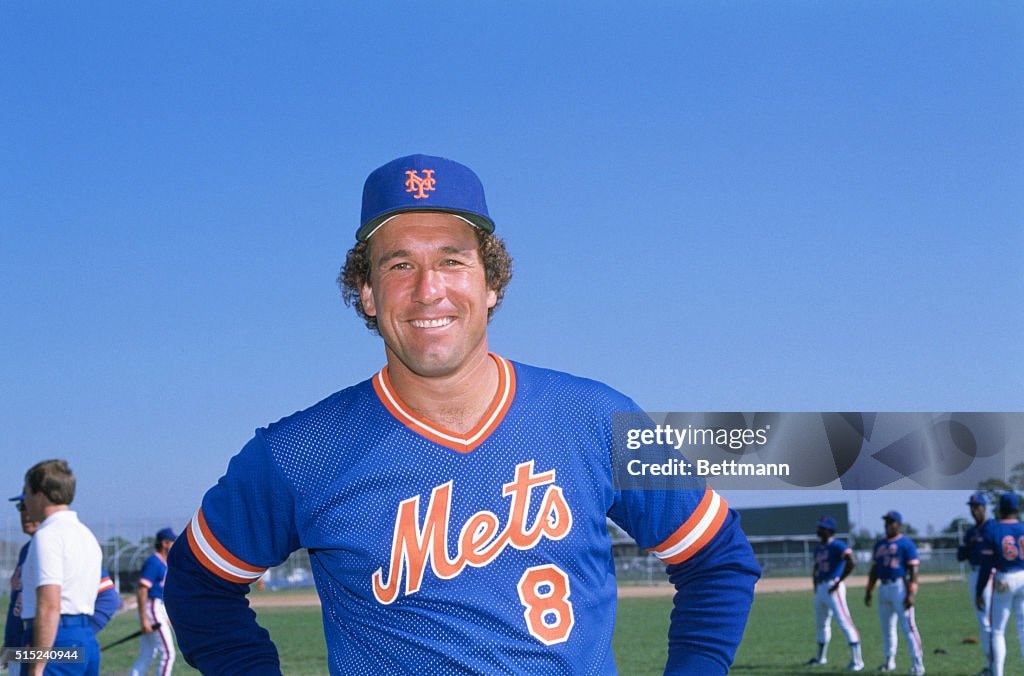
Gary Carter
 United States
Also known as: The Kid
Date de naissance
April 8, 1954
Signe astrologique
Aries
Lieu de naissance
Culver City, California, United States
Âge
Décédé(e) à 57 ans
Taille
6 ft 2 in (188 cm)
À propos
Gary Carter était un receveur de baseball professionnel américain qui a joué 19 saisons en Ligue majeure de baseball, principalement pour les Expos de Montréal et les Mets de New York. Sélectionné 11 fois au match des étoiles, il était connu pour sa puissance au bâton, ses solides compétences défensives et sa personnalité exubérante qui lui a valu le surnom de « The Kid ». Carter a été intronisé au Temple de la renommée du baseball national en 2003, cimentant son héritage comme l'un des plus grands receveurs de l'histoire du baseball.
Ses totaux en carrière incluent 324 circuits et 1 225 points produits, et il a été une figure clé dans le championnat dramatique des Mets lors de la Série mondiale de 1986. En dehors du terrain, Carter était un chrétien dévot et un conférencier motivateur, respecté pour son leadership et son esprit sportif.
Jeunesse et origines
Gary Edward Carter est né le 8 avril 1954 à Culver City, en Californie, et a grandi dans la région de Los Angeles. Il a montré des promesses athlétiques très tôt, remportant le premier concours de compétences Punt, Pass et Kick en 1961 à l'âge de sept ans. Carter a fréquenté la Sunny Hills High School à Fullerton, où il excellait à la fois au baseball et au football américain, jouant comme quart-arrière et defensive back. Son talent au baseball était évident en tant que receveur et voltigeur, et il a été repêché par les Expos de Montréal au troisième tour du repêchage de la MLB en 1972 directement après le lycée. Il a passé deux saisons dans les ligues mineures à perfectionner ses compétences avant de faire ses débuts dans la MLB en 1974.
Évolution de carrière
Carter a fait ses débuts dans la MLB avec les Expos de Montréal le 16 septembre 1974. Il s'est rapidement imposé comme un receveur de premier plan, remportant son premier Prix du Bâton d'Argent en 1975. Défensivement, il a remporté son premier Gant doré en 1979. En 1980, il a été nommé MVP de la Série de championnat de la Ligue nationale après une solide performance en séries éliminatoires. Après la saison 1984, les Expos l'ont échangé aux Mets de New York, où il est devenu une pierre angulaire de l'équipe. En 1985, il a frappé un sommet en carrière de 32 circuits et produit 100 points. Le point culminant est survenu en 1986, lorsqu'il a aidé les Mets à remporter un titre de Série mondiale, frappant notamment un circuit décisif dans le match 5. Il a ensuite joué pour les Dodgers de Los Angeles, les Giants de San Francisco et les Orioles de Baltimore avant de prendre sa retraite en 1992.
Chronologie de carrière
Image publique et style
Carter était largement considéré comme l'un des joueurs les plus enthousiastes et charismatiques de son époque. Son sourire contagieux et son jeu énergique en ont fait un favori des fans. Il était connu pour son leadership sur le terrain, appelant souvent les matchs et guidant les lanceurs. Les médias et ses coéquipiers louaient son éthique de travail et sa durabilité, car il a attrapé plus de 1 000 matchs. Sa foi était une partie centrale de sa personnalité publique, et il parlait fréquemment de l'importance de la famille et de la religion.
Notoriété et fandom
The fanbase surrounding Gary Carter does not operate under a formal collective name, identifying instead through allegiance to the Montreal Expos or New York Mets rather than as a distinct sub-group. This lack of a specific moniker has not diminished the intensity with which supporters guard his legacy, a sentiment made starkly clear in May 2026 when the assignment of his retired number 8 to rookie Nick Morabito triggered immediate and visceral backlash. The organization swiftly reversed the decision, demonstrating that while no official fandom exists, the public acts as an active guardian of the catcher's history. Within this sphere, Carter remains a central figure in franchise mythology, revered for his approachable demeanor and the enduring nickname "The Kid" earned during his debut at age nineteen. His cultural standing is anchored by verified historical achievements, most notably his clutch performance in the 1986 World Series where he helped secure a victory against the Boston Red Sox, cementing his status as a legendary defender known for his rock-solid presence behind home plate. Despite his immense stature in baseball history, iFANN's Global Fame Engine evaluated his current standing in August 2026 and determined that he holds no placement in the published rankings. Gary Carter is currently EVALUATED_UNRANKED within the Global Top 1,000 or any Top-100 scope list. While his influence on the sport remains profound, drawing tributes from across the league following his passing in 2012, he does not currently occupy a quantified position in the global fame hierarchy. The absence of a numeric rank reflects a status where his historical impact is absolute, yet his contemporary viral metrics do not align with the thresholds required for a specific ordinal placement in the current cycle.
Faits intéressants et légendes
Gary Carter's career was marked by distinctive habits and historic firsts that remain part of baseball lore. He was the inaugural winner of the Punt, Pass, and Kick contest and frequently played golf in charity tournaments after his retirement. On the field, he was recognized for wearing a unique catcher's mask equipped with a throat protector and famously caught Bill Stoneman's no-hitter in 1974. His broadcasting career included a stint with the Florida Marlins, where he shared his insights before focusing on motivational speaking. The origin of his beloved nickname, "The Kid," is tied to his youthful energy upon joining the Montreal Expos in 1973, a moniker popularized by announcer Bob Murphy that stuck throughout his nineteen-season career. A defining moment in his legend occurred during the 1986 World Series, where his crucial home run and defensive plays in Game 6 became the primary narrative for fans recalling his contribution to the Mets' championship victory. Historians often describe him as a "rock behind home plate" due to his three Gold Glove Awards and ability to manage pitchers, traits that defined his reputation as one of the game's greatest catchers. Even decades later, the reverence for his legacy persists, evidenced by the swift correction when a rookie was mistakenly issued his number in 2026, proving that the stories of his life continue to resonate with new generations.
Citations notables
“I love the game. I love the fans. I love the challenge. I love the struggle. I love the whole thing.”
“My faith is the most important thing in my life. It's what gets me through all the tough times.”
Famille et vie privée
Gary Carter a épousé Sandy Brubaker, et ils ont eu quatre enfants : Christy, Kim, Tiffany et D.J. Son fils, D.J. Carter, a joué dans les ligues mineures de baseball dans l'organisation des Mets. Carter était un homme de famille dévoué et attribuait souvent à sa femme le soutien de sa carrière. Il était un chrétien dévot et allait régulièrement à l'église. Après sa retraite, il a vécu à Palm Beach Gardens, en Floride, jusqu'à sa mort.
Relations notables
Gary Carter est souvent associé à l'équipe des Mets de New York championne de la Série mondiale de 1986, aux côtés de coéquipiers comme Dwight Gooden, Darryl Strawberry et Keith Hernandez. Il avait également une rivalité notable avec Mike Schmidt des Phillies de Philadelphie. À Montréal, il était une figure clé aux côtés de Steve Rogers et Andre Dawson.
Relations et vie amoureuse
Gary Carter a épousé Sandy Brubaker en 1975. Le couple a eu quatre enfants et est resté marié jusqu'à la mort de Carter en 2012. Il n'y a pas de relations antérieures ou de divorces connus. Carter parlait souvent publiquement de son lien fort avec sa femme et lui attribuait le mérite de son succès. Le mariage était considéré comme stable et privé.
- Marié(e)Sandy Brubaker1975 - 2012Mariés jusqu'à la mort de Carter ; quatre enfants ensemble.
Décès et conséquences
Décès
February 16, 2012 (à 57 ans)
Lieu de décès
Laval, Quebec, Canada
Cause du décès
Complications from an astrocytoma
Gary Carter spent his final years residing in Laval, Quebec, Canada, where he lived with his family and maintained a quiet life away from the public eye. On February 16, 2012, at the age of 57, Carter passed away at his home following a private battle with an astrocytoma, a type of brain tumor diagnosed approximately one year prior. The cause of death was confirmed by his family and the Montreal Expos organization as natural complications arising from the malignancy. Tributes poured in immediately from Major League Baseball, the New York Mets, and fellow Hall of Famers like Mike Piazza and Keith Hernandez, who honored his leadership and distinctive persona.
Fans gathered spontaneously outside spring training facilities and near his residence to pay respects, while the number 8 jersey was retired by the Montreal Expos in recognition of his enduring impact on Canadian baseball. A private funeral service attended by close family and select colleagues took place shortly after his passing in Laval, though specific burial details remain undisclosed. Following his death, the Gary Carter Foundation continued its work supporting children's charities and youth baseball programs, while various documentaries and biographies were produced to document his legacy.
Fortune (valeur de la succession)
$10 Million
Estimation de l’équipe éditoriale d’iFANN
Per iFANN's editorial analysis, the estate of Gary Carter is valued at approximately $10 million as of 2026. During his playing days, particularly throughout the 1980s, Carter accumulated substantial earnings with a peak annual salary reaching around $2 million. Following his retirement, he expanded his income streams through work as a broadcaster and motivational speaker. The financial value of his estate includes residuals generated from memorabilia sales, autograph signings, and various licensing agreements. The Carter family actively manages his enduring legacy through the Gary Carter Foundation, which directs resources toward supporting charitable causes.
Récompenses remportées (10)
Gary Carter a été 11 fois sélectionné au Match des étoiles de la MLB, a remporté trois Gants dorés (1979, 1981, 1986) et cinq Bâtons d'argent (1975, 1981, 1984, 1985, 1986). Il a été nommé MVP de la Série de championnat de la Ligue nationale en 1980 et intronisé au Temple de la renommée du baseball national en 2003.
2003 · Intronisation
Career
1986 · Défense
New York Mets
1981 · Défense
Montreal Expos
1979 · Défense
Montreal Expos
Connu pour
Montreal Expos
1974 · Receveur
New York Mets
1985 · Receveur
1986 World Series Champion
1986 · Receveur
Mots-clés
Faits clés
- Profession
- Baseball Player
- Né(e) le
- 1954-04-08
- Lieu de naissance
- Culver City, California, United States
- Signe astrologique
- Aries
- Taille
- 6 ft 2 in (188 cm)
- Bats/Throws
- Right/Right
Informations personnelles
- Nom complet
- Gary Edward Carter
- Taille
- 6 ft 2 in (188 cm)
- Conjoint
- Sandy Brubaker
- Enfants
- Christy, Kim, Tiffany, D.J.
- Formation
- Sunny Hills High School, Fullerton, California
Questions fréquentes
Quel était le surnom de Gary Carter ?
Pour quelles équipes Gary Carter a-t-il joué ?
Quand Gary Carter a-t-il été intronisé au Temple de la renommée ?
Gary Carter a-t-il gagné une Série mondiale ?
Quelle a été la cause du décès de Gary Carter ?
Personnalités similaires
Rejoindre la communauté
fans en discussion