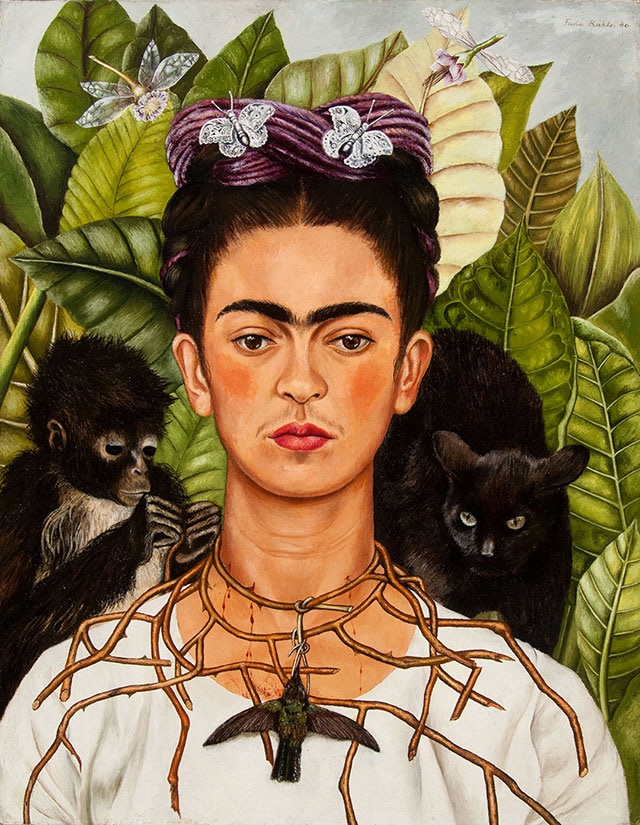
Frida Kahlo
 Mexico
Also known as: Magdalena Carmen Frida Kahlo y Calderón
Date de naissance
July 6, 1907
Signe astrologique
Cancer
Lieu de naissance
Coyoacán, Mexico City, Mexico
Âge
Décédé(e) à 47 ans
Taille
5 ft 3 in (160 cm)
À propos
Frida Kahlo, born Magdalena Carmen Frida Kahlo y Calderón on July 6, 1907, in Coyoacán, Mexico City, was a Mexican painter whose work has become synonymous with bold self-expression and cultural pride. Known for her many self-portraits, she used a naïve folk art style to explore identity, postcolonialism, gender, class, and race. Her paintings mix realism with fantasy, often drawing from her own life, including her chronic pain. She is celebrated as an icon for Chicanos, feminists, and the LGBTQ+ community, her uncompromising depictions of the female experience making her a global symbol of resilience and cultural identity. Her image has been featured on Mexican banknotes, and her home, La Casa Azul, is now the Frida Kahlo Museum, one of the most visited museums in Mexico City. The 2002 biopic Frida, starring Salma Hayek, won two Academy Awards and introduced her to a new generation. In 2018, she was ranked #1 on Rolling Stone's list of "10 Best Visual Artists of All Time," and in 2020, she was named one of TIME's "100 Women of the Year" as a proxy for 1937. The intense global cult of personality around her is sometimes called "Fridamania." Fans often dress as her for Halloween or "Frida Fest" events, and her image is a staple of Day of the Dead celebrations. The official social media accounts post a mix of art history, political statements aligned with her Communist past, and inspirational quotes. As of 2026, her estate is estimated to be worth $60–$80 million, managed by the Frida Kahlo Museum and the Diego Rivera and Frida Kahlo Trust.
Jeunesse et origines
Kahlo a grandi dans la maison familiale connue sous le nom de La Casa Azul à Coyoacán. À six ans, la polio a rendu sa jambe droite plus fine que la gauche, et elle a boité pour le reste de sa vie. Son père, photographe, l'encourageait à jouer au football et à nager pour renforcer sa jambe. C'était une élève brillante et rebelle, l'une des 35 filles seulement à l'École préparatoire nationale de Mexico. C'est là qu'elle a vu pour la première fois Diego Rivera peindre une fresque sur le campus. Un moment charnière est survenu le 17 septembre 1925, lorsque le bus dans lequel elle se trouvait est entré en collision avec un tramway. L'accident l'a transpercée au niveau du bassin, fracturant sa colonne vertébrale, sa clavicule, ses côtes, son bassin et sa jambe droite. Pendant sa longue et douloureuse convalescence, immobile dans un plâtre, elle a commencé à peindre. Sa mère a fait fabriquer un chevalet spécial pour qu'elle puisse peindre au lit, et un miroir placé au-dessus d'elle pour qu'elle puisse peindre des autoportraits. Cet accident de bus a complètement redirigé sa vie, transformant une étudiante en médecine en artiste. Elle donnait souvent son année de naissance comme 1910, début de la Révolution mexicaine, pour aligner sa vie sur le Mexique moderne.
Évolution de carrière
La percée de Kahlo a eu lieu en 1938 lorsque le surréaliste André Breton a organisé sa première exposition personnelle à la Julien Levy Gallery à New York. L'exposition a vendu environ la moitié des 25 tableaux, un succès commercial. En 1939, elle s'est rendue à Paris pour une exposition à la Renou & Colle Gallery, où le Louvre a acheté The Frame, faisant d'elle la première artiste mexicaine du XXe siècle à être collectionnée par le musée. Tout au long des années 1940, elle a enseigné à l'Escuela Nacional de Pintura, Escultura y Grabado « La Esmeralda » et est devenue membre fondateur du Seminario de Cultura Mexicana. En 1953, sa première exposition personnelle au Mexique a eu lieu à la Galería Arte Contemporáneo. Elle y a assisté dans une ambulance et a été portée jusqu'à son lit, qui avait été placé dans la galerie. Elle a continué à peindre jusqu'à sa mort en 1954. De manière posthume, son œuvre a gagné une énorme traction. En 2021, son tableau Diego y yo s'est vendu pour 34,9 millions de dollars, un record pour un artiste latino-américain aux enchères. En 1954, elle a reçu le Premio Nacional de Pintura du gouvernement mexicain. Une grande exposition, « Frida Kahlo: The Life of an Icon », tourne dans le monde entier, proposant des expériences numériques immersives. En 2024, le Musée Frida Kahlo a annoncé une nouvelle exposition permanente axée sur son activisme politique.
Chronologie de carrière
Image publique et style
Le style signature de Kahlo comprend son monobrow, ses couronnes de fleurs, ses robes colorées de Tehuana et un regard direct et inébranlable dans ses autoportraits. Elle est dépeinte comme une icône féministe tragique mais résiliente, un symbole de la douleur transformée en art, et une figure de fierté culturelle pour les Mexicains et les Chicanos. Elle est apparue en couverture de Vogue en 1937, photographiée par Toni Frissell, la faisant connaître au public américain de la mode. TIME a présenté une illustration d'elle en couverture en 2002, et Vanity Fair a eu un article de couverture pour le film Frida la même année. Le compte Instagram officiel @museofridakahlo compte plus de 1,1 million d'abonnés, et la page Facebook plus de 500 000 abonnés. Le compte Twitter/X @FridaKahlo compte plus de 300 000 abonnés. Les fans sont souvent appelés « fridistes » ou « fans de Frida », et il existe une forte sous-culture de mariages « sur le thème de Frida ». La succession continue de lancer de nouvelles gammes de produits sous licence, y compris une récente collaboration avec une maison de haute couture.
Notoriété et fandom (iFAMOUS Rankings)
Frida Kahlo remains the 1st most famous person from Mexico, a position she holds with quiet authority. Her standing extends far beyond her borders, ranking as the 3rd most famous person in Latin America and securing the 4th spot globally for her country of origin at the 4th most famous person in Mexico. Within the global pantheon of creativity, she is recognized as the 3rd most famous person in Art & Design, while her overall cultural footprint places her at the 185th most famous person in the world. These placements, consistent across recent cycles within the iFANN Global Fame Rankings, reflect an enduring devotion that transcends generations. The scale of this attention tracks how her image permeates media coverage, search behaviors, and consumption signals worldwide, cementing her status not merely as a historical figure but as a living presence in contemporary culture.
There is no formal name for her fanbase, though the term "Fridas" has emerged in cultural discourse to describe women who emulate her style or identify with her legacy rather than a structured organization. Unlike modern celebrities whose followers drive campaigns or fund billboards, Kahlo's devotees express their admiration through the preservation of her mythos. This mythology rests on verified biographical events amplified into folklore, such as her survival of a near-fatal bus accident which transformed physical suffering into the pain and passion evident in her self-portraits. Her tumultuous marriage to Diego Rivera and her distinct visual persona, elaborate Tehuana clothing and floral hairstyles adopted to assert Mexican identity, have become symbols of resistance. Recent institutional reactions underscore this devotion; a major exhibition broke pre-sale ticket records at the Tate, while activists filed lawsuits to prevent her paintings from leaving Mexico, arguing they are too culturally vital to be exported. These events highlight a fierce protection of her legacy by a global audience that treats her life story as high drama and her art as a national treasure.
Faits intéressants et légendes
Born Magdalena Carmen Frida Kahlo y Calderón on July 6, 1907, in Coyoacán, she became a painter whose work defined bold self-expression and cultural pride. Known for her many self-portraits, she utilized a naïve folk art style to explore identity, postcolonialism, gender, class, and race. Her paintings mixed realism with fantasy, often drawing from her own life and chronic pain. She was celebrated as an icon for Chicanos, feminists, and the LGBTQ+ community, with her uncompromising depictions of the female experience making her a global symbol of resilience. Her image appeared on Mexican banknotes, and her home, La Casa Azul, served as a museum. Her signature style included her unibrow, flower crowns, colorful Tehuana dresses, and a direct gaze. She appeared on the cover of Vogue in 1937, photographed by Toni Frissell, introducing her to an American fashion audience. TIME featured an illustration of her on its cover in 2002, and Vanity Fair had a spread. She was bisexual and had affairs with both men and women, including the singer Chavela Vargas. She was an avid political activist and joined the Mexican Communist Party in 1928. She loved wearing traditional Tehuana dresses to highlight her Indigenous heritage and hide her scarred leg. She often incorporated her unibrow and facial hair into her self-portraits as a deliberate statement against conventional beauty standards. Her height was 5 feet 3 inches (160 cm). She was honored with a Google Doodle on July 6, 2010, for her 103rd birthday. Notable quotes include: "I paint self-portraits because I am so often alone, because I am the person I know best" (from her diary, circa 1940s); "They thought I was a Surrealist, but I wasn't. I never painted dreams. I painted my own reality" (interview, 1953); "Feet, what do I need you for when I have wings to fly?" (from her diary, 1953, after her leg amputation); and "I hope the exit is joyful, and I hope never to return" (final diary entry, 1954). A story fans still retell involves her near-fatal bus accident in 1925, which sparked her artistic career during recovery. Another legend centers on her relationship with Diego Rivera, marked by volatility and infidelities, including rumors of an affair with Leon Trotsky. Her deliberate rejection of beauty norms, growing a mustache and unibrow, became a core part of her lore.
Citations notables
“I paint self-portraits because I am so often alone, because I am the person I know best.”
“They thought I was a Surrealist, but I wasn't. I never painted dreams. I painted my own reality.”
“Feet, what do I need you for when I have wings to fly?”
“I hope the exit is joyful — and I hope never to return.”
Famille et vie privée
Le père de Kahlo, Guillermo Kahlo, était un immigrant allemand et photographe. Sa mère, Matilde Calderón y González, était d'origine indigène et espagnole. Elle avait trois sœurs : Matilde, Adriana et Cristina. Kahlo n'a jamais eu d'enfants ; une grossesse en 1930 a été interrompue pour des raisons médicales, et des fausses couches ultérieures l'ont laissée profondément déprimée. Elle et Rivera vivaient à La Casa Azul, qui est devenue plus tard le Musée Frida Kahlo. La maison était remplie d'animaux, y compris des singes, des perroquets et un chien Xoloitzcuintli. Elle possédait également un cerf de compagnie nommé Granizo.
Relations notables
Diego Rivera, son mari et collègue muraliste, a été une influence de toute une vie. André Breton, l'écrivain surréaliste, a soutenu son travail et organisé sa première grande exposition. Le photographe Nickolas Muray, son amant, a capturé des images emblématiques d'elle. Salma Hayek l'a incarnée dans le biopic de 2002 et a contribué à faire connaître son histoire au public mondial.
Relations et vie amoureuse
La première relation sérieuse de Kahlo était avec Alejandro Gómez Arias, un leader étudiant charismatique à l'École préparatoire nationale. Ils sont sortis ensemble de 1922 à 1927, et il était avec elle lors de l'accident de bus de 1925. La relation a pris fin à cause de la désapprobation de sa famille et de son infidélité. En 1929, elle a épousé Diego Rivera, un coureur de jupons notoire. Leur mariage était passionné mais tumultueux, marqué par des infidélités des deux côtés. Kahlo a eu des aventures avec des hommes et des femmes, y compris le photographe Nickolas Muray (par intermittence de 1931 à 1941), le sculpteur Isamu Noguchi (1936-1937), le marchand d'art allemand Heinz Berggruen (1938) et l'artiste catalan José Bartolí (1946-1950). Une rumeur d'aventure avec le révolutionnaire russe exilé Léon Trotsky en 1937 a provoqué une rupture entre Kahlo et Rivera. Ils ont divorcé en 1939 mais se sont remariés un an plus tard, le 8 décembre 1940, maintenant une compagnie platonique jusqu'à sa mort. En 2026, Frida Kahlo est décédée.
- A fréquentéAlejandro Gómez Arias1922 - 1927Son premier petit ami sérieux ; ils étaient ensemble lors de l'accident de bus.
- Marié(e)Diego Rivera1929 - 1939Premier mariage, tumultueux avec des infidélités.
- A fréquentéNickolas Muray1931 - 1941Aventure intermittente ; Muray a pris des photos emblématiques de Kahlo.
- A fréquentéIsamu Noguchi1936 - 1937Aventure alors que Rivera était avec sa sœur Cristina.
- RumeurLeon Trotsky1937 - 1939Aventure largement présumée pendant que Trotsky vivait à la Maison Bleue.
- A fréquentéHeinz Berggruen1938 - 1938Brève relation avec le marchand d'art allemand.
- Marié(e)Diego Rivera1940 - 1954Second mariage, compagnonnage platonique jusqu'à sa mort.
- A fréquentéJosé Bartolí1946 - 1950Relation à distance avec l'artiste catalan.
Décès et conséquences
Décès
July 13, 1954 (à 47 ans)
Lieu de décès
Coyoacán, Mexico City, Mexico
Cause du décès
Pulmonary embolism
The announcement of Frida Kahlo's passing came from her family at La Casa Azul in Coyoacán, confirming the end of a life marked by intense physical struggle and artistic brilliance. On July 13, 1954, she died at the age of 47 within the very home where she had spent so much of her creative life, bedridden and isolated by the severe complications of gangrene that had necessitated the amputation of her right leg earlier that year. Her final diary entry reading "I hope the exit is joyful, and I hope never to return" was widely interpreted by historians as relief from chronic suffering rather than an act of suicide, effectively refuting rumors that had circulated about her intent. Public reaction at the time remained subdued, confined largely to close peers and the Mexican art community since she had not yet achieved global fame.
Her husband, Diego Rivera, was devastated by the loss and fell into a deep depression, dying just over a year later in 1957. The funeral was a private affair attended by Rivera, their daughter Matilde Kahlo, and friends like photographer Lola Álvarez Bravo before she was cremated at the Panteón Civil de Dolores. Her ashes were eventually interred at La Casa Azul, which Rivera converted into a museum dedicated to her memory. In the decades that followed, her legacy surged through feminist art history and the publication of her diaries, leading to major exhibitions, the 2002 film Frida, and enduring recognition as a global icon of resilience.
Fortune (valeur de la succession)
$80 Million
Estimation de l’équipe éditoriale d’iFANN
As Frida Kahlo is deceased, her net worth refers to the value of her estate, which is estimated at $80 Million per iFANN's editorial analysis as of 2026. The estate generates income through licensing her image, which is one of the most licensed in the world, appearing on everything from T-shirts to sneakers to Barbie dolls. Merchandise sales, royalties from book and art print sales, and admissions to the Frida Kahlo Museum in Mexico City also contribute. The estate is managed by the Frida Kahlo Museum and the Diego Rivera and Frida Kahlo Trust, which aggressively protects her intellectual property. The trust has sued companies for unauthorized use of her likeness, maintaining the estate's value. Some fan sites project an estate value as high as $200 million, but this is considered a forward-looking projection based on potential future licensing deals.
Récompenses remportées (1)
Kahlo a reçu le Premio Nacional de Pintura du gouvernement mexicain en 1954, juste avant sa mort. Son œuvre a été honorée à titre posthume à travers des expositions muséales et une reconnaissance culturelle, notamment en figurant sur les billets de banque mexicains et dans les Google Doodles.
1954 · Prix national de peinture
Lifetime achievement
Connu pour
Self-Portrait with Thorn Necklace and Hummingbird
1940 · peintre
The Two Fridas
1939 · peintre
The Broken Column
1944 · peintre
Diego y yo
1949 · peintre
The Frame
1938 · peintre
Mots-clés
Faits clés
- Profession
- painter, artist
- Né(e) le
- July 6, 1907
- Lieu de naissance
- Coyoacán, Mexico City, Mexico
- Décès
- July 13, 1954
- Lieu de décès
- Coyoacán, Mexico City, Mexico
- Genre
- Femme
- Conjoint
- Diego Rivera
- Signe astrologique
- Cancer
Informations personnelles
- Nom complet
- Magdalena Carmen Frida Kahlo y Calderón
- Taille
- 5 ft 3 in (160 cm)
- Conjoint
- Diego Rivera
- Formation
- National Preparatory School, Mexico City
Questions fréquentes
Pour quoi Frida Kahlo est-elle la plus célèbre ?
Comment Frida Kahlo est-elle morte ?
Frida Kahlo a-t-elle eu des enfants ?
Pourquoi Frida Kahlo peignait-elle autant d'autoportraits ?
Frida Kahlo était-elle une surréaliste ?
Personnalités similaires
Rejoindre la communauté
fans en discussion