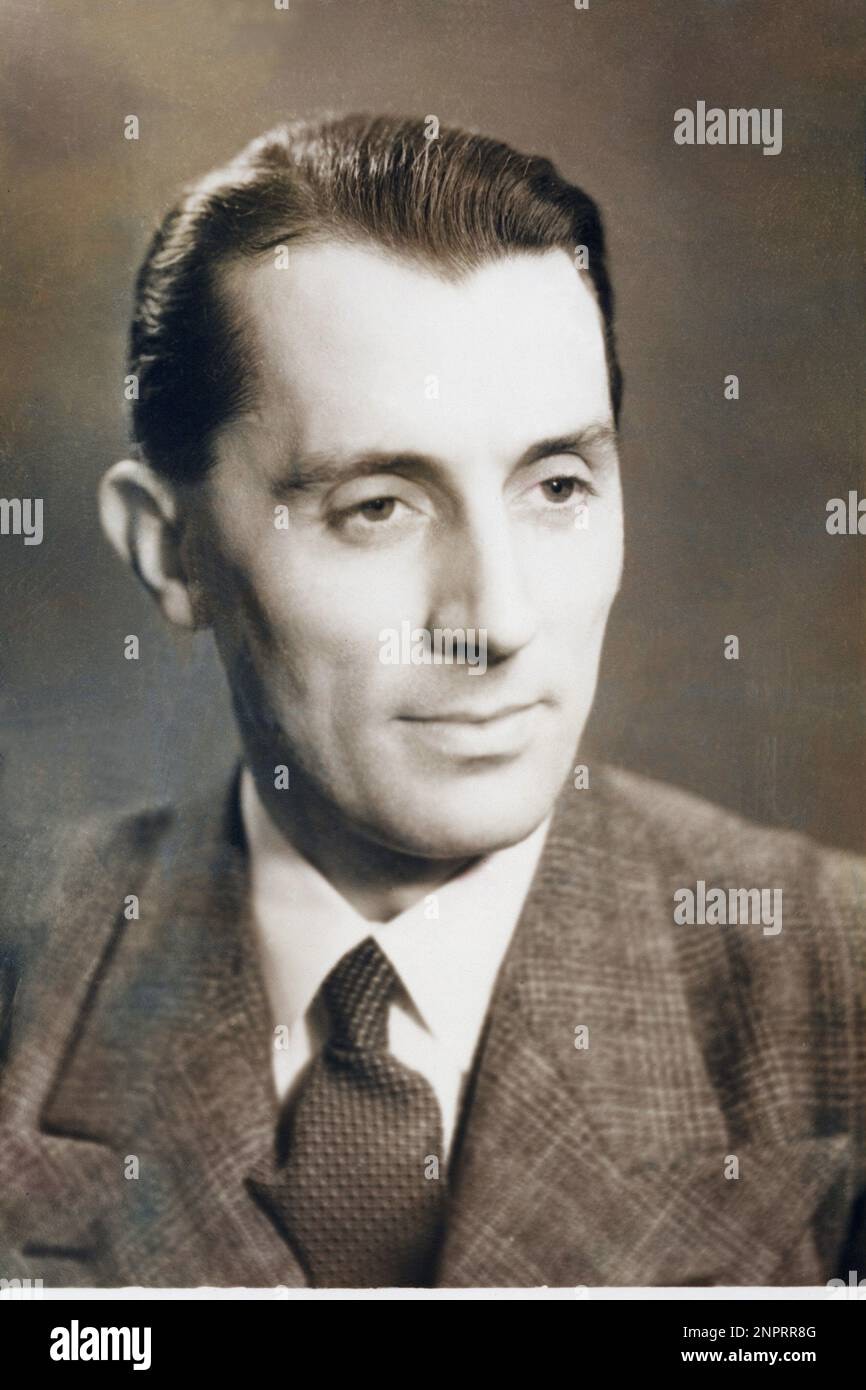
Frédéric Joliot-Curie
 France
nuclear physicist•chemist•professor
Also known as: Jean Frédéric Joliot
Date de naissance
March 19, 1900
Signe astrologique
Pisces
Lieu de naissance
Paris, France
Âge
Décédé(e) à 58 ans
À propos
Frédéric Joliot-Curie était un physicien et chimiste français qui, avec son épouse Irène Joliot-Curie, a découvert la radioactivité artificielle. Pour cette percée, ils ont partagé le prix Nobel de chimie en 1935, devenant ainsi le deuxième couple marié à remporter un Nobel après les parents d'Irène, Marie et Pierre Curie. Aujourd'hui, son héritage perdure à travers le nom Joliot-Curie dans la science, le centre de recherche d'Orsay qu'il a contribué à fonder, et l'influence continue de ses travaux en physique nucléaire. On se souvient de lui comme d'un scientifique qui a allié une recherche brillante à un fort sens des responsabilités sociales, s'opposant aux armes nucléaires tout en promouvant l'énergie atomique à des fins pacifiques.
Jeunesse et origines
Né à Paris dans une famille protestante alsacienne, Frédéric Joliot montra très tôt un talent pour la science. Il entra à l'École Municipale de Physique et de Chimie Industrielles en 1919, où Pierre Curie avait autrefois enseigné, et en sortit major de sa promotion en 1923 en tant qu'ingénieur physicien. Son professeur Paul Langevin l'orienta vers la recherche fondamentale.
En décembre 1924, Joliot rencontra Marie Curie et devint son assistant personnel à l'Institut du Radium. Il y fit la connaissance de sa fille Irène Curie, et ils tombèrent amoureux. Marie insista pour qu'il obtienne des diplômes universitaires supplémentaires, alors Joliot décrocha un second baccalauréat, une licence, et un doctorat en 1930 avec une thèse sur l'électrochimie des radioéléments. Il épousa Irène le 4 octobre 1926, et ils adoptèrent le nom de famille conjoint Joliot-Curie.
Évolution de carrière
En janvier 1934, les Joliot-Curie bombardèrent du bore, de l'aluminium et du magnésium avec des particules alpha et créèrent de nouveaux isotopes radioactifs de l'azote, du phosphore et du silicium, la première radioactivité artificielle. Cette découverte leur valut le prix Nobel de chimie en 1935.
Joliot-Curie devint professeur au Collège de France en 1937. Pendant la Seconde Guerre mondiale, il rejoignit la Résistance française, utilisant son laboratoire pour fabriquer des explosifs et du matériel radio. Après la guerre, il fut nommé directeur du Centre national de la recherche scientifique (CNRS) en 1945 et devint le premier haut-commissaire à l'énergie atomique de la France. Il supervisa la construction du premier réacteur atomique français en 1948. En 1955, il signa le manifeste Russell-Einstein s'opposant aux armes nucléaires.
Chronologie de carrière
Image publique et style
Joliot-Curie était perçu comme un scientifique brillant et dévoué, profondément engagé dans les applications pacifiques de l'énergie nucléaire. Son travail dans la Résistance pendant la guerre ajouta une dimension héroïque à sa personnalité publique. C'était aussi une figure politique, son adhésion au Parti communiste suscitant la controverse pendant la guerre froide. Aujourd'hui, on se souvient de lui comme d'un pionnier qui a su concilier excellence scientifique et conscience sociale.
Notoriété et fandom
Frédéric Joliot-Curie's enduring recognition rests on his scientific achievements and his role in the wartime resistance, rather than on any organized fan base. There is no documented fandom name, no coordinated fan community, and no fan-driven campaigns or rituals associated with him. His legacy is preserved through institutions such as the Institut Curie and the Joliot-Curie laboratory, as well as through Nobel Prize archives and historical foundations. The Picasso portrait from 1959 and the continued scholarly interest in the Curie family dynasty reflect a diffuse, institutional admiration rather than a modern fandom.
As of August 2026, iFANN's Global Fame Engine has evaluated Frédéric Joliot-Curie, but he does not currently hold a placement in the published rankings. This means he is not listed among the Global Top 1,000 most famous people, nor does he appear on any Top-100 scope list. The evaluation acknowledges his historical significance, yet his fame, while considerable, does not currently meet the threshold for a ranked position within iFANN's frameworks.
Faits intéressants et légendes
Frédéric Joliot-Curie played the piano and enjoyed landscape painting. He was an avid reader of Rudyard Kipling, and during the German occupation of France, he coordinated the production of Molotov cocktails for the Resistance. He was a commander of the Legion of Honour and received the Croix de Guerre. In 1942, he joined the French Communist Party, a decision that would later define his public life.
A widely retold story from his wartime activities involves the secret shipment of France's heavy water supply, which was smuggled to England in 1940 to prevent it from falling into German hands. Accounts describe the heavy water being hidden in containers disguised as sardine tins, though the specific details may have been embellished over time. The core event is documented and has become part of his heroic wartime legend.
Another iconic moment is the discovery of artificial radioactivity with his wife Irène in 1934, which earned them the 1935 Nobel Prize in Chemistry. This breakthrough transformed nuclear physics and led to advances in medical imaging and cancer treatment. The Nobel ceremony itself, where they followed in the footsteps of Irène's parents, Marie and Pierre Curie, holds a special place in scientific lore.
Famille et vie privée
Frédéric Joliot-Curie épousa Irène Curie en 1926. Ils eurent deux enfants : Hélène, née en 1927, qui devint physicienne, et Pierre, né en 1932, qui devint biologiste. La famille vivait à Paris et à l'Institut du Radium. Irène mourut en 1956 d'une leucémie liée à l'exposition aux radiations. Frédéric ne se remaria jamais.
Relations notables
Relations et vie amoureuse
Frédéric Joliot a rencontré Irène Curie à l'Institut du Radium en 1925, où elle travaillait aux côtés de sa mère Marie. Ils se sont mariés le 4 octobre 1926 et ont adopté le nom de famille conjoint Joliot-Curie. Leur partenariat était à la fois personnel et professionnel ; ils ont collaboré à la découverte de la radioactivité artificielle. Irène est morte de leucémie en 1956. Frédéric ne s'est pas remarié, restant dévoué à sa mémoire jusqu'à sa propre mort en 1958.
- Marié(e)Irène Joliot-Curie1926 - 1956Mariés le 4 octobre 1926. Ont collaboré à des recherches primées par le prix Nobel. Irène est morte en 1956.
Décès et conséquences
Décès
August 14, 1958 (à 58 ans)
Lieu de décès
Paris, France
Cause du décès
Inconnu
A lithograph portrait drawn by Pablo Picasso in February 1959 stands as a notable cultural artifact commemorating the intersection of two giants of the 20th century, created specifically as an homage following the scientist's passing. This posthumous tribute from a fellow icon preceded any formal state recognition, reflecting the deep respect held for Joliot-Curie among peers in both the scientific and political spheres who noted his contributions to nuclear physics and his engagement with the World Peace Council. The man known for opposing nuclear weapons while advancing atomic energy for peaceful uses passed away on August 14, 1958, in Paris, France, at the age of 58, concluding a life that had seen him serve as a professor at the Collège de France and a director of the National Centre for Scientific Research.
While his wife Irène had died in 1956 from leukemia linked to radiation exposure, Frédéric continued his work until his final days without an official hospital statement detailing the immediate circumstances or last public appearance being released. Consequently, the exact cause remains unconfirmed in public documentation, with no disputed accounts regarding foul play or accident reported in the search results. Public reaction centered on tributes from scientific and political institutions rather than commercial surges or fan vigils, acknowledging a prominent figure whose legacy extended beyond the laboratory into the realm of international peace advocacy. He was buried in the family plot consistent with Curie family tradition, though specific details regarding eulogies or attendees were not widely digitized in general biographical summaries compared to the more publicized events surrounding Marie Curie.
Posthumously, his intellectual property and estate were managed by his family, including his daughter Hélène Langevin-Joliot, who later became a nuclear physicist herself, ensuring the continuation of the family's scientific lineage.
Fortune (valeur de la succession)
La fortune de Frédéric Joliot-Curie n'est pas largement documentée. En tant que scientifique et fonctionnaire, ses revenus provenaient de salaires académiques et de prix Nobel. Il n'a pas accumulé de richesse personnelle significative. Son héritage se mesure à ses contributions scientifiques plutôt qu'à ses actifs financiers.
Récompenses remportées (2)
Frédéric Joliot-Curie a remporté le prix Nobel de chimie en 1935 conjointement avec Irène Joliot-Curie pour la découverte de la radioactivité artificielle. Il a également reçu la médaille Hughes de la Royal Society en 1947 pour ses contributions à la physique nucléaire.
1935 · Chimie
Discovery of artificial radioactivity
1947 · Physique
Contributions to nuclear physics
Connu pour
Discovery of artificial radioactivity
1934 · co-discoverer
Nobel Prize in Chemistry
1935 · laureate
Mots-clés
Sources
Faits clés
- Profession
- nuclear physicist, chemist, professor
- Né(e) le
- March 19, 1900
- Lieu de naissance
- Paris, France
- Décès
- August 14, 1958
- Lieu de décès
- Paris, France
- Genre
- Homme
- Conjoint
- Irène Joliot-Curie
- Signe astrologique
- Pisces
Informations personnelles
- Nom complet
- Jean Frédéric Joliot
- Conjoint
- Irène Joliot-Curie
- Enfants
- Hélène Joliot-Curie, Pierre Joliot-Curie
- Formation
- École Supérieure de Physique et de Chimie Industrielles de Paris
Questions fréquentes
Qui était Frédéric Joliot-Curie ?
Qu'a découvert Frédéric Joliot-Curie ?
Quand Frédéric Joliot-Curie a-t-il remporté le prix Nobel ?
Quel était le rôle de Frédéric Joliot-Curie pendant la Seconde Guerre mondiale ?
Quelle était la fortune de Frédéric Joliot-Curie ?
Personnalités similaires
Rejoindre la communauté
fans en discussion