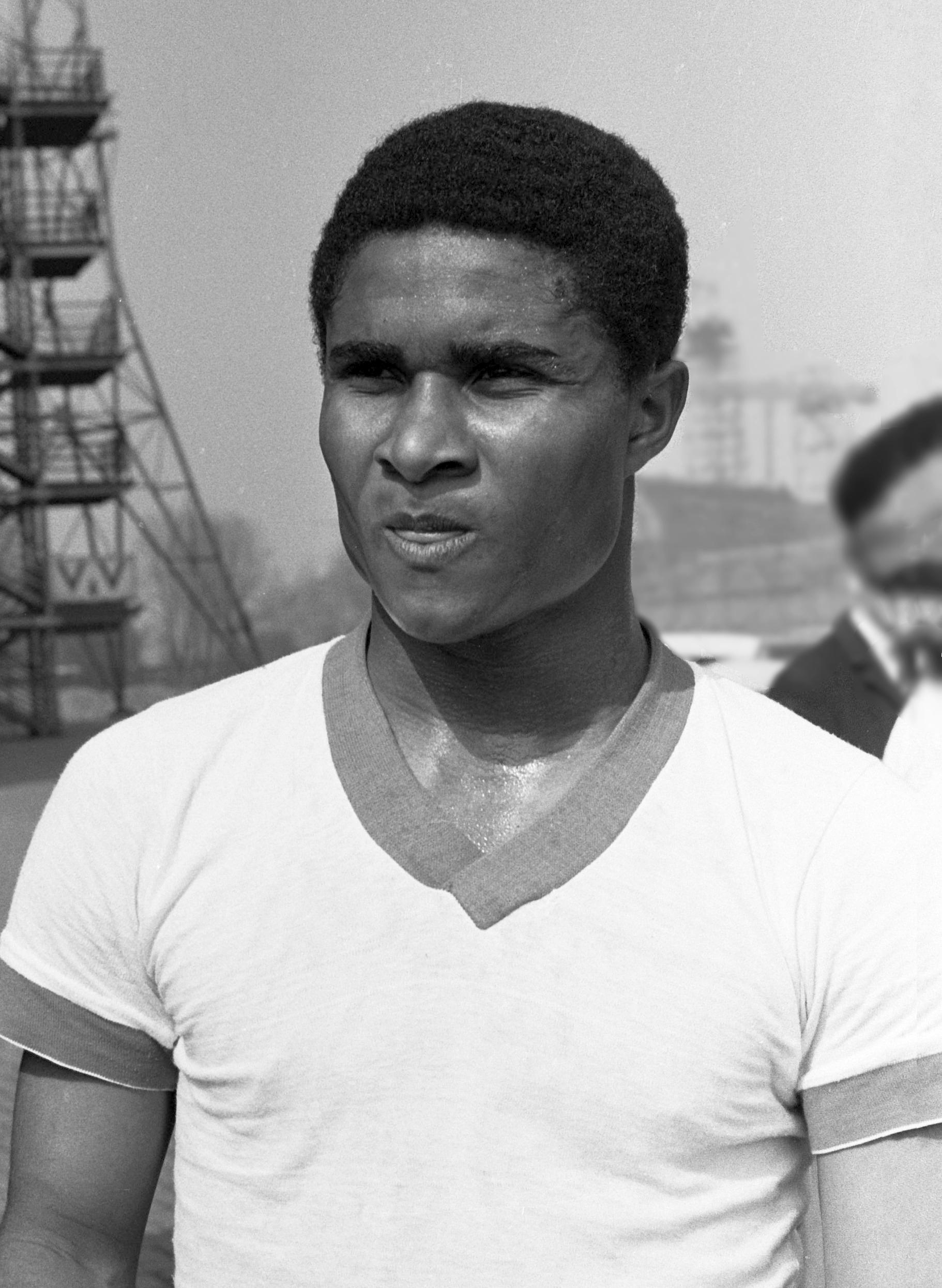
Eusébio
 Mozambique
association football player•athlete
Also known as: Black Panther, Black Pearl, O Rei
Date de naissance
January 25, 1942
Signe astrologique
Aquarius
Lieu de naissance
Maputo, Portuguese Mozambique (now Mozambique)
Âge
Décédé(e) à 71 ans
Taille
5 ft 9 in (175 cm)
À propos
Eusébio da Silva Ferreira était un footballeur portugais largement considéré comme l'un des plus grands attaquants de l'histoire. Connu pour sa vitesse explosive, son puissant tir du pied droit et son athlétisme remarquable, il a marqué 733 buts en 745 matchs de carrière. Eusébio est le meilleur buteur de l'histoire du Benfica avec 473 buts en 440 apparitions en compétition et a mené le Portugal à une troisième place à la Coupe du monde 1966, remportant le Soulier d'or avec neuf buts. Il a gagné le Ballon d'Or en 1965 et a été le premier joueur à remporter le Soulier d'or européen, qu'il a gagné deux fois. Son palmarès comprend 11 titres de Primeira Liga et une Coupe d'Europe avec Benfica. Après sa retraite, il a servi d'ambassadeur mondial du football et reste un héros national bien-aimé au Portugal et une icône du football africain. Les fans et ses pairs le vénèrent comme « O Rei » (Le Roi).
Jeunesse et origines
Eusébio a grandi dans le quartier de Mafalala à Maputo, une banlieue pauvre où il jouait souvent au football pieds nus avec une chaussette remplie de journaux. Son père, un cheminot portugais blanc, est mort quand Eusébio avait huit ans, laissant la famille dans la pauvreté. Il a quitté l'école vers 12 ans pour travailler à des petits boulots, notamment comme cireur de chaussures et assistant mécanicien, afin de soutenir sa mère. À 15 ans, il a rejoint l'équipe de jeunes du Sport Lourenço Marques, marquant 55 buts lors de sa première saison. En 1960, il a été sélectionné pour représenter le Mozambique dans un tournoi au Brésil. Le recruteur de Benfica, José Carlos Bauer, initialement envoyé pour observer un autre joueur, a été stupéfait par la performance d'Eusébio. Le président de Benfica, Maurício Vieira de Brito, a négocié son transfert pour environ 7 500 £, et Eusébio est arrivé à Lisbonne en décembre 1960, juste avant son 19e anniversaire.
Évolution de carrière
Eusébio a fait ses débuts avec Benfica lors d'un match amical contre Santos le 23 mai 1961, marquant un triplé. Ses débuts officiels en compétition ont eu lieu le 1er juin 1961 contre Belenenses. Lors de la finale de la Coupe d'Europe 1962, il a marqué deux fois pour aider Benfica à battre le Real Madrid 5-3 et à conserver le trophée. Il a remporté le Ballon d'Or en 1965, devenant le premier joueur portugais à le faire. À la Coupe du monde 1966, il a marqué neuf buts en six matchs, dont quatre contre la Corée du Nord en quarts de finale, remportant le Soulier d'or. Il a gagné le premier Soulier d'or européen en 1968 avec 42 buts en championnat et a réitéré l'exploit en 1973 avec 40 buts. Il a remporté la Bola de Prata en tant que meilleur buteur de la Primeira Liga un record de sept fois. Après 15 saisons à Benfica, il est parti en 1975, ayant marqué 473 buts en 440 matchs de compétition. Il a ensuite joué pour les Boston Minutemen, Monterrey, Toronto Metros-Croatia (remportant le championnat NASL en 1976), Las Vegas Quicksilver et San Jose Earthquakes avant de prendre sa retraite en 1978.
Chronologie de carrière
Image publique et style
Le style de jeu d'Eusébio était défini par une vitesse explosive, un puissant tir du pied droit et un incroyable athlétisme. Il portait généralement un maillot blanc de Benfica avec un short noir. Les médias le dépeignaient comme une figure humble, généreuse et profondément loyale, l'appelant souvent « O Rei » (Le Roi). Les fans de Benfica, connus sous le nom de Benfiquistas, le tiennent en vénération quasi-sainte ; son maillot numéro 13 a été retiré par le club, et sa statue devant l'Estádio da Luz est un lieu de pèlerinage. Les fans chantent son nom pendant les matchs. Les comptes officiels sur les réseaux sociaux, gérés par sa succession, publient des séquences historiques et des hommages en portugais et en anglais. Eusébio est célébré à la fois comme un héros national portugais et une icône du football africain.
Notoriété et fandom (iFAMOUS Rankings)
Eusébio da Silva Ferreira is currently evaluated by the iFANN Global Fame Engine as holding no placement in the published rankings, a status that reflects his standing as a historical figure rather than a current trending entity. While he does not occupy a spot within the Global Top 1,000 or any scope-specific top-100 lists as of August 2026, his enduring presence remains anchored in the institutional memory of Portuguese football and the broader global consciousness of the sport's history. His fanbase lacks a single, globally recognized official name distinct from the clubs he served; supporters identify primarily through their allegiance to S.L. Benfica or the Portuguese national team. Within these groups, Eusébio is revered not merely as a player but as a cultural icon, often referred to collectively by his nicknames "O Rei" (The King) and "A Pantera Negra." The term "Black Panther" evokes a mythology surrounding his speed and ferocity, transcending sports to enter the Portuguese cultural lexicon. The club itself serves as the primary vessel for this fandom, with the Estádio da Luz functioning as a pilgrimage site where fans sing his name during matches. Posthumously, his legacy has been maintained through high-profile tributes initiated by state institutions and the club, including a prominent statue in Lisbon and an archive dedicated solely to his career at the Museu do Sport Lisboa e Benfica. A significant interaction occurred in 2026 when Cristiano Ronaldo surpassed Eusébio's World Cup goal record, sparking public discourse among fans who actively compared modern achievements against the benchmarks set by the late legend.
Faits intéressants et légendes
Eusébio's powerful right-footed shot was measured at 120 km/h (75 mph), a feat of physical capability that defined his era. He was the first African-born player to win the Ballon d'Or and scored a hat-trick on his Benfica debut against a Santos side featuring Pelé. In the 1966 World Cup quarter-final, Portugal trailed North Korea 3–0 after 25 minutes; Eusébio scored four goals to secure a 5–3 victory, a story fans still retell as the moment Portugal came of age on the world stage. He turned down a move to Real Madrid in 1965 to remain at Benfica and was never sent off in his entire professional career. A heavy smoker, he reportedly consumed two packs of cigarettes daily during his playing days. The nickname "Black Panther" was coined by French journalists following a match against Stade de Reims. Beyond his statistics, the narrative of his death and state funeral in 2014 solidified his transition from sporting hero to national saint, with millions lining Lisbon streets to bid him farewell. Recent discussions have also framed his legacy through the lens of colonial history, noting how he was celebrated while the realities of his birthplace were often softened in the national mythos.
Citations notables
“I never thought about records. I just wanted to play football and score goals.”
“Benfica is my life. I owe everything to this club.”
“When I played, I played for the love of the game. The money was secondary.”
“I am proud to be African, proud to be Portuguese, and proud to have represented both.”
Famille et vie privée
Eusébio était le quatrième enfant de Laurindo António Ferreira, un cheminot portugais blanc, et d'Elisa Anissabeni, une femme mozambicaine noire. Son père est mort quand il avait huit ans. Il a épousé Flora Claudina Burheim, une femme portugaise d'origine allemande, le 28 décembre 1965. Ils ont eu deux enfants : Carlos, né en 1966, et Sandra, née en 1969. Eusébio et Flora sont restés mariés jusqu'à la mort de ce dernier en 2014. Son fils Carlos gère sa succession et son image publique. La famille vivait à Lisbonne, et Eusébio était connu pour être profondément dévoué à sa famille.
Relations notables
Eusébio partageait une amitié proche avec Pelé, qui l'appelait « le plus grand joueur que j'aie jamais vu ». Son partenaire au milieu de terrain à Benfica et au Portugal était Mário Coluna, et son partenaire d'attaque était José Torres. L'entraîneur Béla Guttmann l'a recruté et a mené Benfica à la Coupe d'Europe 1962. Le fils d'Eusébio, Carlos Ferreira, gère sa succession et son image publique.
Relations et vie amoureuse
Eusébio était marié à Flora Claudina Burheim du 28 décembre 1965 jusqu'à sa mort en 2014. Ils se sont rencontrés par l'intermédiaire d'amis communs à Lisbonne et ont célébré un mariage catholique. Le couple a eu deux enfants : Carlos (né en 1966) et Sandra (née en 1969). Leur mariage a duré 48 ans, sans aucun rapport public de séparation ou de divorce. En 2026, Eusébio est décédé ; au moment de sa mort, il était toujours marié à Flora.
- Marié(e)Flora Claudina Burheim1965 - 2014Rencontrés par des amis communs à Lisbonne ; mariage catholique ; deux enfants ensemble ; sont restés mariés jusqu'à la mort d'Eusébio.
Décès et conséquences
Décès
January 5, 2014 (à 71 ans)
Lieu de décès
Lisbon, Portugal
Cause du décès
Insuffisance cardiaque
Eusébio da Silva Ferreira spent his final days receiving treatment for respiratory and cardiac complications at the Hospital de Santa Maria in Lisbon, having largely withdrawn from public view due to declining health. He passed away on January 5, 2014, at the age of 71, with official statements from his family and Benfica club officials confirming the event occurred following a period of hospitalization. The cause of death was reported as heart failure, a condition consistent with his long-standing health issues. Public reaction to his passing was immediate and global, characterized by an outpouring of grief from the football community, including tributes from FIFA, UEFA, Pelé, Franz Beckenbauer, and Cristiano Ronaldo.
The Portuguese government declared three days of national mourning, while fans gathered spontaneously outside the Estádio da Luz and the hospital to lay flowers and light candles. A moment of silence was observed during major football matches worldwide, honoring the man who led Portugal to a third-place finish at the 1966 World Cup. The funeral took place on January 8, 2014, in Lisbon as a state funeral held at the National Pantheon before his burial at the Cemitério dos Prazeres. The ceremony featured religious rites and eulogies attended by thousands of mourners, including President Aníbal Cavaco Silva and Prime Minister Pedro Passos Coelho, marked by a military honor guard and the playing of the national anthem.
Posthumously, the stadium where he played his entire club career was renamed the Estádio da Luz, Eusébio in 2015, and a statue now stands prominently outside the ground. The Eusébio Foundation continues to operate focusing on social projects and youth football development in Mozambique and Portugal, while several books and documentaries have been released analyzing his 1966 performance. His estate remains managed privately without public dispute.
Fortune (valeur de la succession)
$10 Million
Estimation de l’équipe éditoriale d’iFANN
Per iFANN's editorial analysis, Eusébio da Silva Ferreira had an estimated net worth of $10 Million at the time of his death in 2014. This figure represents the accumulated value of his illustrious playing career, most notably his tenure with Benfica, where he earned substantial salaries and bonuses throughout his prime. Additionally, he benefited from various endorsement deals and public appearances, though specific figures from those contracts are not publicly detailed. Following his retirement, Eusébio served as a global ambassador for football, a role that provided ongoing income and sustained his financial standing until his passing. His net worth reflects a lifetime of achievement in the sport, with earnings derived from contracts, endorsements, and later ambassadorial roles contributing to his financial legacy.
Récompenses remportées (20)
Eusébio a remporté le Ballon d'Or en 1965 et a été le premier récipiendaire du Soulier d'Or européen, qu'il a obtenu en 1968 et 1973. Il a décroché le Soulier d'Or de la Coupe du Monde en 1966 avec neuf buts et a été trois fois meilleur buteur de la Coupe d'Europe. Au niveau national, il a remporté la Bola de Prata un record de sept fois. Il a été élu Footballeur portugais de l'année à six reprises. En 2003, l'UEFA l'a nommé Joueur en or du Portugal, et en 2004, il a été inclus dans la liste FIFA 100 par Pelé.
1965 · Meilleur Joueur
Benfica / Portugal
1973 · Meilleur Buteur
Benfica
1968 · Meilleur Buteur
Benfica
Connu pour
1966 FIFA World Cup
1966 · Portugal striker (9 goals, Golden Boot)
Benfica
1961 · Striker (all-time top scorer, 473 goals)
Ballon d'Or
1965 · Récipiendaire
European Cup
1962 · Winning goalscorer in final
Mots-clés
Faits clés
- Profession
- association football player, athlete
- Né(e) le
- +1942-01-25
- Lieu de naissance
- Maputo
- Décès
- +2014-01-05
- Lieu de décès
- Lisbon
- Genre
- Homme
- Conjoint
- Flora Claudina Burheim
- Signe astrologique
- Aquarius
Informations personnelles
- Nom complet
- Eusébio da Silva Ferreira
- Taille
- 5 ft 9 in (175 cm)
- Conjoint
- Flora Claudina Burheim
- Enfants
- Carlos Ferreira (son, born 1966), Sandra Ferreira (daughter, born 1969)
Questions fréquentes
Quel âge avait Eusébio à sa mort ?
Quelle est la fortune d'Eusébio en 2026 ?
Eusébio était-il marié ?
Pourquoi Eusébio est-il considéré comme l'un des plus grands footballeurs de tous les temps ?
Combien de buts Eusébio a-t-il marqués lors de la Coupe du Monde 1966 ?
Personnalités similaires

Rejoindre la communauté
fans en discussion