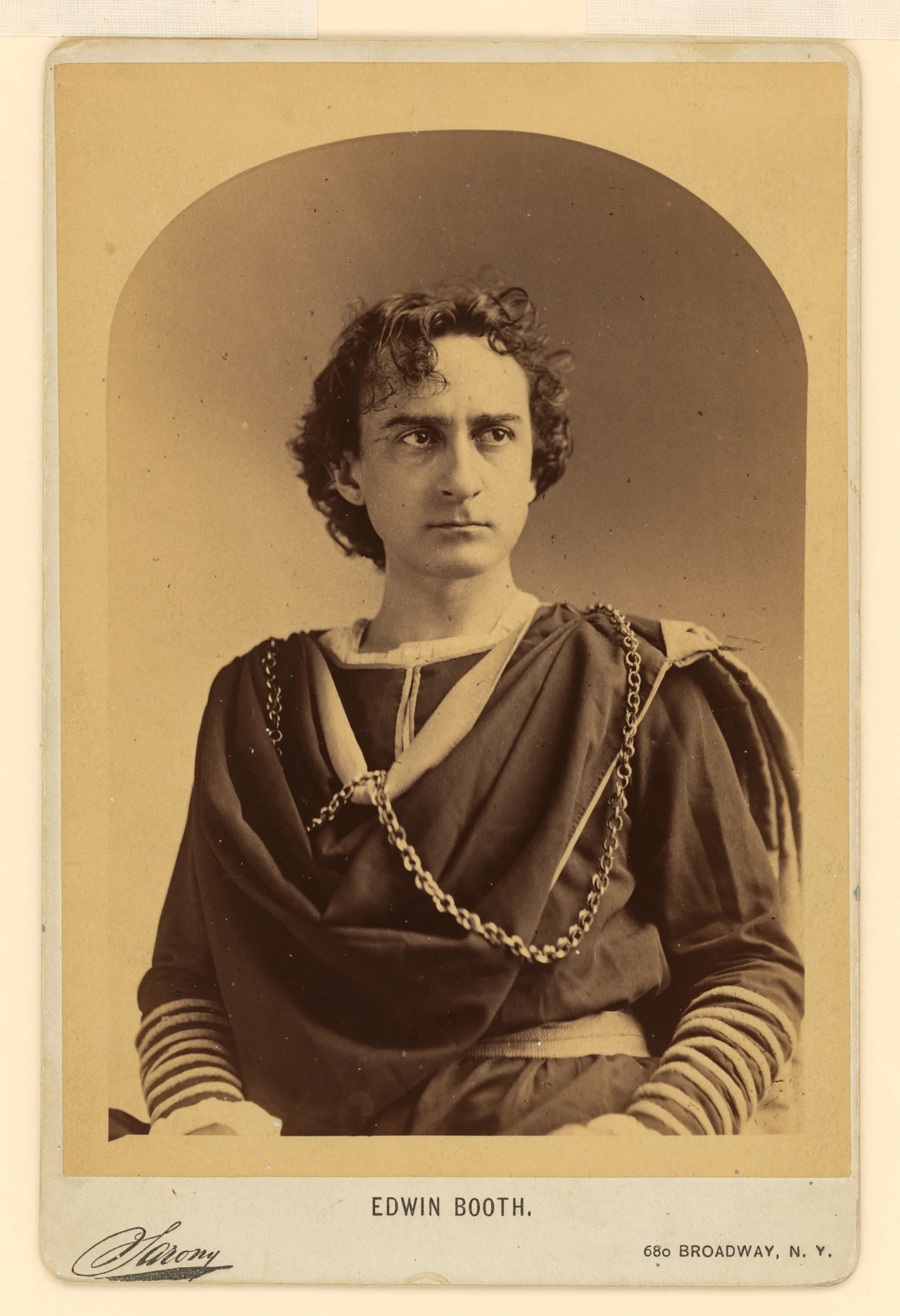
Edwin Booth
 Belgium
Also known as: Edwin Thomas Booth, The Master
Date de naissance
November 13, 1833
Signe astrologique
Scorpio
Lieu de naissance
Bel Air, Maryland, United States
Âge
Décédé(e) à 59 ans
À propos
Edwin Thomas Booth était un acteur de théâtre et directeur de théâtre américain, largement considéré comme le plus grand acteur shakespearien américain du XIXe siècle. Né dans une dynastie théâtrale, Booth s'est fait connaître grâce à ses interprétations nuancées de personnages complexes, en particulier Hamlet, qu'il a joué plus souvent qu'aucun autre acteur avant ou après lui. Sa série record de 100 représentations consécutives d'Hamlet en 1864-65 reste inégalée. Booth a fondé le Booth's Theatre à New York en 1869, un lieu à la pointe de la technologie qui incarnait sa vision artistique. Malgré son immense succès professionnel, son héritage est souvent lié à celui de son jeune frère, John Wilkes Booth, qui a assassiné le président Abraham Lincoln. Aujourd'hui, Booth est considéré comme une figure transformatrice du théâtre américain, dont le style réservé et introspectif a révolutionné l'interprétation shakespearienne. Il était de petite taille, mince, brun et sensible d'apparence, avec un visage pâle et mobile marqué par la mélancolie. Sa présence sur scène était décrite comme ayant une étrange qualité magnétique, attirant les foules partout où il se produisait. L'intégrité personnelle de Booth et son dévouement à son art lui ont valu des admirateurs, même si l'infamie de son frère menaçait d'éclipser ses réalisations. Il reste un sujet de recherche historique et de biographie, sa vie étant dépeinte dans le film de 1955 Prince of Players avec Richard Burton.
Jeunesse et origines
Edwin Booth est né le 13 novembre 1833 à Bel Air, dans le Maryland, dans la cabane en rondins de la famille. Il a été nommé d'après Edwin Forrest et Thomas Flynn, deux collègues de son père. Son enfance a été marquée par l'alcoolisme croissant et l'instabilité de son père. Junius Brutus Booth, considéré comme le plus grand acteur américain de son époque, a commencé à boire abondamment et a souffert de crises de rage après la mort de trois de ses enfants en peu de temps. À l'âge de 13 ans, Edwin a été envoyé pour accompagner son père en tournée, chargé de le maintenir sobre et sain d'esprit. La biographe Eleanor Ruggles a écrit que la présence calme et attentionnée d'Edwin pouvait « rappeler le père lorsque Booth était en proie à la mélancolie ou perdu dans la frénésie ». Cette expérience lui a donné une éducation précoce dans le style d'acteur emphatique de l'époque. Edwin a reçu une éducation formelle limitée mais a fait preuve d'une intelligence et d'une détermination remarquables. Il a fait ses débuts sur scène le 10 septembre 1849 au Boston Museum, jouant le rôle mineur de Tressel face à son père qui jouait Richard III. Deux ans plus tard à New York, lorsque son père a refusé de jouer, Edwin l'a remplacé dans le rôle de Richard III, livrant une performance imitative mais crédible qui a marqué son premier grand pas vers la célébrité.
Évolution de carrière
Après la mort de son père en 1852, Edwin Booth est devenu une star du circuit des théâtres de répertoire, se produisant dans des camps miniers enneigés, vivant brièvement dans une hutte près de San Francisco, tournant dans les îles du Pacifique, et revenant finalement à l'Est en 1854 pour reprendre le rôle le plus célèbre de son père, Richard III. En 1862, il devient directeur du Winter Garden Theatre à New York, où il monte des productions shakespeariennes acclamées. Sa série de 100 représentations consécutives d'Hamlet de 1864 à 1865 reste un record. Il a interprété Hamlet plus souvent qu'aucun autre acteur de l'histoire. En 1869, il fonde le Booth's Theatre, un lieu moderne doté de machineries de scène avancées, considéré comme l'un des théâtres les plus spectaculaires de son époque. Il a fait une tournée en Europe de 1880 à 1882, se produisant à Londres et dans d'autres capitales avec un grand succès. Booth a continué à jouer jusqu'à sa mort en 1893, consolidant sa réputation d'acteur américain prééminent de son siècle.
Chronologie de carrière
Image publique et style
Edwin Booth possédait une étrange qualité magnétique qui attirait les foules partout où il se produisait. Sur scène, il était transcendant et magnétique, connu pour son style raffiné et introspectif qui contrastait fortement avec l'approche emphatique de son père. Hors scène, il était décrit comme grave, réfléchi et réservé. Son visage pâle et mobile et ses yeux mélancoliques sont devenus sa marque de fabrique. Les fans bloquaient la porte des loges juste pour l'apercevoir. La personnalité réservée de Booth et son dévouement à son art lui ont valu le surnom de « Le Maître » dans les cercles théâtraux. Il était un partisan de l'Union pendant la guerre de Sécession, et son intégrité personnelle lui a valu des admirateurs même si l'infamie de son frère menaçait d'éclipser ses réalisations. Lorsqu'il marchait dans les rues, les gens s'arrêtaient pour le regarder. Sa présence sur scène était caractérisée comme ayant « une admiration qu'aucun mot ne peut décrire adéquatement ». Le style signature de Booth était raffiné et réservé, le distinguant de ses contemporains.
Notoriété et fandom (iFAMOUS Rankings)
For a man who never knew the frenzy of a modern fan base, Edwin Booth commanded a devotion that bordered on the religious. Audiences didn't just watch him; they waited by the stage door for hours, hoping to catch a glimpse of those melancholy eyes. His Hamlet, a role he performed more than any actor before or since, was the performance of a lifetime, a psychological revelation that left playgoers stunned into silence before the applause erupted. The 100-night consecutive run in 1864-65 was not merely a record, it was a phenomenon that made his name synonymous with theatrical greatness.
Yet Booth's following was not a fandom in the modern sense. There was no official name for his admirers, no organized clubs, no coordinated campaigns. His fans were the theatergoers of his era, bound by word of mouth and the shared experience of live performance. Their devotion was expressed in the packed houses and the fervent reviews, in the way they elevated him to the status of a cultural icon. Even after his death, his legacy was preserved not by fan groups but by institutions like The Players Club, which he founded, and the archives that keep his memory alive.
In the annals of fame, Edwin Booth's place is secure, though iFANN's Global Fame Engine has evaluated his standing and found that he currently does not hold a placement in the published rankings, not in the Global Top 1,000, nor in any Top-100 scope list. This is a reflection of the era in which he lived, a time before the global media landscape that fuels modern fame. Yet, in the annals of theatrical history, his name remains a touchstone, a legend that continues to resonate.
Faits intéressants et légendes
Edwin Booth's life was marked by extraordinary coincidences and quiet acts of kindness. He once saved the life of Robert Todd Lincoln, pulling the president's son from a train platform gap in Jersey City, a story that gains tragic irony when one recalls that Edwin's brother, John Wilkes, would assassinate the president a year later. This tale is often the first told to newcomers, a reflection of the strange hand of fate that linked the Booth family to the Lincolns.
During the Civil War, Booth hung a Union flag over his infant daughter's bed, a quiet declaration of loyalty that contrasted sharply with his brother's actions. He also contributed to a fund that purchased a horse and buggy for the poet Walt Whitman, who had become lame, a gesture of kindness that spoke to his character. Booth urged his daughter to learn ice-skating, lamenting that he had no childhood opportunities for play, and he lived a Bohemian lifestyle in his early career, with casual encounters he boasted about in letters to his brother Junius.
The Folger Shakespeare Library holds extensive materials on the Booth family, ensuring his legacy is preserved. His support for President Lincoln made his brother's assassination particularly devastating, and he withdrew from the stage briefly in the public backlash. He is interred at Mount Auburn Cemetery in Cambridge, Massachusetts, where his grave remains a site of pilgrimage for theater lovers.
Citations notables
“My youth began with my marriage.”
“Starring around the country is sad work.”
“I have never known a happy day since I left the stage.”
“The actor must be a student of human nature.”
“The stage is a world within a world.”
Famille et vie privée
Edwin Booth était le septième de dix enfants nés de Junius Brutus Booth, un célèbre acteur d'origine anglaise, et de Mary Ann Holmes, sa maîtresse qui devint plus tard son épouse. Son frère aîné était Junius Brutus Booth Jr., directeur de théâtre. Ses frères et sœurs plus jeunes comprenaient Asia Booth Clarke et John Wilkes Booth, l'acteur qui assassina le président Lincoln. Edwin a eu un enfant survivant, une fille nommée Edwina Booth Grossman, issue de son premier mariage. Il a vécu à New York et plus tard dans sa vie est devenu un reclus. Aucun animal de compagnie n'est documenté. Après l'assassinat de Lincoln, Edwin n'a pas été emprisonné comme d'autres membres de la famille parce qu'il avait des amis haut placés.
Relations notables
Edwin Booth était le fils de Junius Brutus Booth, un acteur célèbre, et le frère de John Wilkes Booth, qui a assassiné Abraham Lincoln. Il était également le frère de Junius Brutus Booth Jr., directeur de théâtre, et d'Asia Booth Clarke. Sa première épouse, Mary Devlin, était actrice, et sa seconde épouse, Mary McVicker, également actrice. Sa fille Edwina Booth Grossman a compilé ses lettres. Il a contribué à un fonds pour le poète Walt Whitman.
Relations et vie amoureuse
Edwin Booth a été marié deux fois. Sa première épouse était Mary Devlin, une actrice qui a joué Juliette face à son Roméo à Richmond, en Virginie. Ils se sont mariés en 1860, et Mary a abandonné la scène pour devenir sa femme. Ils ont eu une fille, Edwina, née en 1861. Mary est décédée en 1863, peu après le premier anniversaire d'Edwina. Booth a dit d'elle : « Ma jeunesse a commencé avec mon mariage. » En 1869, il a épousé Mary McVicker, également actrice. Ce mariage a duré jusqu'à sa mort en 1881. Aucun enfant n'a survécu du second mariage. Booth a également eu des relations informelles plus tôt dans sa carrière, comme en témoignent ses lettres à son frère. Au moment de sa mort en 1893, Booth était veuf, ayant survécu à ses deux épouses.
- Marié(e)Mary Devlin Booth1860 - 1863Mary Devlin était une actrice qui a épousé Booth en 1860 et a donné naissance à leur fille Edwina en 1861. Elle est décédée en 1863.
- Marié(e)Mary McVicker Booth1869 - 1881Mary McVicker était une actrice. Le mariage a duré jusqu'à sa mort en 1881. Aucun enfant survivant.
Décès et conséquences
Décès
June 7, 1893 (à 59 ans)
Lieu de décès
New York City
Cause du décès
Apoplexy
The official announcement regarding Edwin Thomas Booth's passing came from his attending physicians, who certified the cause as apoplexy following a sudden collapse at his New York City residence. The celebrated actor, born in 1833, succumbed to what was understood to be a cerebral hemorrhage on June 7, 1893, at the age of fifty-nine. His final days had been marked by a decline in health attributed to chronic heart issues and the physical toll of years spent touring, though he had already retired from active stage management before his last hours.
The theatrical community and the public reacted with immediate and profound mourning, recognizing the loss of the man who had worked tirelessly to restore the family name after the tragedy involving his brother. Tributes poured in from institutions across the United States and Europe, honoring the actor whose record-breaking performances of Hamlet had defined a generation of American theater. Booth's funeral was conducted shortly after his death as a private affair attended by family and close friends, reflecting both the sensitivity of his history and his high standing within the profession.
He was laid to rest at Mount Auburn Cemetery in Cambridge, Massachusetts, where his grave has since become a site of interest for those studying American theater history. Posthumous recognition continued to grow, notably through the dedication of a statue in Gramercy Park, which commemorates his character and his famous rescue of Robert Todd Lincoln. His legacy was further cemented by publications such as an article in The Century Magazine, which helped distinguish his heroic narrative from the infamy of his sibling.
Fortune (valeur de la succession)
$5 Million
Estimation de l’équipe éditoriale d’iFANN
iFANN currently estimates the estate of Edwin Booth at approximately $5 million. During his lifetime, Booth earned substantial sums from his tours and theatre management, often commanding thousands of dollars per performance. However, he also spent heavily on his theatrical ventures, particularly Booth's Theatre, which proved a financial burden. After his death in 1893, his estate was managed by his daughter, Edwina Booth Grossman, who compiled and published his letters in 1902. Revenue sources for the estate include royalties from published works, licensing of his name and image for historical publications, and ongoing performances of Shakespearean productions associated with his legacy. The estate has grown modestly over the years through careful management and historical interest. Specific estate valuation figures from his death are not readily available, but his earnings from starring tours and theatre management were significant, though offset by the costs of his ambitious theatrical projects.
Prix et distinctions
View 5 records, honours and achievementsConnu pour
Hamlet
1864 · Hamlet
Richard III
1851 · Richard III
Booth's Theatre
1869 · Fondateur
Mots-clés
Sources
Faits clés
- Profession
- stage actor, theatre manager
- Né(e) le
- +1833-11-13
- Lieu de naissance
- Bel Air, Maryland, United States
- Décès
- +1893-06-07
- Lieu de décès
- New York City, New York, United States
- Genre
- Homme
- Conjoint
- Mary Devlin Booth, Mary McVicker Booth
- Signe astrologique
- Scorpio
Informations personnelles
- Nom complet
- Edwin Thomas Booth
- Conjoint
- Mary Devlin Booth, Mary McVicker Booth
- Enfants
- Edwina Booth Grossman
Questions fréquentes
Pour quoi Edwin Booth est-il le plus connu ?
Comment Edwin Booth a-t-il réagi au meurtre de Lincoln par son frère ?
Edwin Booth a-t-il eu des enfants ?
Combien de fois Edwin Booth s'est-il marié ?
Quel théâtre Edwin Booth a-t-il construit ?
Personnalités similaires
Rejoindre la communauté
fans en discussion