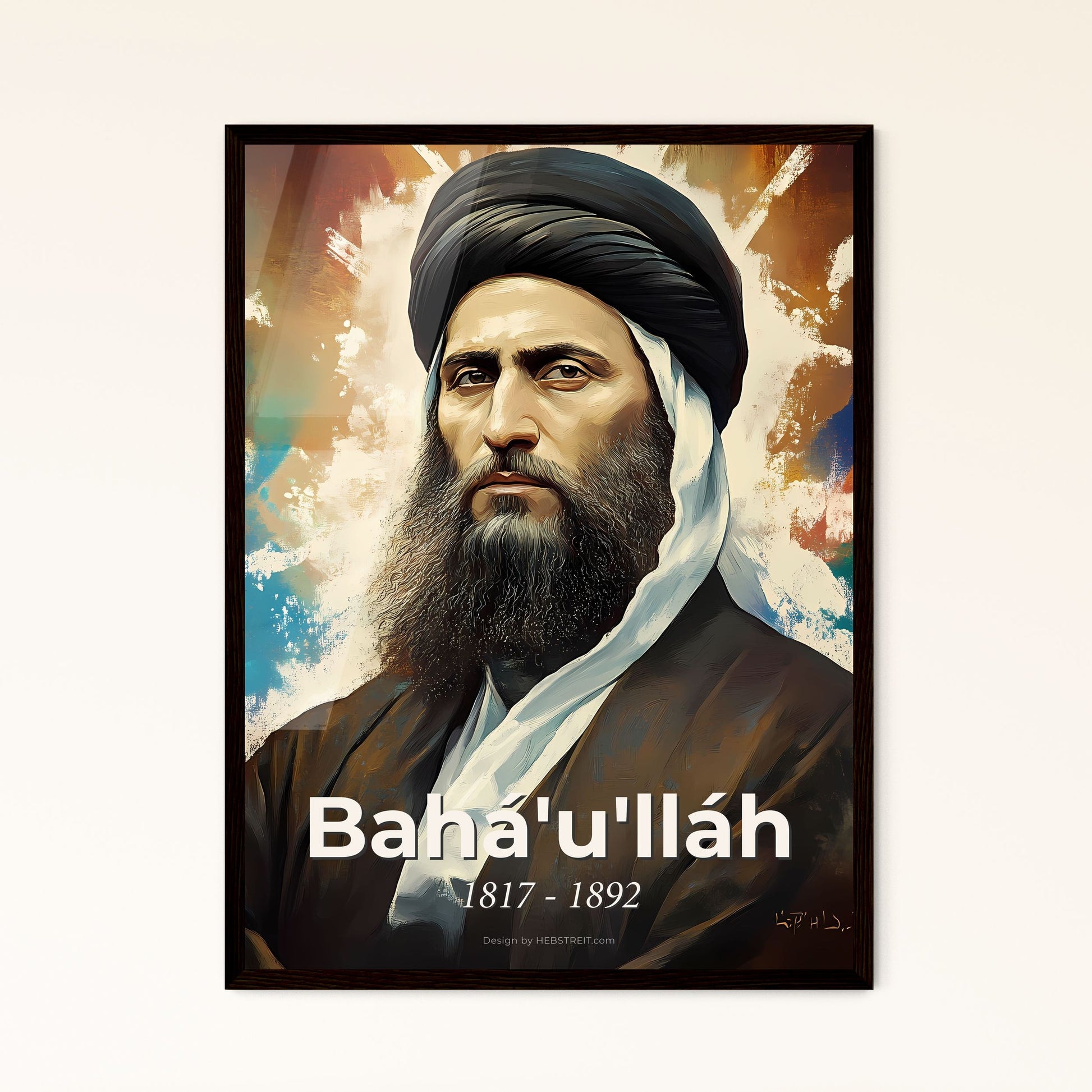
Baháʼu'lláh
 Iran
IranAlso known as: Mírzá Ḥusayn-ʻAlí Núrí, Baháʼu'lláh, The Blessed Beauty
Date de naissance
November 12, 1817
Signe astrologique
Scorpio
Lieu de naissance
Tehran, Persia (now Iran)
Âge
Décédé(e) à 74 ans
À propos
Baháʼu'lláh, born Mírzá Ḥusayn-ʻAlí Núrí in 1817, was the founder of the Baháʼí Faith, a global religion with 5 to 8 million adherents. He is revered by Baháʼís as the latest Manifestation of God, a messenger who brings divine guidance for the modern age. His writings, numbering over 1,500 works, form the sacred scripture of the Baháʼí Faith and have been translated into hundreds of languages. Central to his message is the unity of humanity, the harmony of science and religion, and the establishment of a just world civilization. Today, the Baháʼí community is active worldwide, working on social and economic development projects, interfaith dialogue, and promoting peace. Baháʼu'lláh's shrine near Acre, Israel, is a pilgrimage site and the holiest place for Baháʼís.
Jeunesse et origines
Baháʼu'lláh est né dans une famille aristocratique éminente à Téhéran. Son père, Mírzá ʻAbbás Núrí, était vizir du Shah, ce qui conférait à la famille une richesse et une influence considérables. Dès son plus jeune âge, Baháʼu'lláh a montré une compassion remarquable pour les pauvres et une profonde inclination spirituelle. Il a refusé l'éducation traditionnelle offerte aux enfants nobles, préférant étudier par lui-même, mais il est devenu très versé dans la littérature persane et arabe, la philosophie et le mysticisme islamique.
À 22 ans, son père mourut et le gouvernement lui offrit un poste ministériel de haut rang. Il refusa, choisissant plutôt de gérer les domaines familiaux et de se consacrer à des œuvres caritatives. Il devint connu pour sa générosité, donnant souvent de l'argent et de la nourriture aux nécessiteux. En 1844, à 27 ans, il rencontra le mouvement bábí, un mouvement religieux réformateur qui proclamait l'arrivée imminente d'un nouveau messager divin. Baháʼu'lláh embrassa les enseignements du Báb et devint rapidement un leader éminent, utilisant sa richesse pour protéger et soutenir ses coreligionnaires bábís. Cela attira l'attention des autorités, et après l'exécution du Báb en 1850, Baháʼu'lláh fut arrêté et emprisonné dans le célèbre cachot de Síyáh-Chál à Téhéran. C'est là, dans les chaînes et l'obscurité, qu'il fit l'expérience des premières intuitions de sa propre mission divine.
Évolution de carrière
Le tournant eut lieu en 1853 lorsque Baháʼu'lláh fut libéré du Síyáh-Chál et exilé à Bagdad. Au cours de la décennie suivante, il dirigea la communauté bábíe, qui était en désarroi après la mort du Báb. En 1863, lors d'une retraite dans un jardin près de Bagdad, il déclara publiquement à ses compagnons qu'il était celui promis par le Báb. Cette déclaration, connue sous le nom de période de Ridván, marque le début formel de la foi baháʼíe.
Les autorités ottomanes et persanes, alarmées par son influence croissante, l'exilèrent à Constantinople (Istanbul), puis à Edirne, et enfin en 1868 dans la colonie pénitentiaire d'Acre en Palestine ottomane. Malgré un emprisonnement sévère et de multiples tentatives d'assassinat, Baháʼu'lláh continua à écrire abondamment. Il rédigea le Kitáb-i-Aqdas, son livre de lois, et le Kitáb-i-Íqán, une œuvre théologique clé. À Acre, il reçut des visiteurs et écrivit des lettres aux dirigeants du monde, dont la reine Victoria et Napoléon III, appelant au désarmement et à la sécurité collective. Ses dernières années furent passées dans une liberté relative au manoir de Bahjí, où il mourut en 1892.
Chronologie de carrière
Image publique et style
Pour les baháʼís, Baháʼu'lláh est la manifestation de Dieu pour cet âge, une figure d'autorité spirituelle suprême et de compassion. Son image est celle d'un père aimant et d'un réformateur intrépide qui a enduré d'immenses souffrances pour le bien de l'humanité. Il est souvent dépeint dans la littérature baháʼíe comme la « Beauté bénie », un titre reflétant son rayonnement spirituel perçu. En dehors de la foi, il est reconnu comme un leader religieux fondateur qui a introduit des principes sociaux progressistes, tels que l'égalité des sexes et l'éducation universelle, bien avant qu'ils ne deviennent courants. Les historiens et les chercheurs étudient ses écrits pour leur profondeur littéraire et philosophique. La communauté baháʼíe, diverse et mondiale, est unie dans la vénération pour lui, célébrant sa vie et ses enseignements par la prière, l'étude et le service. Il n'y a pas de fandom au sens séculier, mais une communauté mondiale dévouée qui compte des millions de personnes.
Notoriété et fandom
The community surrounding Baháʼu'lláh operates not as a fandom in the modern pop-culture sense, but as a global religious movement with deep historical roots and structured spiritual practices. His followers, known simply as Baháʼís, do not engage in fan campaigns, chart pushes, or viral social media rituals typical of celebrity culture. Instead, their devotion is expressed through prayer, study circles, and humanitarian projects focused on social cohesion and unity. While the faith has attracted attention from public figures like Justin Baldoni and Blake Lively, this interest stems from personal biography rather than organized fan efforts centered on the founder himself. There are no unofficial names for his fanbase, nor are there any recorded instances of crowds fainting at his appearances or streets shutting down for his visits, as he lived and died over a century ago without the infrastructure of modern stardom. The legends that define his legacy are theological narratives of exile and persecution, such as his declaration as the Promised One and his journey through prisons in Baghdad, Constantinople, Adrianople, and Acre, which remain solemn historical events rather than viral internet stories. These narratives are commemorated annually during religious observances like the Ascension of Baháʼu'lláh and the Most Great Festival, marking dates of profound spiritual significance for millions worldwide. Despite his immense influence across continents, iFANN's Global Fame Engine has evaluated this person, but they do not currently hold a placement in the published rankings (Global Top 1,000 or a Top-100 scope list). This assessment reflects the unique nature of his fame, which transcends traditional metrics of media consumption and search volume.
Faits intéressants et légendes
Born Mírzá Ḥusayn-ʻAlí Núrí in 1817, Baháʼu'lláh carried the honorific 'Mírzá' to denote his noble lineage. Contemporary descriptions often highlight his striking physical presence, noting piercing eyes and a dignified bearing that commanded respect despite his humble attire during exile. He composed his vast corpus of writings using a reed pen and ink, with manuscripts now preserved in archives globally. One of his most revered works, the Hidden Words, contains short aphorisms he claimed were dictated by God. Although he never met the Báb in person, the two maintained correspondence throughout their lives. Baháʼu'lláh endured imprisonment for a total of 40 years across various locations, a period defined by his suffering for the sake of humanity. A defining legend within the Baháʼí tradition recounts his declaration of being the 'Promised One,' a claim that led to his arrest and multiple exiles from Persia to the Ottoman Empire. Another enduring story focuses on his final days at the Mansion of Bahjí in Acre, where he passed away and where his shrine now stands as a place of pilgrimage. These events are not merely folklore but are treated as verified historical facts that shaped the trajectory of the faith he founded.
Citations notables
“The earth is but one country, and mankind its citizens.”
“My purpose is none other than the education of all men.”
“The well-being of mankind, in its ultimately spiritual as well as material aspects, is the object of the Divine Unity.”
“Let your vision be world-embracing, rather than confined to your own self.”
Famille et vie privée
Baháʼu'lláh épousa trois épouses, comme c'était la coutume dans la Perse du XIXe siècle. Sa première épouse et épouse principale était Ásíyih Khánum, une noble connue pour sa dévotion et sa force. Elle l'accompagna dans tous ses exils et est considérée comme un modèle de constance. Ils eurent sept enfants, mais seulement trois survécurent jusqu'à l'âge adulte : ʻAbdu'l-Bahá, qui dirigea plus tard la foi baháʼíe ; Bahíyyih Khánum, une figure éminente ; et Mírzá Mihdí, qui mourut dans un accident à 22 ans. Baháʼu'lláh épousa également Fatimih Khánum et Gawhar Khánum, avec qui il eut d'autres enfants. La famille endura des épreuves immenses, notamment la perte de propriétés, la séparation et la mort de Mírzá Mihdí, qui tomba par une lucarne pendant qu'il priait. Le foyer de Baháʼu'lláh à Acre comprenait plusieurs de ses enfants et petits-enfants, créant une communauté soudée qui forma le noyau de l'administration baháʼíe primitive.
Relations notables
La mission de Baháʼu'lláh fut annoncée par le Báb, qui fonda le mouvement bábí. Après la mort de Baháʼu'lláh, son fils ʻAbdu'l-Bahá devint l'interprète autorisé de ses écrits et dirigea la communauté baháʼíe. Son épouse Ásíyih Khánum est vénérée comme un modèle de fidélité. D'autres figures clés incluent sa fille Bahíyyih Khánum et son fils Mírzá Mihdí.
Relations et vie amoureuse
Baháʼu'lláh a épousé sa première femme, Ásíyih Khánum, vers 1835. Elle était la fille d'un noble et resta sa principale compagne tout au long de sa vie. Ils eurent sept enfants, dont trois survécurent à l'enfance. Vers 1849, il épousa Fatimih Khánum, puis plus tard Gawhar Khánum. Ses trois femmes l'accompagnèrent lors de ses exils. Ásíyih Khánum mourut en 1886, et Baháʼu'lláh la pleura profondément. Ses mariages étaient conformes aux coutumes de l'époque, et sa vie familiale fut marquée par la dévotion et les épreuves partagées.
- Marié(e)Ásíyih Khánum1835 - 1886Épouse principale, mère de ʻAbdu'l-Bahá et de Bahíyyih Khánum.
- Marié(e)Fatimih Khánum1849 - 1892Deuxième épouse, connue sous le nom de Mahd-i-ʻUlyá.
- Marié(e)Gawhar Khánum1849 - 1892Troisième épouse.
Décès et conséquences
Décès
May 29, 1892 (à 74 ans)
Lieu de décès
Akká, Ottoman Empire (present-day Israel)
Cause du décès
Prolonged illness and fever
Baháʼu'lláh passed away on the evening of May 29, 1892, in the Mansion of Bahjí just outside Akká, bringing an end to a life defined by exile and spiritual revelation. Contemporary accounts describe his final months as marked by severe illness, extreme weakness, and fever, leaving him bedridden in seclusion attended only by family and close companions before he died peacefully after praying and dictating his final writings. Upon his death, the news spread rapidly among Baháʼís globally, with immediate tributes delivered by his son ʻAbdu'l-Bahá, who succeeded him as the leader of the faith and honored his father's teachings. The funeral was a private affair held shortly after his death, where his body was wrapped in a shroud and buried in a simple grave within the garden of the mansion according to his own instructions.
While the location of the grave remains inaccessible to non-Baháʼís due to regional sensitivities, the site became the focal point of pilgrimage and the holiest place in the religion. Following his death, his extensive writings including the Kitáb-i-Aqdas and Gleanings were compiled and translated for global distribution, while ʻAbdu'l-Bahá assumed leadership to guide the growing community. Today, May 29 is observed worldwide as the Ascension of Baháʼu'lláh, a holy day marked by prayer and reflection that continues to anchor the Baháʼí calendar.
Fortune (valeur de la succession)
Not Publicly Available
Estimation de l’équipe éditoriale d’iFANN
As a 19th-century religious leader rather than a commercial figure, Baháʼu'lláh never accumulated personal wealth in the modern sense. Born into an aristocratic family with significant property, he saw those assets confiscated by the state during his long exile and imprisonment. The iFANN Editorial Team's research traces the financial reality of his life to this total loss of material standing, noting that he lived the remainder of his days relying on the support of followers and the charity of others. Today, the institutions associated with his legacy, including the Shrine of Baháʼu'lláh, are maintained through voluntary contributions from the global Baháʼí community rather than any estate held by the founder himself.
Prix et distinctions
View 2 records, honours and achievementsConnu pour
Founding the Baháʼí Faith
1863 · Founder and Manifestation of God
Kitáb-i-Aqdas
1873 · Auteur
Hidden Words
1858 · Auteur
Kitáb-i-Íqán
1862 · Auteur
Mots-clés
Faits clés
- Profession
- writer, poet, religious leader
- Né(e) le
- +1817-11-12
- Lieu de naissance
- Tehran, Persia
- Décès
- +1892-05-29
- Lieu de décès
- Acre, Ottoman Palestine
- Genre
- Homme
- Conjoint
- Ásíyih Khánum, Fatimih Khánum, Gawhar Khanum
- Signe astrologique
- Scorpio
Informations personnelles
- Nom complet
- Mírzá Ḥusayn-ʻAlí Núrí
- Conjoint
- Ásíyih Khánum, Fatimih Khánum, Gawhar Khanum
- Enfants
- Several, including ʻAbdu'l-Bahá, Bahíyyih Khánum, and Mírzá Mihdí
Questions fréquentes
Qui était Baháʼu'lláh et qu'a-t-il fait ?
Quand et où Baháʼu'lláh est-il né ?
Quels sont les principaux enseignements de Baháʼu'lláh ?
Quel est le livre le plus important de Baháʼu'lláh ?
Où Baháʼu'lláh est-il enterré ?
Personnalités similaires
Rejoindre la communauté
fans en discussion