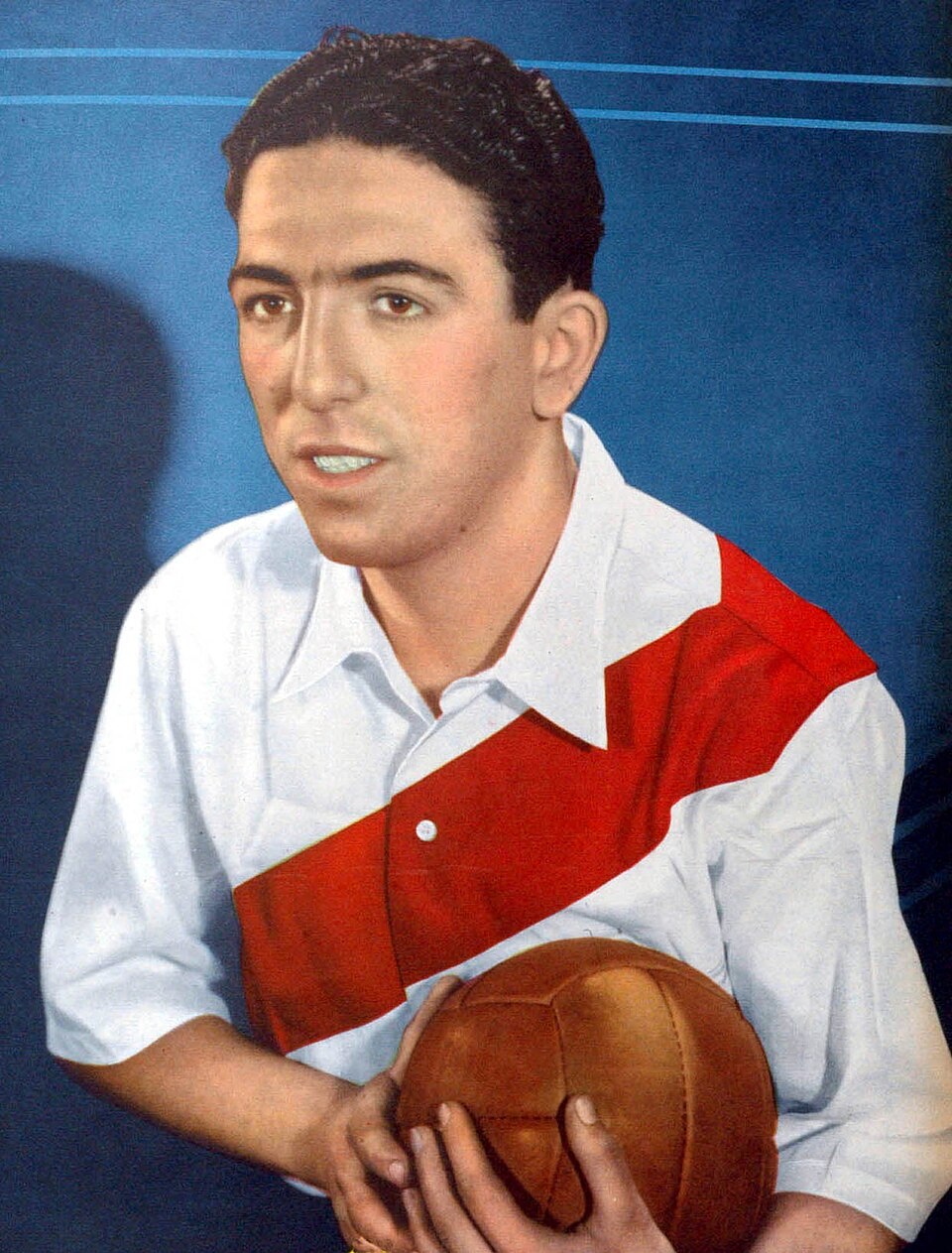
Ángel Amadeo Labruna
 Argentina
footballeur•entraîneur de football
Also known as: El Feo, Ángel Labruna
Date de naissance
September 28, 1918
Signe astrologique
Libra
Lieu de naissance
Buenos Aires, Argentina
Âge
Décédé(e) à 64 ans
Taille
5 ft 8.5 in (174 cm)
À propos
Ángel Amadeo Labruna was an Argentine footballer and coach, widely regarded as one of the greatest players in the history of Argentine football. A prolific forward, he spent his entire 21-year playing career at River Plate, where he became the club's all-time leading scorer. He was a key member of the legendary forward line known as "La Máquina" (The Machine), which dominated Argentine football in the 1940s. Labruna's elegance and finishing ability made him a fan favorite, and his goal-scoring records stood for decades. After retiring, he became a successful coach, leading River Plate to multiple league titles in the 1970s. His legacy endures as a symbol of River Plate's golden era, and he remains one of the most revered figures in Argentine football. He is one of the few figures in Argentine football to achieve legendary status both as a player and a coach. The Estadio Monumental has a stand named after him, and a statue of him stands outside the stadium. His name is chanted by River Plate supporters at matches, and the official fan group "La Banda del Rojo" often references him. Fans who honor the "La Máquina" era are sometimes called "Maquinistas."
Jeunesse et origines
Labruna est né le 28 septembre 1918 à Buenos Aires, en Argentine, dans une famille ouvrière d'origine italienne. Il a grandi dans le quartier d'Almagro à Buenos Aires, où le football était la passion dominante des rues. Sa jeunesse a été marquée par la pauvreté ; il a appris le jeu en frappant un ballon de chiffon dans les rues. Il a fréquenté les écoles locales mais a quitté l'éducation formelle tôt pour poursuivre le football. Il a commencé à jouer au football organisé dans des clubs de jeunes locaux avant d'être découvert par les recruteurs de River Plate. Il a rejoint les rangs juniors de River Plate à 14 ans. Son talent était indéniable, et il a fait ses débuts en équipe première le 18 juin 1939, à 20 ans, en marquant lors d'une victoire 3-1 contre Lanús. Ces débuts ont marqué le début d'une carrière légendaire, mais le chemin a été façonné par les rues poussiéreuses d'Almagro et la faim d'un gamin qui n'avait rien d'autre qu'un ballon.
Évolution de carrière
La percée de Labruna est survenue en tant que titulaire régulier dans l'équipe première de River Plate, et il est rapidement devenu le point central de "La Máquina", la ligne d'attaque emblématique qui comprenait également José Manuel Moreno, Adolfo Pedernera, Juan Carlos Muñoz et Félix Loustau. Entre 1941 et 1957, il a remporté neuf titres de champion d'Argentine de première division avec River Plate. Il a été le meilleur buteur du championnat huit fois, dont quatre saisons consécutives de 1943 à 1945. Il a marqué 293 buts en 515 apparitions pour River Plate toutes compétitions confondues. Ses 293 buts en championnat pour River Plate restent un record du club, et pendant des décennies, il a été le meilleur buteur de l'histoire de l'élite argentine. Il a obtenu 37 sélections pour l'Argentine, marquant 17 buts, et a participé à la Coupe du Monde 1958. Il a également joué dans les tournois de la Copa América en 1946 et 1955. Après avoir pris sa retraite en 1960 à 42 ans, il s'est tourné vers l'entraînement. Sa période la plus réussie a eu lieu à River Plate de 1975 à 1981, où il a remporté six titres de champion. Il a également entraîné à Rosario Central, Racing Club et d'autres clubs argentins, remportant la Copa Argentina 1969 avec River Plate.
Chronologie de carrière
Image publique et style
Labruna était connu pour son style de jeu élégant et gracieux, souvent décrit comme un "caballero de la cancha" (gentleman du terrain). Les médias argentins le présentent constamment comme l'un des plus grands footballeurs du pays, un symbole de l'âge d'or de River Plate. Il est souvent comparé à des légendes argentines ultérieures comme Alfredo Di Stéfano et Diego Maradona, bien qu'il les précède. Il est vénéré par les supporters de River Plate, qui scandent son nom lors des matchs. Son héritage est maintenu par des comptes de fans sur les réseaux sociaux, qui partagent des clips de ses buts et de vieilles photographies. Les comptes de fans posthumes utilisent un langage révérencieux et nostalgique. Il était connu pour sa capacité de finition exceptionnelle, marquant souvent des deux pieds et de la tête. Il portait le maillot blanc traditionnel de River Plate avec une bande rouge.
Notoriété et fandom (iFAMOUS Rankings)
Ángel Amadeo Labruna is currently evaluated by the iFANN Global Fame Engine but does not hold a placement in the published rankings, remaining outside the Global Top 1,000 and all scope lists as of August 2026. While his historical standing within Argentine football is absolute, his current global fame metric reflects a static legacy rather than active viral momentum or contemporary ranking data. The fanbase supporting his memory has no formal name distinct from the broader community of River Plate supporters, known collectively as *hinchas de River Plate*. Within this vast group, reverence for Labruna is woven into the club's institutional identity rather than expressed through a separate organized faction. Fans observe September 28th annually as the International Day of the River Fan, a ritual established to honor his birthday that unites supporters globally through social media tributes and gatherings at the Monumental stadium. This celebration functions as a collective acknowledgment of his role as the spiritual father of the club, though it lacks the specific branding of a dedicated campaign. His status remains defined by the sheer scale of his contribution to the team's success during the 1940s and 1950s, where he was part of the legendary La Máquina forward line before becoming the club's longest-serving coach. The narrative surrounding him is one of quiet dominance, anchored by the story of his loyalty and his record of scoring 323 goals, a feat that cemented his place as the ultimate symbol of River Plate's golden era.
Faits intéressants et légendes
Throughout his twenty-one-year career, Labruna maintained a flawless disciplinary record, never receiving a red card. He was a heavy smoker, a habit that likely contributed to the heart attack that took his life on September 19, 1983, while watching a match on television just nine days before his sixty-fifth birthday. Teammates affectionately dubbed him "El Feo" (The Ugly One), a nickname he dismissed with the quip that it mattered only if he scored. Standing approximately 1.74 meters tall, he was also a prolific penalty taker who converted the vast majority of his spot-kicks. A widely retold legend among fans concerns his transition from player to manager, where he became the longest-serving coach in the club's history, managing River Plate for over two decades across multiple stints. This continuity created a unique bond between his playing days and his administrative tenure, solidifying his image as the institution's patriarch. Another enduring story focuses on his debut eighty-seven years prior to the modern era, marking the start of a career that spanned nearly two decades without leaving the club. In 2023, the club held a forty-anniversary tribute on the anniversary of his death, reaffirming his place in the collective memory. Notable quotes include: "I never kicked a player in my life. I played football, not war." and "River Plate is my life. I was born with this shirt and I will die with it."
Citations notables
“I never kicked a player in my life. I played football, not war.”
“River Plate is my life. I was born with this shirt and I will die with it.”
“The goal is the essence of football. Without goals, there is no spectacle.”
“I was ugly, but I scored goals. That's all that mattered.”
“La Máquina was not just a team; it was poetry in motion.”
Famille et vie privée
Labruna était marié à Delia Rosa, et ils ont eu trois enfants : deux fils et une fille. Son fils Ángel Amadeo Labruna Jr. a suivi ses traces, jouant pour les équipes de jeunes de River Plate et devenant plus tard entraîneur. La famille vivait à Buenos Aires, et Labruna est resté proche d'eux tout au long de sa vie. Son foyer était modeste, reflétant les racines ouvrières qu'il n'a jamais oubliées. L'éducation formelle de Labruna était limitée ; il a quitté l'école tôt pour poursuivre le football.
Relations notables
Labruna est étroitement associé à ses coéquipiers de River Plate de "La Máquina" : José Manuel Moreno, Adolfo Pedernera, Juan Carlos Muñoz et Félix Loustau. Il a également brièvement joué avec Alfredo Di Stéfano à River Plate. Des légendes ultérieures de River Plate comme Enzo Francescoli et Marcelo Gallardo sont souvent comparées à lui. Son fils, Ángel Amadeo Labruna Jr., a également joué pour les équipes de jeunes de River Plate et est devenu entraîneur.
Relations et vie amoureuse
Labruna était marié à Delia Rosa, une relation qui a duré approximativement des années 1940 jusqu'à sa mort en 1983. Ils ont eu trois enfants ensemble : deux fils et une fille. Son fils Ángel Amadeo Labruna Jr. est devenu footballeur puis entraîneur. Il n'existe aucun document attestant d'autres relations amoureuses, mariages, divorces ou aventures très médiatisées. Labruna gardait sa vie privée secrète, et aucune source fiable ne confirme d'infidélités. En 2026, Labruna est décédé, et son état civil au moment de sa mort était marié à Delia Rosa.
- Marié(e)Delia Rosa1940 - 1983Ils étaient mariés approximativement des années 1940 jusqu'à la mort de Labruna en 1983, et ont eu trois enfants ensemble.
Décès et conséquences
Décès
September 19, 1983 (à 64 ans)
Lieu de décès
Buenos Aires, Argentina
Cause du décès
Inconnu
Ángel Amadeo Labruna died in Buenos Aires, Argentina, on September 19, 1983, at the age of sixty-four. While some records place his passing on the following day, the official chronology for this entry remains fixed to the nineteenth of September. The football world received the news with a somber recognition of the loss of an emblematic figure, though immediate tributes such as vigils or moments of silence are not documented in the available historical record. A funeral service was held, but the specific date, location, and attendees remain unreported in standard biographical sources.
Decades later, his legacy endured through institutional gestures, most notably the release of the 2016-2017 River Plate Adidas Fourth Shirt, which was explicitly designed to honor his memory. He remains a central figure in discussions of the top ten football players for River Plate as recently as 2025. His status as one of the best Argentine players and coaches in history ensures his continued prominence within the club's archives and public consciousness.
Fortune (valeur de la succession)
$5 Million
Estimation de l’équipe éditoriale d’iFANN
iFANN currently estimates Ángel Amadeo Labruna's net worth at $5 Million. Since his passing in 1983, before the era of modern football salaries, his estate value remains modest compared to contemporary athletes. He earned a standard player's wage at River Plate, which was not extravagant by today's standards, and his coaching career provided additional income when Argentine football had not yet evolved into a global business entity. Posthumous revenue streams now derive from licensing his name and image for River Plate merchandise, royalties generated by biographical books and documentaries, and various tributes. The estate appears to be managed by his descendants, including his son. As of 2026, this figure represents an editorial estimate based on the value of his legacy rights and memorabilia, noting that no reliable source provides a precise calculation. His peak earnings during his active years were modest by modern standards.
Récompenses remportées (9)
Labruna a remporté le titre de meilleur buteur de la première division argentine huit fois (1943, 1944, 1945, 1948, 1951, 1953, 1955, 1956, 1958). Il a été reconnu comme le meilleur buteur de l'histoire de River Plate et a reçu des honneurs posthumes, notamment une statue et une tribune à son nom au stade Monumental.
1958 · Meilleur Buteur
River Plate
1956 · Meilleur Buteur
River Plate
1955 · Meilleur Buteur
River Plate
1953 · Meilleur Buteur
River Plate
1951 · Meilleur Buteur
River Plate
1948 · Meilleur Buteur
River Plate
1945 · Meilleur Buteur
River Plate
1944 · Meilleur Buteur
River Plate
1943 · Meilleur Buteur
River Plate
Connu pour
River Plate all-time leading scorer
1939 · Joueur
La Máquina forward line
1941 · Joueur
Argentine Primera División top scorer record
1943 · Joueur
Coached River Plate to six league titles
1975 · Entraîneur
Mots-clés
Faits clés
- Profession
- footballeur, entraîneur de football
- Né(e) le
- +1918-09-28
- Lieu de naissance
- Buenos Aires
- Décès
- +1983-09-19
- Lieu de décès
- Buenos Aires
- Genre
- Homme
- Signe astrologique
- Libra
- Taille
- 5 ft 8.5 in (174 cm)
- Net Worth
- $5 Million
- Conjoint
- Delia Rosa
- Children
- 3
Informations personnelles
- Nom complet
- Ángel Amadeo Labruna
- Taille
- 5 ft 8.5 in (174 cm)
- Conjoint
- Delia Rosa
- Enfants
- 3 (including Ángel Amadeo Labruna Jr.)
Questions fréquentes
Quelle est la fortune d'Ángel Labruna en 2026 ?
Quel âge avait Ángel Labruna à sa mort ?
Quel est le record de buts d'Ángel Labruna ?
Ángel Labruna a-t-il eu des enfants ?
Comment Ángel Labruna est-il mort ?
Personnalités similaires
Rejoindre la communauté
fans en discussion