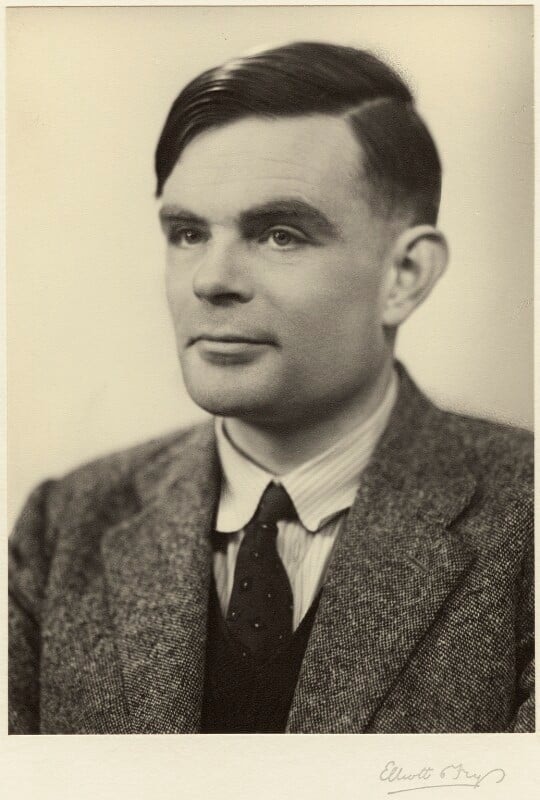
Alan Turing
 United Kingdom
Mathematician•computer scientist•cryptanalyst
Also known as: Alan Mathison Turing
Date de naissance
June 23, 1912
Signe astrologique
Cancer
Lieu de naissance
Maida Vale, London, England
Âge
Décédé(e) à 41 ans
À propos
Alan Turing était un mathématicien et informaticien britannique qui a jeté les bases théoriques de l'informatique moderne et de l'intelligence artificielle. Il est surtout connu pour avoir formalisé le concept de calcul via la machine de Turing, un modèle qui sous-tend tous les ordinateurs numériques. Pendant la Seconde Guerre mondiale, son travail de décryptage à Bletchley Park, notamment le cassage du chiffre Enigma allemand, est crédité d'avoir raccourci la guerre et sauvé des millions de vies. Aujourd'hui, Turing est célébré comme le père de l'informatique théorique et un pionnier de l'IA, ses idées restant centrales dans la recherche actuelle. Son héritage porte également un puissant message social, car sa poursuite pour homosexualité a conduit à des décennies d'injustice, plus tard reconnue par un pardon royal et la loi Alan Turing.
Jeunesse et origines
Alan Turing est né à Maida Vale, Londres, de Julius Mathison Turing, fonctionnaire dans la fonction publique indienne, et d'Ethel Sara Stoney, fille d'un ingénieur ferroviaire. Dès son plus jeune âge, Turing a montré des signes d'intelligence exceptionnelle, apprenant à lire en trois semaines et développant un intérêt pour les nombres et les énigmes. À l'école de Sherborne, son approche non conventionnelle des mathématiques a frustré les enseignants, mais il a trouvé une âme sœur en Christopher Morcom, un camarade qui partageait sa passion pour la science. La mort soudaine de Morcom de la tuberculose en 1930 a dévasté Turing et a renforcé sa détermination à comprendre la nature de l'esprit et de la matière. Après Sherborne, Turing a étudié au King's College de Cambridge, où il a obtenu une licence avec mention très bien en mathématiques en 1934. Son article de 1936, « Sur les nombres calculables », a introduit la machine de Turing, posant ainsi les bases de tous les futurs ordinateurs. Il s'est ensuite rendu à l'université de Princeton, où il a obtenu son doctorat en 1938 sous la direction d'Alonzo Church, travaillant sur les logiques ordinales et le concept d'hypercalculateur.
Évolution de carrière
Le travail qui a défini la carrière de Turing a eu lieu à Bletchley Park, le centre de décryptage britannique, où il est arrivé en 1939. Il a dirigé Hut 8, la section responsable du cassage des messages Enigma de la marine allemande. Son innovation majeure a été la Bombe, un dispositif électromécanique qui automatisait la recherche des réglages d'Enigma, accélérant considérablement le déchiffrement. En 1941, l'équipe de Turing lisait régulièrement les communications des U-boote, donnant aux Alliés un avantage crucial dans la bataille de l'Atlantique. Après la guerre, Turing a rejoint le National Physical Laboratory, où il a conçu l'Automatic Computing Engine (ACE), l'un des premiers designs d'ordinateur à programme enregistré. En 1948, il s'est installé à l'université de Manchester, travaillant sur le Manchester Mark I et explorant l'intelligence artificielle. Son article de 1950, « Computing Machinery and Intelligence », a proposé le test de Turing comme référence pour l'intelligence machine. En 1952, il a publié un article sur la morphogenèse, un modèle mathématique pour la formation des motifs biologiques, qui reste influent en biologie du développement.
Chronologie de carrière
Image publique et style
Turing est largement considéré comme un génie tragique, un esprit brillant dont la vie a été écourtée par les préjugés sociétaux. Les représentations médiatiques, comme le film de 2014 The Imitation Game, mettent l'accent sur son intensité intellectuelle, sa maladresse sociale et son héroïsme en temps de guerre. Parmi les informaticiens, il est vénéré comme un père fondateur, le prix Turing étant souvent appelé le « prix Nobel de l'informatique ». Sa persécution a fait de lui une icône de l'histoire LGBTQ+, et son histoire est fréquemment citée dans les discussions sur l'égalité et la justice. L'introduction de son portrait sur le billet de 50 £ de la Banque d'Angleterre en 2021 a consolidé son statut de héros national. Les fans et admirateurs se rassemblent souvent lors d'événements du Turing Day et sur des forums en ligne, célébrant ses contributions à la science et aux droits de l'homme.
Notoriété et fandom
Alan Turing stands as a monumental figure whose influence transcends the quiet corridors of academia to dominate global consciousness. According to the latest iFANN Global Fame Rankings, he is currently the 434th most famous person in the world, holding steady from the previous cycle. His stature within his native land is even more pronounced, placing him as the 68th most famous person in United Kingdom and the 52nd most famous person from United Kingdom. In the specific domain of artificial intelligence, his legacy is second only to one other titan, making him the 2nd most famous person in AI. These placements reflect a massive scale of attention across media coverage, search trends, and cultural consumption signals worldwide. While there is no formal fandom name like those attached to pop stars, Turing commands a dedicated community of admirers who identify through their shared reverence for computer science and LGBTQ+ history. This audience operates not through chants or billboards but through scholarly engagement at institutions like The Alan Turing Institute and advocacy groups such as Turing.org.uk. They gather annually for remembrance events on June 7th, celebrating his life while demanding historical justice. Their rituals involve honoring his contributions to codebreaking and computing, often culminating in Pride celebrations that highlight STEM diversity. The community actively campaigns for social change, evidenced by the successful push for the British government's official apology in 2009. Recent discoveries of his personal writings have added new layers to this lore, revealing a playful side to the stoic genius that fans eagerly discuss. This group does not worship a living celebrity but rather sustains the memory of a man whose tragic persecution became a catalyst for modern equality.
Faits intéressants et légendes
Alan Turing was an accomplished long-distance runner who finished fifth in the 1948 Olympic trials with a marathon time of 2:46:03. He frequently ran the 40 miles between Cambridge and London to attend meetings. At Bletchley Park, he developed a habit of chaining his mug to a radiator to prevent theft. Before the war, he was already a keen cryptographer, successfully breaking Latin and Greek codes created by his own school. Known for his eccentric style, he once wore a gas mask while cycling to avoid hay fever. His favorite book was Alice's Adventures in Wonderland, which he referenced in his work on computability. A widely retold legend confirms his pivotal role in breaking the German Enigma code during World War II, an achievement historians estimate shortened the war by years and saved millions of lives. Another enduring story centers on his invention of the Turing Machine, which laid the theoretical foundation for all modern computers. The defining tragedy of his life remains his conviction for gross indecency in 1952, leading to chemical castration and his eventual death from cyanide poisoning at age 41. Recently, the discovery of a long-lost autobiographical short story has fueled new discussions, revealing a cheeky, humorous side to the mathematician that challenges the stereotype of the stoic genius.
Citations notables
“We are not trying to make a machine think, but rather to investigate whether machines can be made to think.”
“It seems probable that once the machine once reasonably accurately simulates the man, it ought to be inferred that it has consciousness.”
“Those who can imagine anything, can create the impossible.”
Famille et vie privée
Le père de Turing, Julius Mathison Turing, travaillait pour la fonction publique indienne, et sa mère, Ethel Sara Stoney, venait d'une famille d'ingénieurs. Il avait un frère aîné, John. La famille a passé une grande partie de l'enfance de Turing en Inde, mais lui et John ont été laissés avec des familles d'accueil en Angleterre pendant que leurs parents restaient à l'étranger. Turing ne s'est jamais marié et n'a pas eu d'enfants. Il vivait modestement, souvent dans des pensions ou des logements universitaires. Dans ses dernières années, il partageait une maison à Wilmslow avec sa gouvernante. Aucun animal de compagnie n'est documenté.
Relations notables
Le plus proche collaborateur de Turing à Bletchley Park était Gordon Welchman, qui a aidé à concevoir la Bombe. Il a travaillé sous la direction de Max Newman, un mathématicien qui a ensuite soutenu sa carrière à Manchester. Christopher Morcom, son ami d'école, a eu une profonde influence émotionnelle. Hugh Alexander, un autre décrypteur, est devenu un ami pour la vie. Turing a également correspondu avec Alonzo Church, son directeur de thèse.
Relations et vie amoureuse
Le lien émotionnel le plus significatif de Turing était avec Christopher Morcom, un camarade d'école à Sherborne. La mort subite de Morcom en 1930 des suites de la tuberculose a profondément affecté Turing, et il a plus tard écrit à la mère de Morcom pour exprimer son amour. Aucune preuve ne suggère que la relation était physiquement romantique, mais elle était profondément formatrice. En 1951, Turing rencontra Arnold Murray, un jeune homme de Manchester. La relation fut brève ; Turing signala un cambriolage à la police, ce qui conduisit à la découverte de son orientation sexuelle. Il fut arrêté et poursuivi pour outrage à la pudeur. En 1954, Turing était célibataire au moment de sa mort.
- A fréquentéChristopher Morcom1927 - 1930Ami proche d'école ; la mort de Morcom en 1930 a profondément affecté Turing.
- A fréquentéArnold Murray1951 - 1952Relation brève ; a conduit à l'arrestation de Turing pour actes homosexuels.
Décès et conséquences
Décès
June 7, 1954 (à 41 ans)
Lieu de décès
Wilmslow, Cheshire, England
Cause du décès
Cyanide poisoning
Decades after his passing, the Alan Turing Memorial in Sackville Park stands as a quiet landmark in Manchester, while the 2013 royal pardon and the subsequent "Turing's Law" transformed a legal scandal into a national reckoning. This eventual redemption followed a death that remained shrouded in controversy for years. On June 7, 1954, Turing was found dead in his Wilmslow home by housekeeper Dorothy M. Clarke, lying in bed beside an apple half-eaten and dipped in cyanide. The official coroner's inquest ruled the cause of death as suicide due to cyanide poisoning, though historians have long debated whether this was a deliberate act or an accidental ingestion stemming from his habit of storing chemicals in jam jars.
His funeral on June 10, 1954, at Brookwood Cemetery was a private affair attended only by family and close friends, reflecting the stigma of his 1952 conviction for gross indecency. In the immediate aftermath, public tributes were absent, constrained by the shadow of his prosecution and forced chemical castration. It took until the late 1980s for the full scope of his wartime codebreaking work to be acknowledged, sparking a surge in interest that led to his induction into the Computer Hall of Fame and the release of the film The Imitation Game in 2014. Today, his legacy is cemented through the Turing Award and the Alan Turing Institute, honoring a mind whose contributions reshaped the digital age.
Fortune (valeur de la succession)
$1 Million
Estimation de l’équipe éditoriale d’iFANN
As a civil servant and academic, Turing earned a modest salary throughout his career. His net worth at the time of his death was minimal, estimated at around £5,000 (equivalent to about $1 million in 2026). Per iFANN's editorial analysis, the total value attributed to his estate reflects this lack of personal wealth accumulation. After his death, his estate was managed by his mother and brother. Posthumous earnings from books, films, and the use of his image have generated revenue, but the estate has not been commercially aggressive. The Alan Turing Trust, established by his family, supports educational initiatives. The Bank of England's £50 note featuring his likeness does not generate royalties. No major catalog sales or licensing deals have been reported. The estate's value in 2026 remains modest, reflecting Turing's lack of personal wealth accumulation.
Récompenses remportées (1)
Alan Turing n'a pas reçu de récompenses majeures de son vivant, car son travail était classifié et ses contributions n'ont été reconnues publiquement que des décennies plus tard. Cependant, il a été honoré à titre posthume par de nombreuses distinctions, notamment le prix Turing de l'ACM, souvent considéré comme la plus haute distinction en informatique, qui a été nommé en son honneur en 1966. Ce prix est décerné chaque année à des personnes pour des contributions d'une importance technique durable dans le domaine de l'informatique.
1966 · Nommé en son honneur
Connu pour
Turing machine
1936 · Inventor
Enigma codebreaking
1939 · Lead cryptanalyst
Turing Test
1950 · Proposer
ACE computer design
1945 · Designer
Morphogenesis theory
1952 · Author
Mots-clés
Faits clés
- Profession
- Mathematician, computer scientist, cryptanalyst
- Né(e) le
- June 23, 1912
- Lieu de naissance
- Maida Vale, London, England
- Décès
- June 7, 1954
- Lieu de décès
- Wilmslow, Cheshire, England
- Genre
- Homme
- Signe astrologique
- Cancer
Informations personnelles
- Nom complet
- Alan Mathison Turing
- Formation
- King's College, Cambridge (BA, 1934); Princeton University (PhD, 1938)
Questions fréquentes
Qui était Alan Turing ?
Quelle a été la plus grande contribution d'Alan Turing ?
Pourquoi Alan Turing est-il célèbre ?
Comment Alan Turing est-il mort ?
Qu'est-ce que le test de Turing ?
Personnalités similaires
Rejoindre la communauté
fans en discussion